04 An Electron's Address
star
star
star
star
star
Last updated about 5 years ago
33 Nsɛmmisa
1
1
1
1
1
1
1
1
1
1
1
1
1
1
1
1
1
1
1
1
1
1
1
1
1
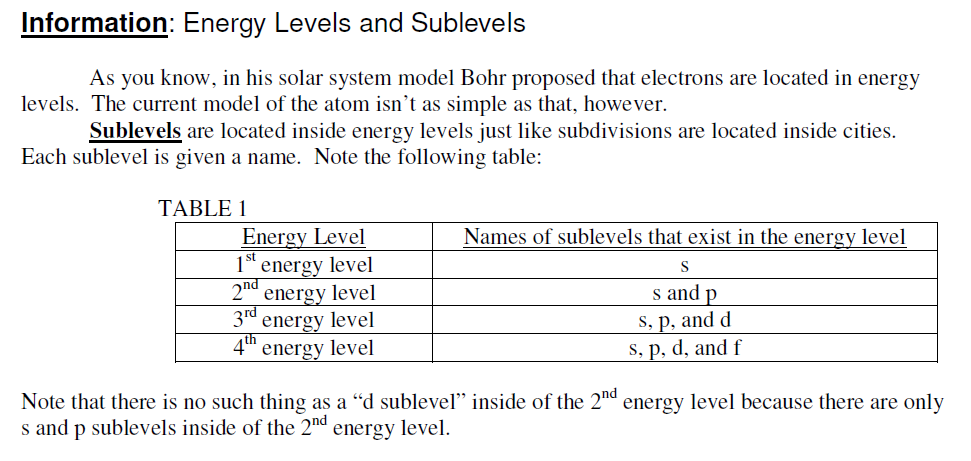
How many sublevels exist in the 1st energy level?
How many sublevels exist in the 2nd energy level?
How many sublevels exist in the 3rd energy level?
How many sublevels would you expect to exist in the 5th energy level?
Is an f sublevel possible in the 3rd energy level? Why or why not?
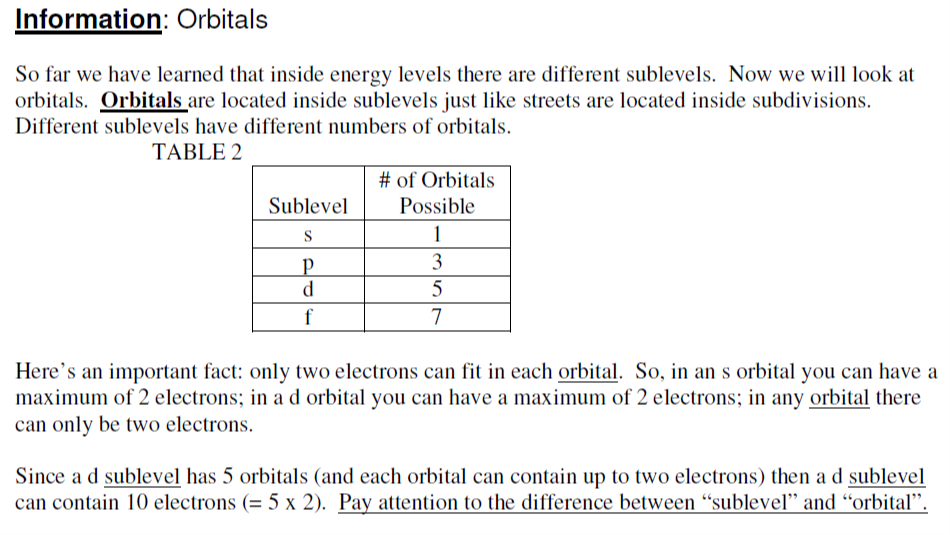
How many orbitals are there in a p sublevel?
How many orbitals are there in a d sublevel?
How many total SUBLEVELS would be found in the entire 2nd energy level?
How many total ORBITALS would be found in the entire 2nd energy level?
How many total SUBLEVELS would be found up to and including the 2nd energy level?
How many total orbitals would be found up to and including the 2nd energy level?
How many electrons can fit in an f SUBLEVEL?
How many electrons can fit in an f ORBITAL?
How many electrons can fit in a d orbital? in a p orbital? in any kind of orbital?
In your own words, what is the difference between a sublevel and an orbital?
How many electrons can fit in the 1st energy level?
How many electrons can fit in the 2nd energy level?
How many electrons can fit in the 3rd energy level?
How many electrons can fit in the 4th energy level?
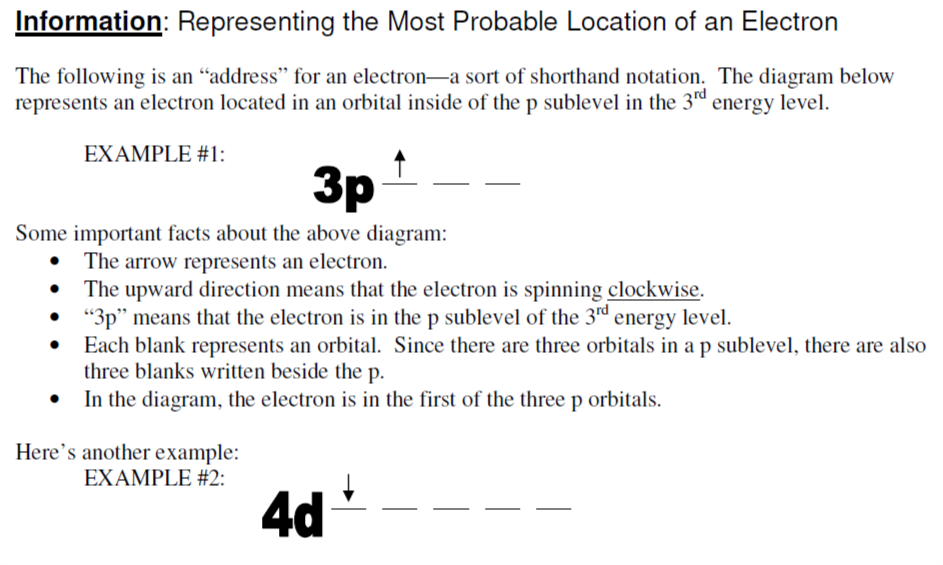
In example #2, why are there 5 lines drawn next to the d?
In example #2, what does it mean to have the arrow pointing down?
Write the notation for an electron in a 2s orbital spinning clockwise.
Write the notation for an electron in the first energy level spinning clockwise.
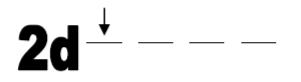
What is wrong with the following notation? You should find two things wrong.
Electron configurations- Time to put it together. The arrows in the boxes are the full diagram of all the electrons in an element. The electron configuration is the short hand of the diagram and more usable.
Each element atom has a unique configuration based on the number of electrons that matches the number of protons, or the atomic number. Use the filled-in information to determine what should be filled in for each marked area. For example, the last line has the diagram and configuration filled in. Each reflects 11 electrons. The element with 11 electrons is sodium so the answer would be Na.
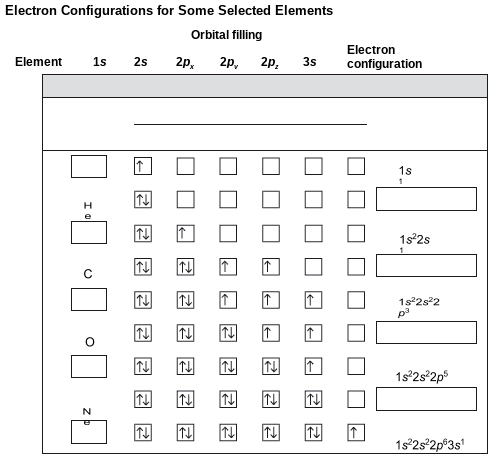
What pattern do you see forming?
Count the arrows or exponents. They should match. Use this to identify the element.
Write the configuration of Helium that has 2 electrons. Click the keyboard symbol and choose the x with a gray box in the upper right to write the exponent.
Which symbol goes here?
Write the configuration of C. Click the keyboard symbol and choose the x with a gray box in the upper right to write the exponent.
Which element symbol goes here?
Write the configuration of O. Click the keyboard symbol and choose the x with a gray box in the upper right to write the exponent.
What symbol goes here?
Write the configuration of Ne. Click the keyboard symbol and choose the x with a gray box in the upper right to write the exponent.