Unit 6 Exam
star
star
star
star
star
Last updated over 3 years ago
13 questions
2
A reaction is most likely to occur when reactant particles collide with
2
Under what conditions will the rate of a chemical reaction always decrease?
2
A student conducts an experiment where she reacts a lump of Zinc (Zn) with hydrocholoric acid (HCl). The balanced equation below represents the reaction.
Zn (s) + 2 HCl (aq) --> H2 (g) + ZnCl2 (aq)
Which set of reaction conditions produces H2 at the fastest rate?
A student conducts an experiment where she reacts a lump of Zinc (Zn) with hydrocholoric acid (HCl). The balanced equation below represents the reaction.
Zn (s) + 2 HCl (aq) --> H2 (g) + ZnCl2 (aq)
Which set of reaction conditions produces H2 at the fastest rate?
2
Increasing the temperature increases the rate of a reaction by:
2
For the reaction between aluminum metal and copper chloride (CuCl2) that we performed together, what is the reason that breaking a single 5 g piece of aluminum into 25 smaller pieces of aluminum (still with a total mass of 5 g) speeds up the reaction rate.
2
Which solution of CuCl2 will lead to the fastest reaction with aluminum?
2
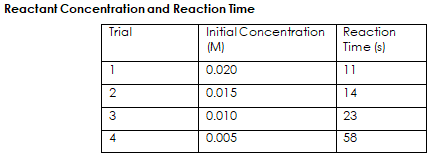
State the effect of the concentration of the reactant on the rate of the chemical reaction above.
2
Explain your answer to 7 in terms of collision theory.
2
In a different experiment involving the same reaction, it was found that an increase in temperature increased the rate of the reaction. Explain this result in terms of collision theory.
1
How does pressure affect reation rate? Explain this in terms of collision theory
2
Given the information below, which of the following changes will increase the rate of the forward reaction? Assume all reactants and products involved are in the gaseous form.
A + B + heat --> C + D
Given the information below, which of the following changes will increase the rate of the forward reaction? Assume all reactants and products involved are in the gaseous form.
A + B + heat --> C + D
2
Which statement regarding this reaction at equilibrium is always true?
2
At constant temperature and pressure, an increase in the concentration of A(g) will cause