Summative of molecular geometry (VSPER) and intermolecular forces
1 point
1
Question 1
1.
Use the valence-shell electron-pair repulsion (VSEPR) theory to determine the molecular geometry of Dihydrogen Monoxide (H2O).
1 point
1
Question 2
2.
Which molecule does NOT have a dipole moment?
1 point
1
Question 3
3.
While researching the ozone (O3) layer surrounding the Earth, Ling found that chemists represent the Lewis dot structure of O3 using 2 resonance forms that obey the octet rule. Which structure is one of the resonance structures of O3?
1 point
1
Question 4
4.
Hydrogen sulfide (H2S) has a boiling point of −60.7°C, and water (H2O) has a boiling point of 100.0°C. Which statement best explains this difference in boiling points?
1 point
1
Question 5
5.
Which compound exhibits hydrogen bonding?
1 point
1
Question 6
6.
Use the valence-shell electron-pair repulsion (VSEPR) theory to determine the geometry of Carbon Tetrachloride (CCl4).
1 point
1
Question 7
7.
Ethylene has the chemical structure H2C=CH2. Which statement describes the bonding hybridization between the 2 carbon (C) atoms in ethylene?
1 point
1
Question 8
8.
Use the valence-shell electron-pair repulsion (VSEPR) theory to determine the geometry of PBr3.
1 point
1
Question 9
9.
Use the valence-shell electron-pair repulsion (VSEPR) theory to predict the geometry of boron trichloride (BCl3). HINT:B does NOT obey the octet rule.
1 point
1
Question 10
10.
Compare a triple bond to a single bond.
1 point
1
Question 11
11.
Acetic acid (C2H4O2) has 2 carbon (C) atoms, 1 and 2.
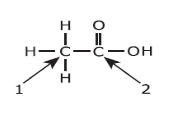
Which statement accurately describes the orbital geometries of Atom 1 and Atom 2?
1 point
1
Question 12
12.
Which compound is the most polar?
1 point
1
Question 13
13.
Which one of the following would be considered to be nonpolar based on its structure?
1 point
1
Question 14
14.
The organic gas acetylene (C2H2) is used commercially to produce plastics. What would be the correct lewis structure for acetylene?