- Determine x-intercepts by factoring, then solving a quadratic equation.
- Notice patterns when graphing parabolas (quadratic equations)
- Graph a parabola based on a vertex
I recommend you have a piece of paper to jot down notes or scratch work (I needed it!)
1 point
1
Question 1
1.
Match the standard form of each quadratic with its factored form.
Draggable item
arrow_right_alt
Corresponding Item
arrow_right_alt
arrow_right_alt
arrow_right_alt
1 point
1
Question 2
2.
Match each equation with its solutions.
Draggable item
arrow_right_alt
Corresponding Item
0=(x+1)(x-5)
arrow_right_alt
x=-3 and x=5
0=(x+3)(x-5)
arrow_right_alt
x=-2 and x=5
0=(x+2)(x-5)
arrow_right_alt
x=-1 and x=5
1 point
1
Question 3
3.
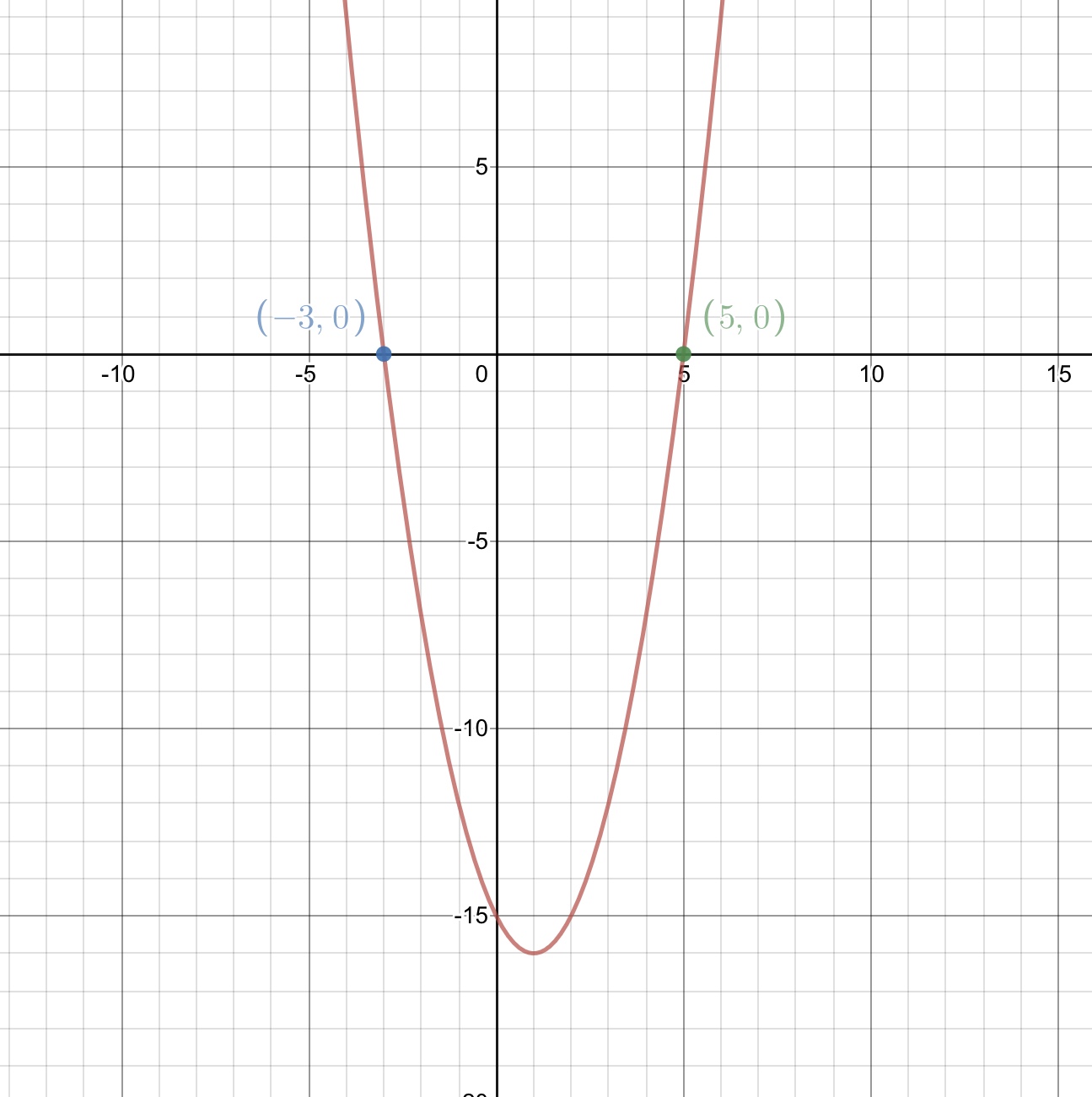
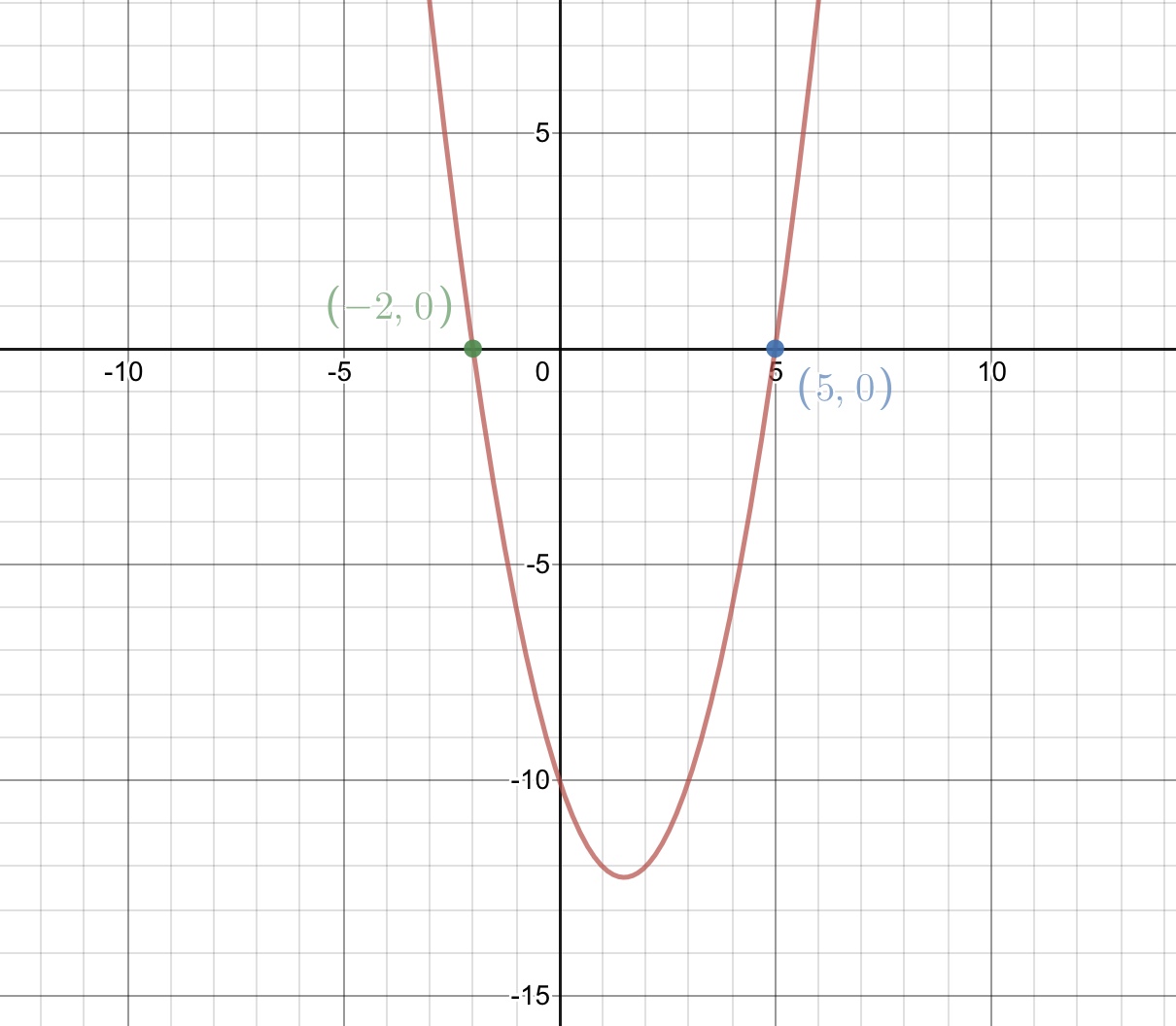
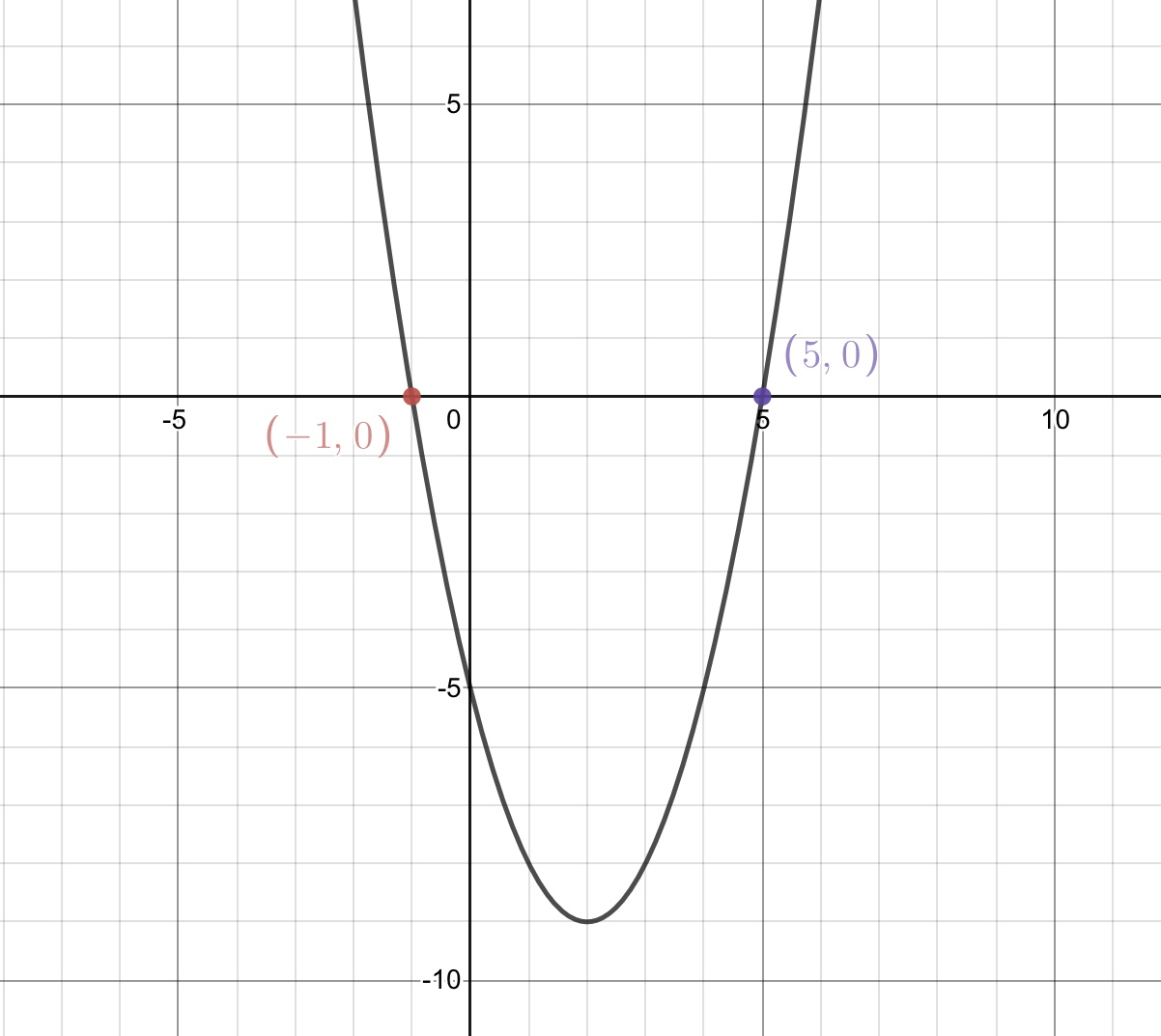
Match each set of solutions (also known as x-intercepts) with it's graph. If you're unsure, just focus on where the parabola crosses the x-axis.
Draggable item
arrow_right_alt
Corresponding Item
(-1,0) and (5,0)
arrow_right_alt
(-3,0) and (5,0)
arrow_right_alt
(-2,0) and (5,0)
arrow_right_alt
Now we're going to look at evaluating and graphing the simplest quadratic, which is called the "parent graph."
Quick Reminder:
x-squared means that we take the value of x (which varies) and multiply it by itself.
1 point
1
Question 4
4.
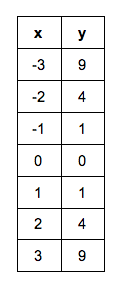
I'd prefer to have you complete an (x,y) table, but because I can't, we'll do this a different way.
Given the equation
What is the value of y when x=-3
*remember that a negative times a negative is a positive!
1 point
1
Question 5
5.
Given the equation
What is the value of y when x=-2
*Remember that a negative times a negative is a positive- your calculator might lie to you!
1 point
1
Question 6
6.
Given the equation
What is the value of y when x=-1
*Remember that a negative times a negative is a positive- your calculator might lie to you!
1 point
1
Question 7
7.
Given the equation
What is the value of y when x=0
1 point
1
Question 8
8.
Given the equation
What is the value of y when x=1
1 point
1
Question 9
9.
Given the equation
What is the value of y when x=2
1 point
1
Question 10
10.
Given the equation
What is the value of y when x=3
1 point
1
Question 11
11.
The vertex is the lowest (or highest if the parabola has a negative a-value, but we're focusing on positive for this class) point on a parabola. That means it has the lowest y-value. What are the coordinates for the vertex of
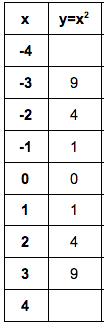
Here is the table of the (x,y) values you found in the previous problems.
Type your coordinates as (x,y)
1 point
1
Question 12
12.
Move from the vertex of (0,0) in the table in both directions and see if you can figure out the pattern in the y-values. What would the y-values in the blank boxes be?
1 point
1
Question 13
13.
Graph the equation
To do this, you will type y=x^2 and the parabola should appear on the graph.
We have released a new and improved Graphing question type! Students will no longer be able to answer this question.
1 point
1
Question 14
14.
Use the board and graph (the best you can) to see if you can show the pattern you figured out from number #12.
The video below explains the pattern in the table and the graph of the parabola.
1 point
1
Question 15
15.
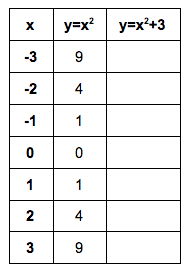
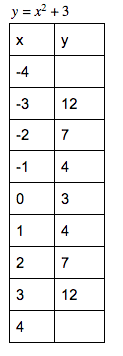
What happens if you add 3 to the equation? Match each x-value with its y-value for the new equation.
Draggable item
arrow_right_alt
Corresponding Item
-1 and 1
arrow_right_alt
12
-2 and 2
arrow_right_alt
7
0
arrow_right_alt
4
-3 and 3
arrow_right_alt
3
1 point
1
Question 16
16.
Graph the equation
To do this, you will type y=x^2+3 and the parabola should appear on the graph.
We have released a new and improved Graphing question type! Students will no longer be able to answer this question.
1 point
1
Question 17
17.
Keeping in mind the "1, 3, 5" pattern, what is the y-value for the missing boxes?
1 point
1
Question 18
18.
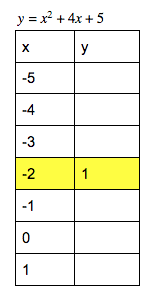
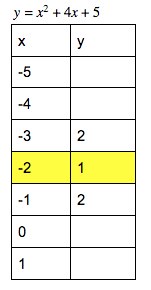
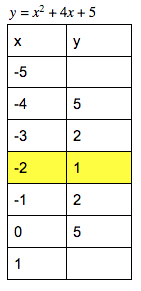
Some people used the "1-3-5" pattern to fill in the previous table, and others may have done the math in their head or on the calculator. With an equation like the one below, using the pattern can be a little easier. If (-2,1) is the vertex (highlighted), use the "1-3-5" pattern to figure out the value for x=-3 and x=-1.
I don't suggest actually plugging in the x-values, just focus on the pattern. I also suggest you just write this table and complete it- the next few problems will go much faster.
1 point
1
Question 19
19.
What is the y-value for x=-4 and x=0
1 point
1
Question 20
20.
What is the value of y when x=-5 and x=1
1 point
1
Question 21
21.
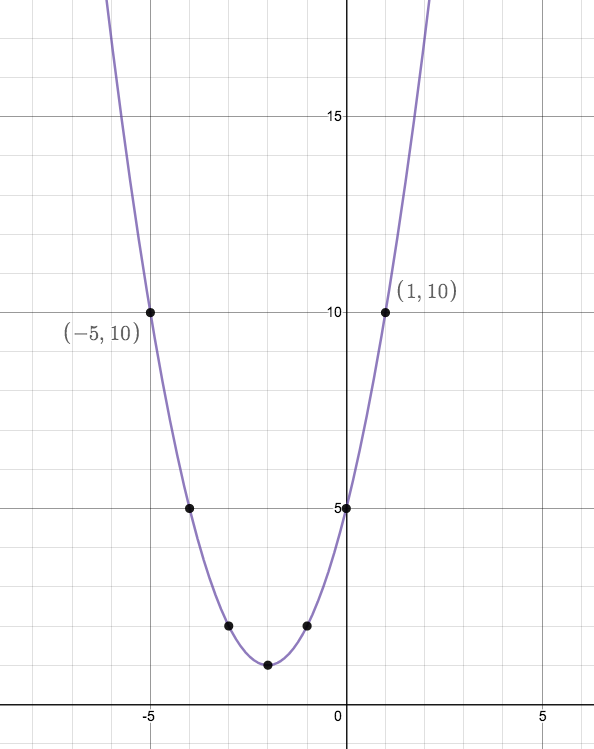
Below is the graph of
If we go out one unit from the labeled points, how many should we go up to find the next two points?
1 point
1
Question 22
22.
The equation
has a vertex of (4,-9). If we graph according to the "1-3-5" pattern, what will the first two points be? I've included a graph with the vertex on it in case you're better visually. (list them left to right for easier scoring)
If I were doing this, I would graph the whole thing and write the coordinates you find on paper so you can easily enter them in the next few problems.
1 point
1
Question 23
23.
The equation
has a vertex of (4,-9). If we graph according to the "1-3-5" pattern, what will the next two points be? The graph now has the vertex and the first two points.
1 point
1
Question 24
24.
What are the next two points in the pattern?
1 point
1
Question 25
25.
The equation
has a vertex of (-4,-1) which has been placed on the graph in the "Show your work" box. Graph the next six points. Then watch the video to check your work.
1 point
1
Question 26
26.
The equation
has a vertex of (-4,-1) which has been placed on the graph in the "Show your work" box. Graph the next six points. Then watch the video to check your work.