Science 8-2: Mechanical Systems Section 2.0 Quiz
star
star
star
star
star
Last updated 3 months ago
28 Nsɛmmisa
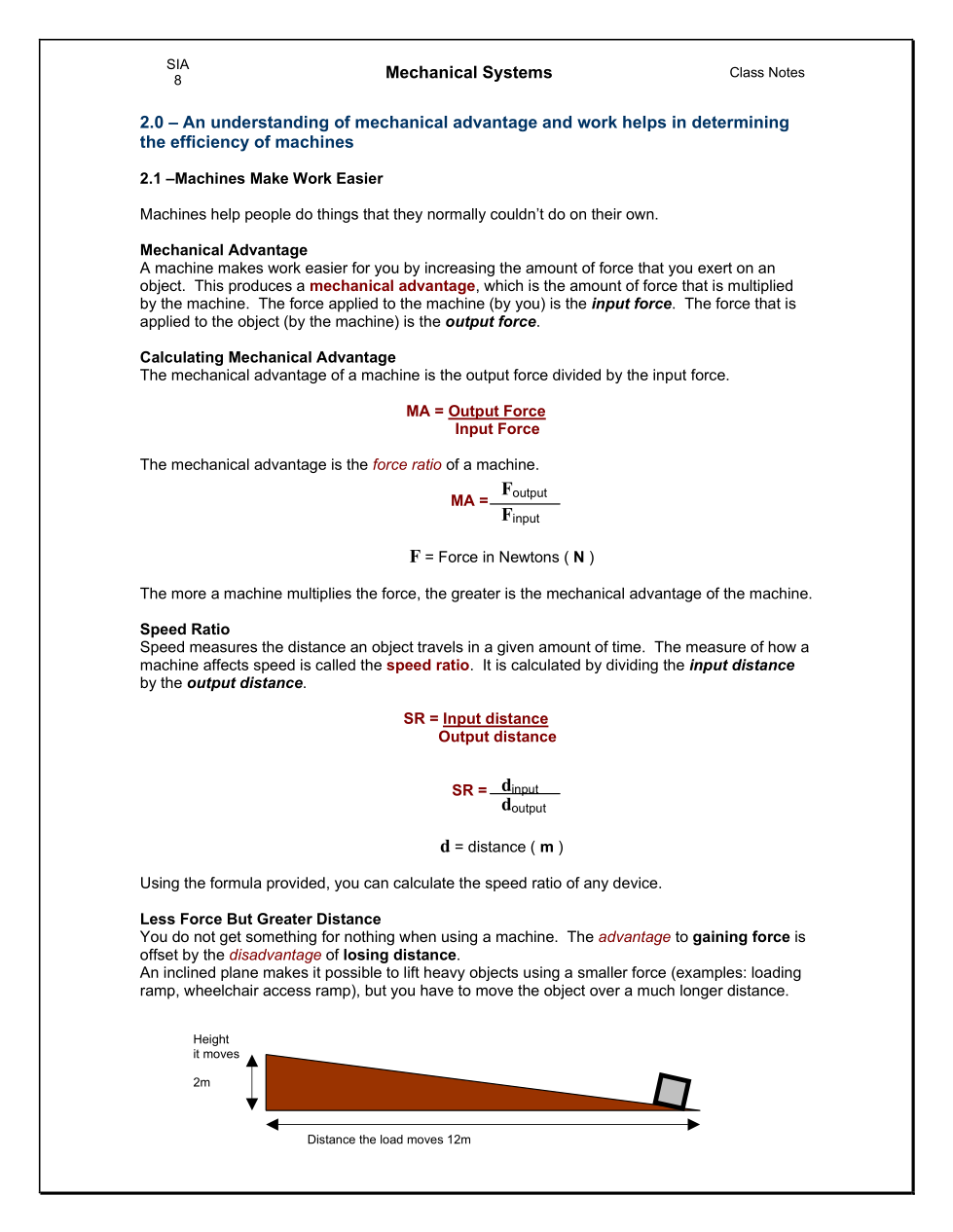
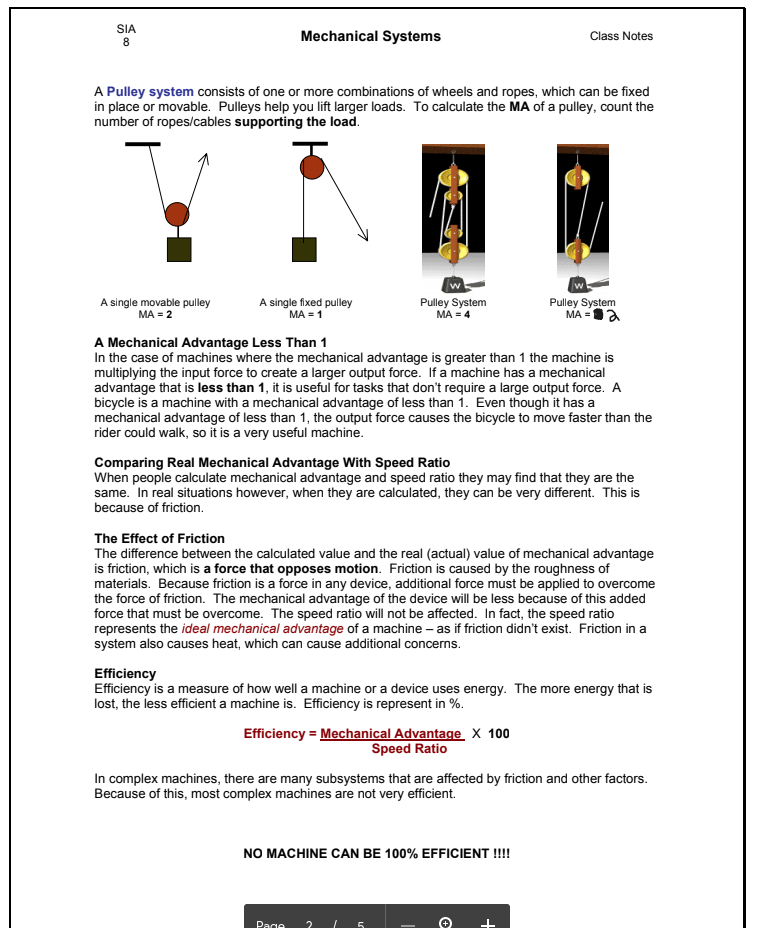
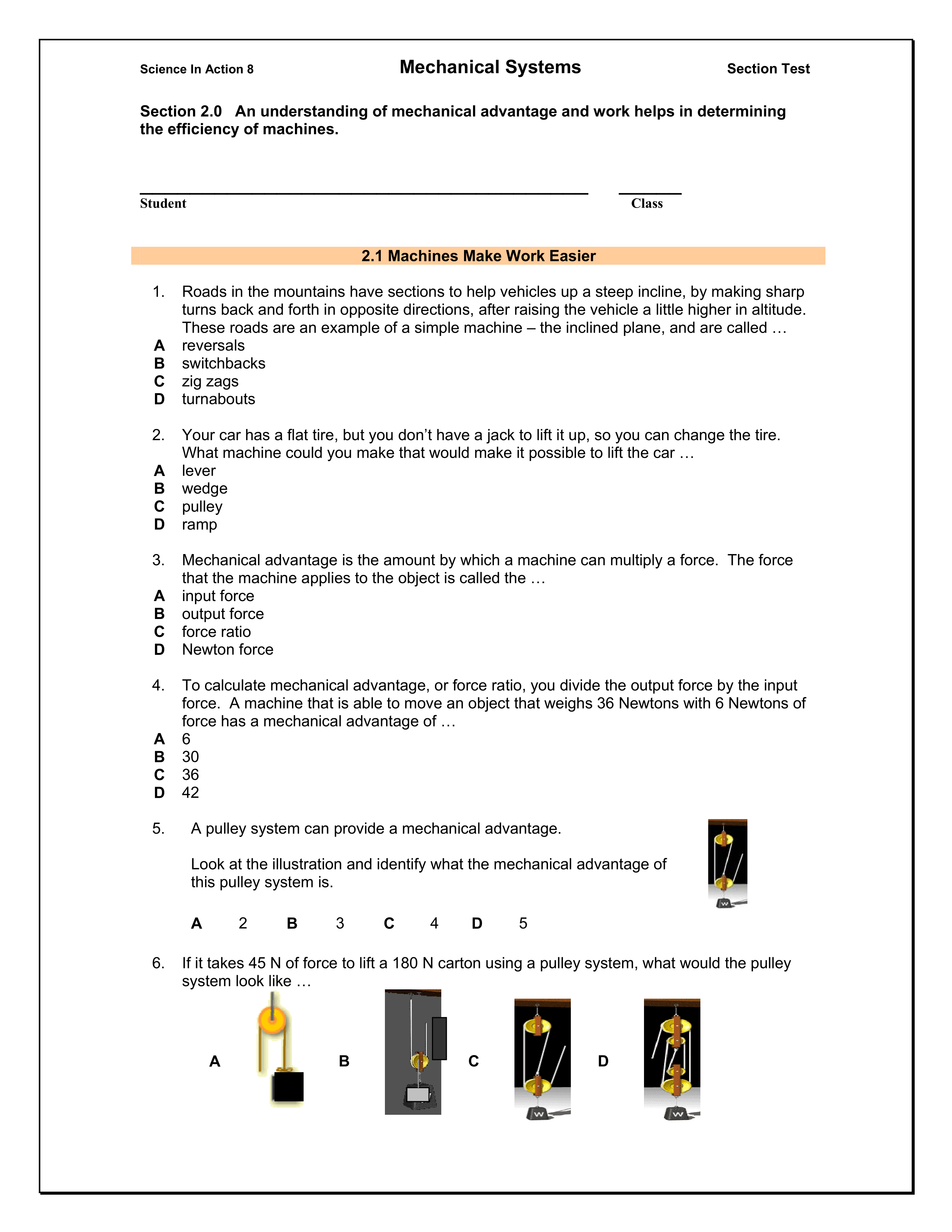
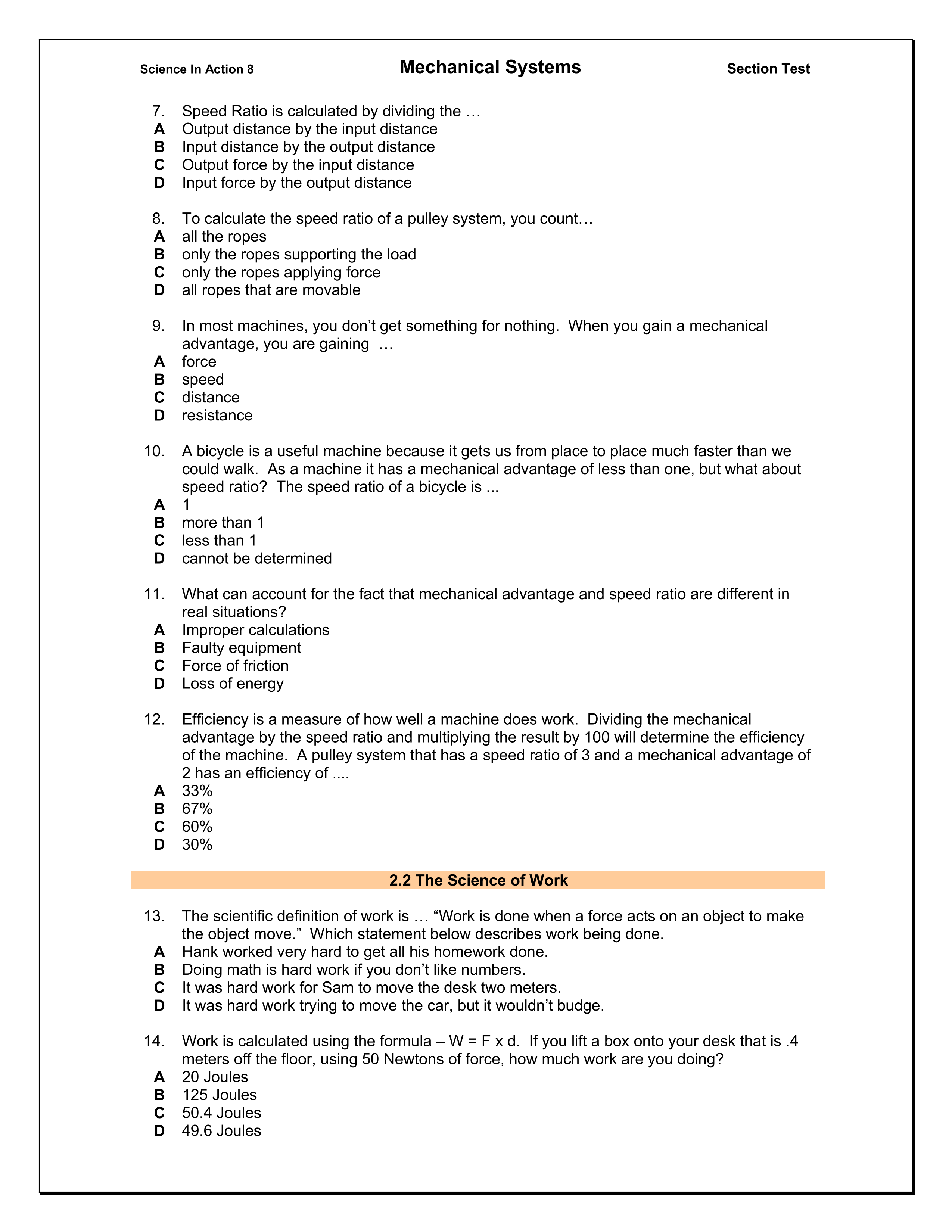
Roads in the mountains have sections to help vehicles up a steep incline, by making sharp turns back and forth in opposite directions, after raising the vehicle a little higher in altitude. These roads are an example of a simple machine – the inclined plane, and are called ...
Your car has a flat tire, but you don’t have a jack to lift it up, so you can change the tire. What machine could you make that would make it possible to lift the car ...
Mechanical advantage is the amount by which a machine can multiply a force. The force that the machine applies to the object is called the ...
To calculate the mechanical advantage or force ratio, you divide the output force by the input force. A machine that is able to move an object that weighs 36 Newtons with 6 Newtons of force has a mechanical advantage of ...
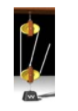
A pulley system can provide a mechanical advantage.
Look at the illustration and identify what the mechanical advantage of
this pulley system is.
If it takes 45 N of force to lift a 180 N carton using a pulley system, what would the pulley system look like ...
Speed Ratio is calculated by dividing the ...
To calculate the speed ratio of a pulley system, you count...
In most machines, you don’t get something for nothing. When you gain a mechanical advantage, you are gaining ...
A bicycle is a useful machine because it gets us from place to place much faster than we could walk. As a machine it has a mechanical advantage of less than one, but what about speed ratio? The speed ratio of a bicycle is ...
What can account for the fact that mechanical advantage and speed ratio are different in real situations?
Efficiency is a measure of how well a machine does work. Dividing the mechanical advantage by the speed ratio and multiplying the result by 100 will determine the efficiency of the machine. A pulley system that has a speed ratio of 3 and a mechanical advantage of
2 has an efficiency of...
The scientific definition of work is ...
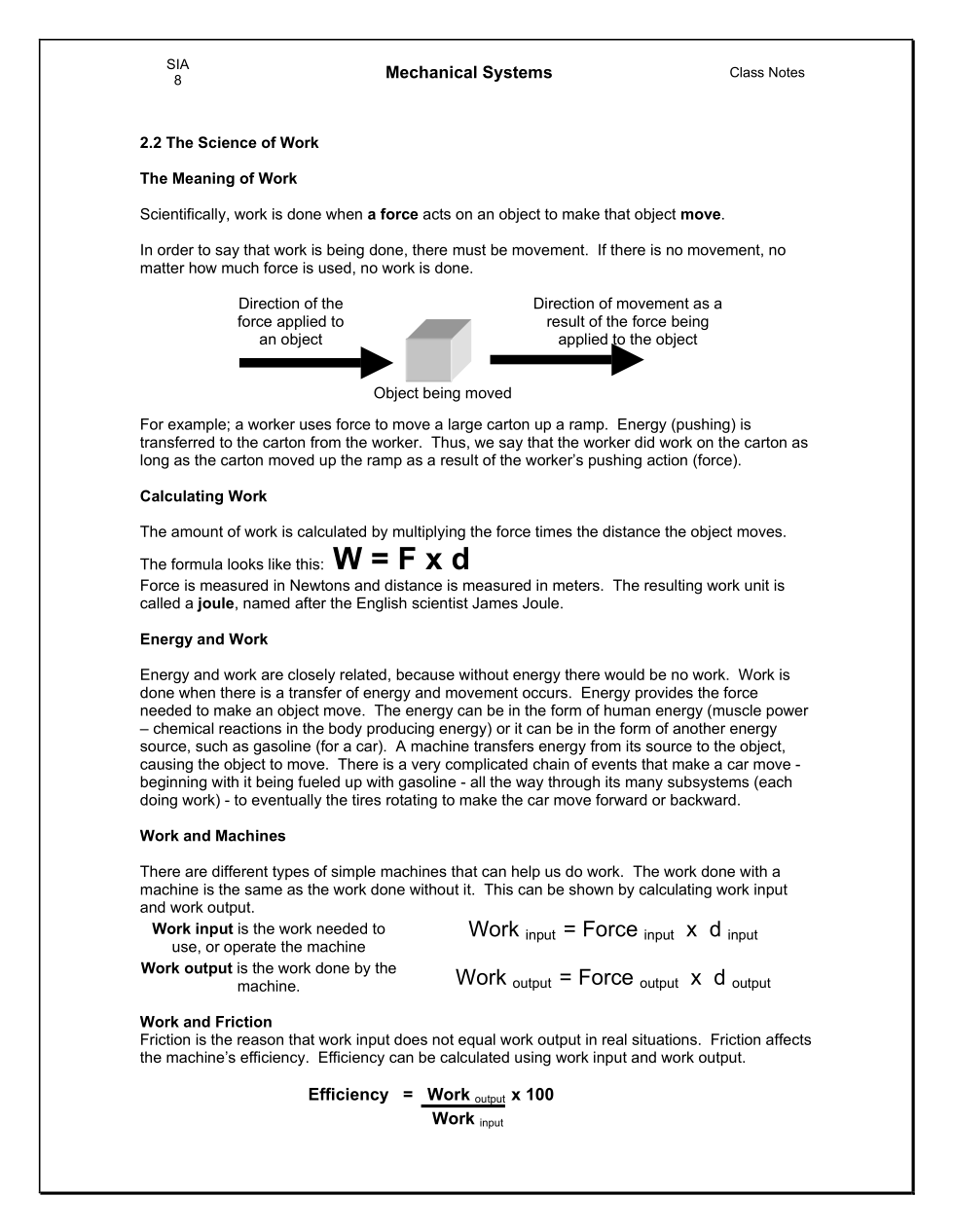
“Work is done when a force acts on an object to make the object move.”
Which statement below describes work being done.
Work is calculated using the formula W = F x d. If you lift a box onto your desk that is 0.4 meters off the floor, using 50 Newtons of force, how much work are you doing?
In a car, what provides the force (energy source) that makes work (the car moving) possible?
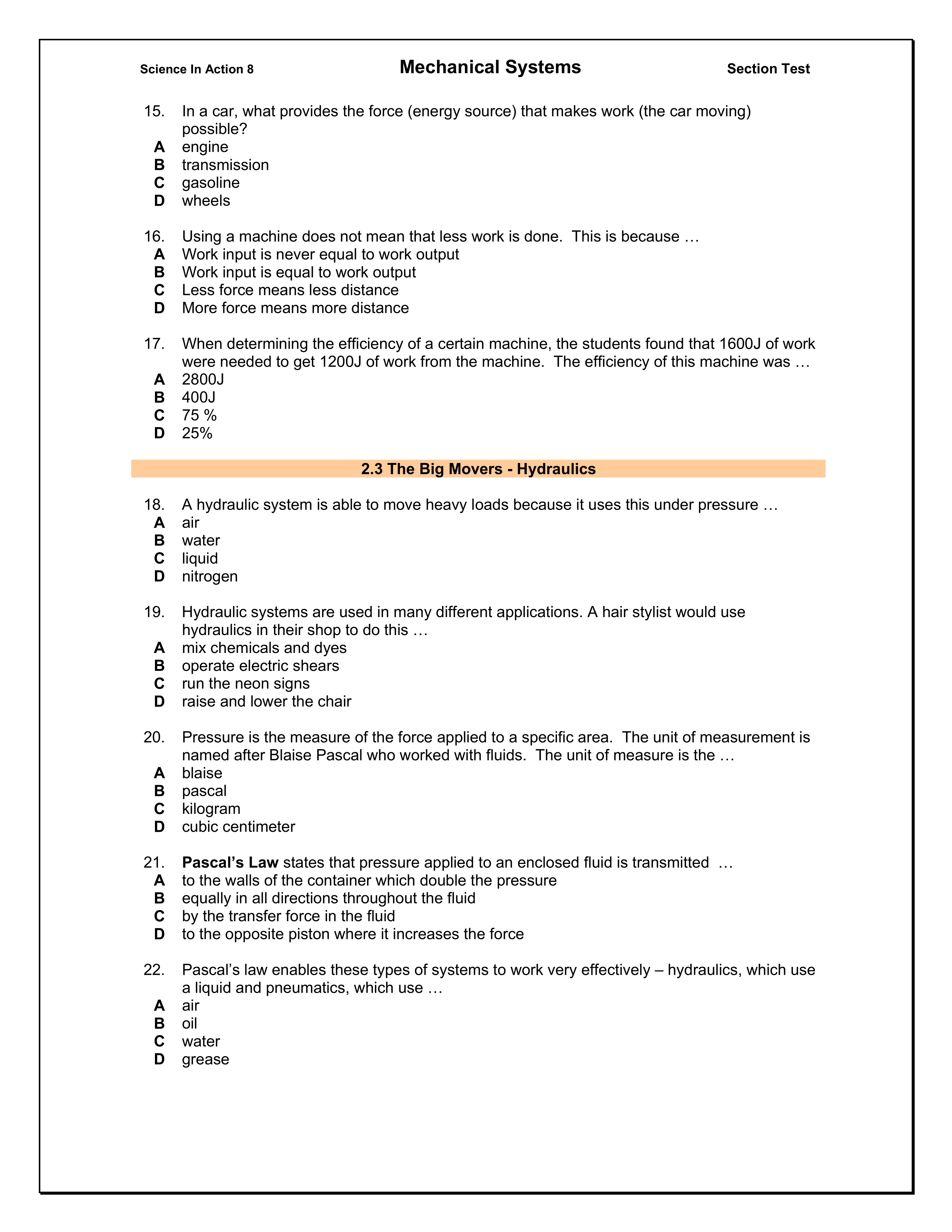
Using a machine does not mean that less work is done. This is because ...
When determining the efficiency of a certain machine, the students found that 1600J of work were needed to get 1200J of work from the machine. The efficiency of this machine was ...
A hydraulic system is able to move heavy loads because it uses this under pressure ...
Hydraulic systems are used in many different applications. A hair stylist would use hydraulics in their shop to do this ...
Pressure is the measure of the force applied to a specific area. The unit of measurement is named after Blaise Pascal who worked with fluids. The unit of measure is the ...
Pascal’s Law states that pressure applied to an enclosed fluid is transmitted ...
Pascal’s law enables these types of systems to work very effectively – hydraulics, which use a liquid and pneumatics, which use ...
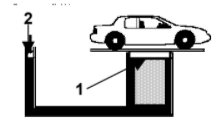
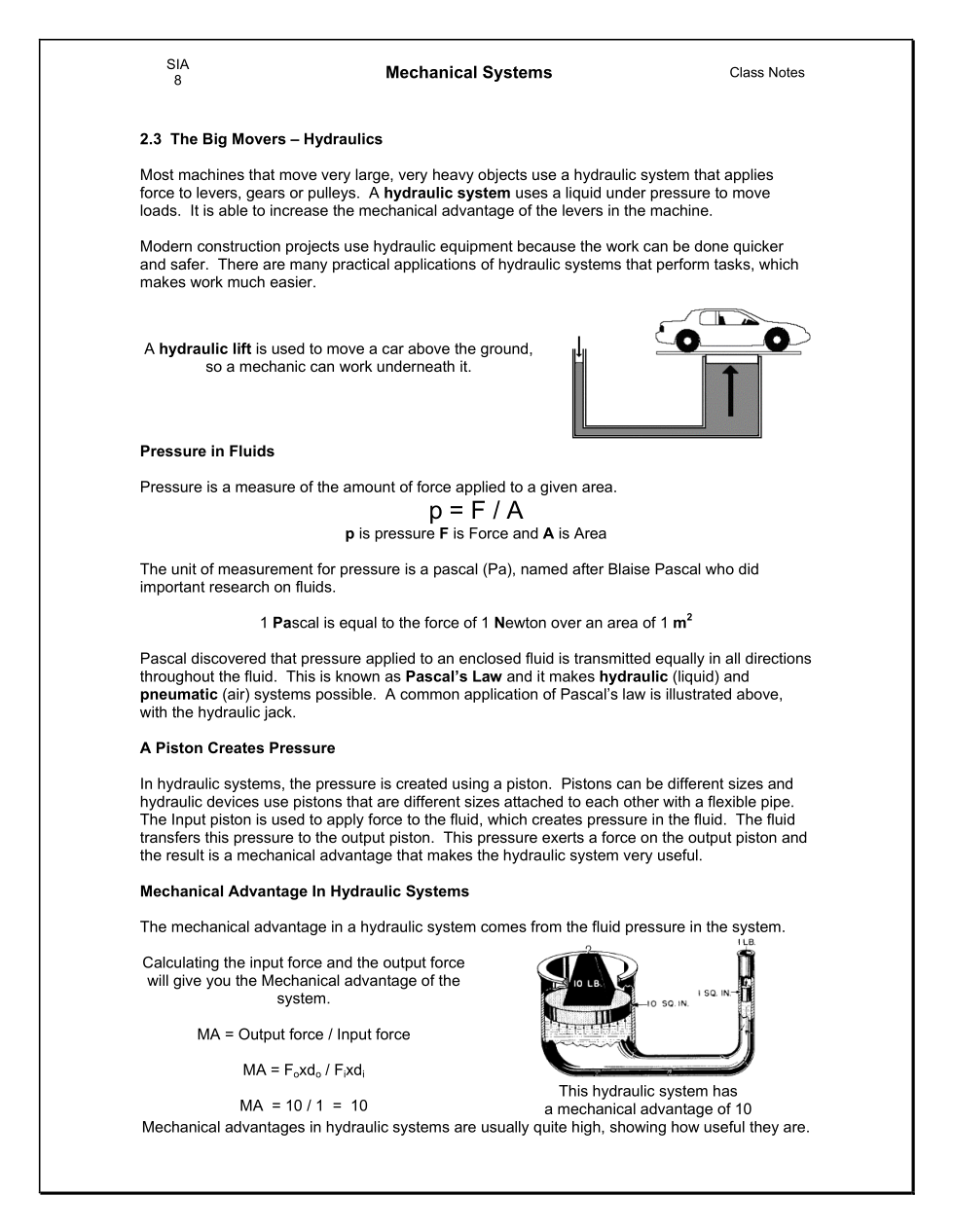
A common application of the hydraulic system is the
hydraulic jack, like the one shown here ...
The piston identified by # 1 is the ...
The mechanical advantage in a hydraulic system is provided by the ...
A good example of a hydraulic system at work inside the body is the ...
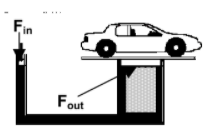
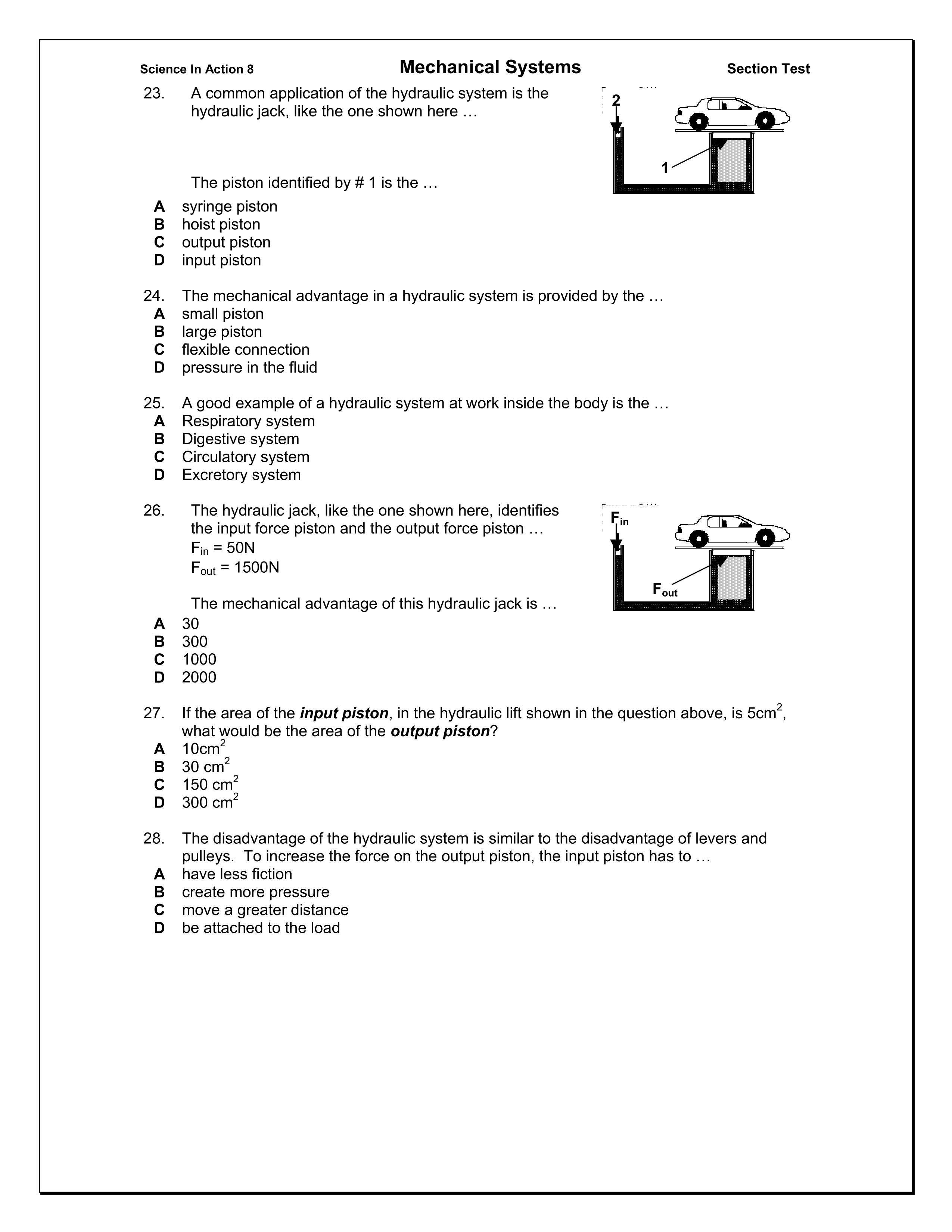
The hydraulic jack, like the one shown here, identifies the input force piston and the output force piston ...
Fin = 50N
Fout = 1500N
The mechanical advantage of this hydraulic jack is ...
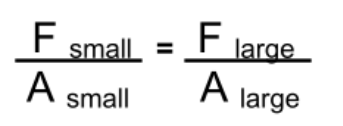
If the area of the input piston, in the hydraulic lift shown in the question above, is 5cm2, what would be the area of the output piston? Set up a ratio using this formula to solve for
A large
The disadvantage of the hydraulic system is similar to the disadvantage of levers and pulleys. To increase the force on the output piston, the input piston has to ...