01.12.21 - Graded Potentials, Synapses, and Neurotransmitters
star
star
star
star
star
Last updated over 5 years ago
26 Nsɛmmisa
1
1

1
1
1
1
1
1
1
1
1
1
1
1

1
1
1
1
1
1
1
1
1
1
1
1
Objectives:
distinguish between action potentials and graded potentials
determine the parts of a neuron that play a role in messaging between cells
sequence the steps of a message moving from one neuron to another
distinguish between different types of neurotransmitters
explain how different types of neurotransmitters have different effects on neurons
Introduction:
In our last lesson, we learned about the action potential, or the significant change in membrane potential that occurs when a message is being sent down the axon of a neuron. In this lesson, we will be learning about how messages are sent from one cell to another.
Note: All reading segments are adapted from the openstax Anatomy & Physiology textbook
Warm up #1:
Without looking at any other sources, draw the change in membrane potential during an action potential on the axes below as best as you can. Label everything that you can remember.
Warm up #2
What do you think the term "depolarization" means? Please don't google it - break it down into parts and think about what it might mean.
The electrical changes taking place within a neuron (action potentials!) are similar to a light switch being turned on. A stimulus starts the depolarization, but the action potential runs on its own once a threshold has been reached. The question is now, “What flips the light switch on?” Temporary changes to the cell membrane voltage can result from neurons receiving information from the environment, or from the action of one neuron on another. These special types of potentials influence a neuron and determine whether an action potential will occur or not.
Local changes in the membrane potential are called graded potentials and are usually associated with the dendrites of a neuron. The amount of change in the membrane potential is determined by the size of the stimulus that causes it. In the example of testing the temperature of the water in a shower, slightly warm water would only initiate a small change in a thermoreceptor, whereas hot water would cause a large amount of change in the membrane potential.
Graded potentials can be of two sorts, either they are depolarizing or hyperpolarizing (see figure below). For a membrane at the resting potential, a graded potential represents a change in that voltage either above -70 mV or below -70 mV. Depolarizing graded potentials are often the result of positive ions entering the cell, which causes the membrane potential to increase. Hyperpolarizing graded potentials can be caused by positive ions leaving the cell or negative ions entering the cell. If a positive charge moves out of a cell, the cell becomes more negative; if a negative charge enters the cell, the same thing happens.
Examine the model below:

Graded Potentials Graded potentials are temporary changes in the membrane voltage, the characteristics of which depend on the size of the stimulus. Some types of stimuli cause depolarization of the membrane, whereas others cause hyperpolarization. It depends on the specific ion channels that are activated in the cell membrane.
Use the reading and image above to answer questions 3-4
Match the following with the best description
| Draggable item | arrow_right_alt | Corresponding Item |
|---|---|---|
the difference in charge across the cell membrane gets larger | arrow_right_alt | depolarization |
the difference in charge across the cell membrane gets smaller | arrow_right_alt | hyperpolarization |
Consider what you learned about action potentials. Use your understanding to categorize the following as characteristics of either graded or action potentials.
small depolarizing or hyperpolarizing changes in the membrane potential
transmitted over long distances
the change in electrical potential associated with the transmission of impulses along the membrane of a nerve cell
a change in membrane potential that can vary in magnitude
a large depolarization that reaches +40 mV
transmitted over short distances
Graded potentials
Action potentials
All types of graded potentials will result in small changes of either depolarization or hyperpolarization in the voltage of a membrane. These changes can lead to the neuron reaching threshold if the changes add together, or summate. If the total change in voltage in the membrane is a positive 15 mV, meaning that the membrane depolarizes from -70 mV to -55 mV, then the graded potentials will result in the membrane reaching threshold.
In order to gain a better understanding of summation, watch the first 2:40 of the video below. Then, answer questions 5-7:
(Stop at 2:40! You do not need to know about the types of summation!)
What is "threshold"?
If the summated graded potentials of a neuron do not depolarize a cell to -55 mV, what will happen?
Action potentials are often referred to as "all or nothing" events. What does this mean? Choose all correct answers.
There are two types of connections between electrically active cells, chemical synapses and electrical synapses. For the purpose of this class, we will focus on chemical synapses only.
In a chemical synapse, a chemical signal—namely, a neurotransmitter—is released from one cell and it affects another cell. In an electrical synapse, there is a direct connection between the two cells so that ions can pass directly from one cell to the next. Chemical synapses involve the transmission of chemical information from one cell to the next.
An example of a chemical synapse is the neuromuscular junction (NMJ) that we learned about in the muscle unit. In the nervous system, there are many more synapses that are essentially the same as the NMJ. All synapses have common characteristics, which can be summarized in this list (think to yourself... which ones do you remember?):
presynaptic cell
neurotransmitter (packaged in vesicles)
synaptic cleft
receptor proteins
postsynaptic cell
neurotransmitter elimination or re-uptake
For the NMJ, these characteristics are as follows: the presynaptic element is the motor neuron's axon terminals, the neurotransmitter is acetylcholine, the synaptic cleft is the space between the cells where the neurotransmitter diffuses, the receptor protein is the acetylcholine receptor, the postsynaptic element is the sarcolemma of the muscle cell, and the neurotransmitter is eliminated by acetylcholinesterase. Other synapses are similar to this, and the specifics are different, but they all contain the same characteristics.
Use the reading above to answer questions 8-9
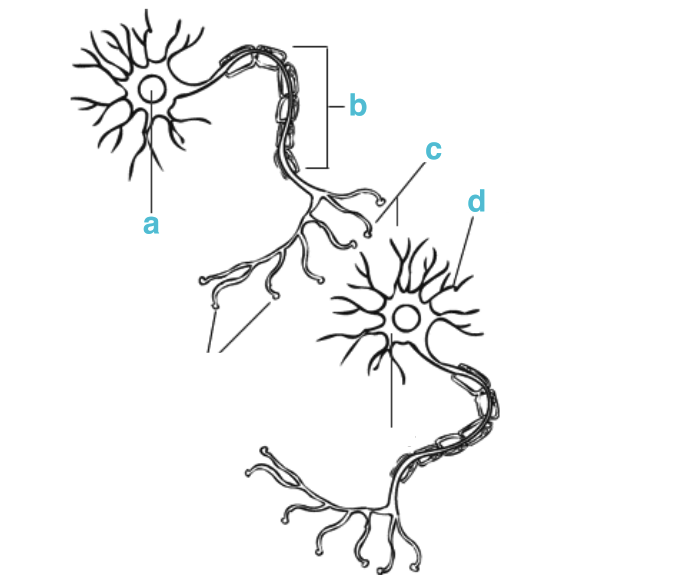
Examine the diagram below. Which letter represents the synapse?
Match the following terms with the best definition
| Draggable item | arrow_right_alt | Corresponding Item |
|---|---|---|
postsynaptic neuron | arrow_right_alt | the neuron that releases neurotransmitter into a synapse (the "sending" cell) |
presynaptic neuron | arrow_right_alt | The neuron that "receives" the neurotransmitter |
Ok - it's time for us to zoom in a little bit more. Let's look at what happens between the axon terminal of one neuron and the dendrite of another neuron.
To start off, watch the video below. As you watch, think about what you know, what you don't yet know, and what you have questions about.
Now, click on the 'Show your Work' box below. Draw and label the following for an "at rest" synapse:
dendrite
axon terminal
synaptic cleft
calcium ion (Ca2+) channels
docking protein
vesicles
neurotransmitter
receptor proteins
Step 1: the action potential reaches the ( a ) of the sending cell, causing ( b ) to flow into the ( c ) cell through Ca2+ channels.
axon terminal
calcium ion(s)
dendrite
postsynaptic
sodium ion(s)
presynaptic
a
b
c
Step 2: Calcium ions entering the cell bind to the ( a ). When this happens, the vesicles are triggered to bind to the ( b ). ( c ) are then released into the ( d ).
receptor proteins
calcium channels
action potentials
synaptic cleft
vesicles
neurotransmitters
docking proteins
a
b
c
d
Step 3: Neurotransmitters find and attach to ( a ) on the membrane of the ( b ) cell, triggering a(n) ( c ).
action potential
docking proteins
graded potential
presynaptic
receptor protein
postsynaptic
a
b
c
Step 4: Neurotransmitters re-enter the ( a ). If enough neurotransmitters attach to receptor proteins, a(n) ( b ) MAY be triggered in the ( c ) cell.
vesicles
presynaptic
graded potential
postsynaptic
synapse
action potential
a
b
c
Now that we have an idea on how messages are sent from one neuron to another, let's learn a little bit about the different neurotransmitters. For a short introduction to neurotransmitters, watch the following video:
According to the video, neurons can send neurotransmitters to which of the following tissues?
As mentioned in the video, how many neurotransmitters have been discovered?
Match the neurotransmitters with their basic function:
| Draggable item | arrow_right_alt | Corresponding Item |
|---|---|---|
norepinephrine | arrow_right_alt | activates muscles |
GABA | arrow_right_alt | increases heart rate and blood pressure |
serotonin | arrow_right_alt | incites feelings of pleasure and reward |
dopamine | arrow_right_alt | suppresses anxiety |
acetylcholine | arrow_right_alt | promotes feeling of well being and happiness |
As you probably guessed, the descriptions provided in the video above are very basic and do not describe all of the functions of the neurotransmitters mentioned.
Take a few minutes to look through the transmitters listed in the table below. Focus specifically on the neurotransmitters discussed in the video:

Use the table to answer questions 18-20
Neurotransmitters are either inhibitory or excitatory. They can not be both.
What do you think the terms "excitatory" and "inhibitory" mean?
Thinking about your answer for #19...
if there is enough, can initiate an action potential in the post-synaptic neuron
will prevent an action potential from occuring in the post-synaptic neuron
hyperpolarizes post-synaptic cell
depolarizes post-synaptic cell
excitatory neurotransmitter
inhibitory neurotransmitter
Use the table above to categorize the following neurotransmitters as being used primarily in the brain, spinal cord, or peripheral nervous system
dopamine
norepinephrine
acetylcholine
GABA
serotonin
glycine
glutamate
brain
spinal cord
peripheral nervous system
Radiolab: Seeking Patterns
Listen to the podcast below, then answer questions 22-23.
Which neurotransmitter is the focus of the podcast?
Describe the benefits and downsides of the drug that Ms. Klinestiver was prescribed. (This shouldn't be something you google, just what you get from the podcast!)
The link below is to a ten minute video on the effects of poverty on the child brain. Click on the link and watch the video, then answer questions 24-25.
How does the "toxic stress" of poverty hurt the developing brain?
Write a 3-4 sentence description of the news segment
Look once more at the table of neurotransmitters:
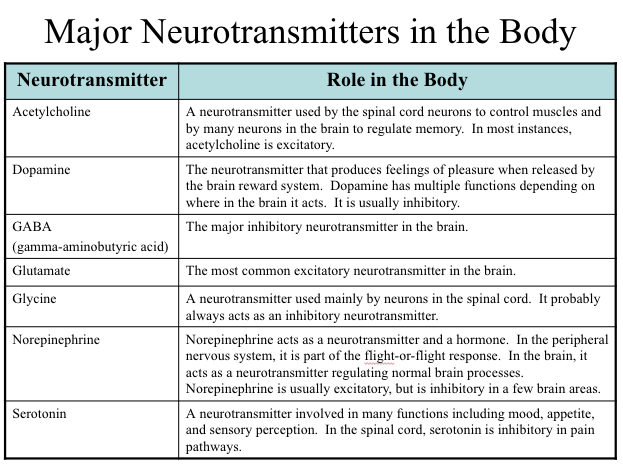
Considering what you heard about in the news segment about the effects of poverty on the developing brain, pick two neurotransmitters that you think might be affected by poverty in young kids. Explain your answer.
Wrap-Up:
Is there anything about graded potentials, synapses, or neurotransmitters that you would like for us to discuss in our next synchronous session?