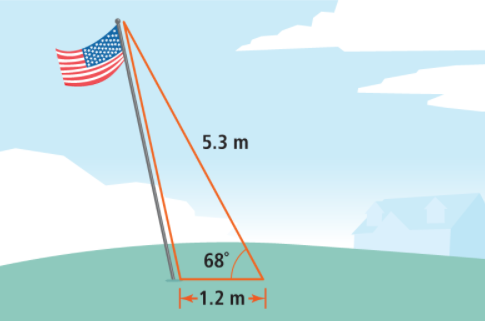
In this example you will use both Law of Sines and Law of Cosines
1 point
1
Question 1
1.
Part 1: Begin by using the Law of Cosines to solve for side length l, the length of the flagpole. Round to the nearest whole number.
1 point
1
Question 2
2.
Part 2: Next, use the Law of Sines and your answer from Part 1 to find the angle between the ground and the flagpole. Try to avoid significant error from rounding your intermediate calculations. Use the nearest whole degree in your final answer.
1 point
1
Question 3
3.
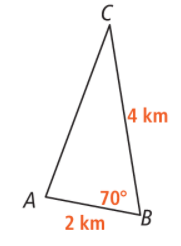
A bike race follows a triangular path, represented by \triangle{ABC}. If A is the starting point and the measure of the angle at point B is {70}\degree, what is the measure of the angle formed by path BC and path CA? Round to the nearest tenth degree.
1 point
1
Question 4
4.
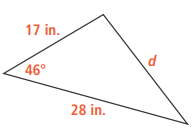
Two students are solving for d in the triangle shown, using the Law of Cosines. Rex says the answer is 20 in., and Bev says the answer is 20.3 in. Is either student incorrect? Expain your reasoning.
1 point
1
Question 5
5.
The head sail for Melissa's sailboat is a triangle with three sides having lengths 24 ft, 23 ft, and 12 ft. What is the measure of the sail's greatest angle? Round to the nearest whole degree.
1 point
1
Question 6
6.
The head sail for Melissa's sailboat is a triangle with three sides having lengths 24 ft, 23 ft, and 12 ft. What is the measure of the sail's greatest angle? Round to the nearest whole degree.
1 point
1
Question 7
7.
In \triangle{PQR}, p=5, q=8, and r=9. What is the measure of \angle{P}? Round to the nearest tenth degree.
1 point
1
Question 8
8.
In \triangle{PQR}, p=14, q=6, and r=12. What is the measure of \angle{P}? Round to the nearest tenth degree.