01.14.21 HW - Reflex Arcs

Last updated almost 5 years ago
12 questions

Reflex Arcs

Objectives: Students will...
  • explain the importance of reflex arcs
  • outline the pathway of a reflex arc
  • distinguish between two-neuron and three-neuron reflex arcs
  • investigate and describe the clinical importance of testing reflex arcs

Part 1: What are reflexes?

Changes in the environment of the body are sent to the CNS to elicit certain responses. Responses requiring a high degree of coordination or memory require the function of the serebral cortex of the brain in order to determine correct responses. However, many responses may be initiated via a simple transmission of impulses involving only the nerve fibers and the spinal cord. We call these automatic responses to stimuli reflexes.

To start this lesson, watch the crash course video below on the peripheral nervous system. The first six minutes should be mostly review. Follow the instructions below while you watch:

  1. Watch the first six minutes, considering which things sound familiar and which things do not.
  2. As you watch, pause the video and answer questions 1-2 below.
  3. Continue watching the rest of the video, paying close attention to the topics asked about in questions 3-7.

1

What topics reviewed in the first six minutes are you feeling comfortable with? Write at least three.

1

What topics reviewed in the first six minutes are you still not understanding? Write at least one.

1

What is an effector?

1

Order the steps of a reflex arc from first (top) to last (bottom):

  1. Receptor senses a stimulus
  2. Effector cells respond by contracting or secreting
  3. Motor neuron sends directions on how to react to the stimulus
  4. Integration center decodes the signal
  5. Sensory neuron transmits signal up the PNS to the CNS
1

Categorize the following definitions and examples

  • Example: catching a baseball when it is thrown towards you
  • Example: pulling your hand away from a hot stovetop
  • A reflex that can be established over time
  • An automatic reflex that can not be controlled or improved with practice
  • Innate reflex
  • Learned reflex
1

A person can control whether or not a reflex arc will happen

1

Two students are having a heated argument about reflex arcs.

Student 1 claims that the brain is not involved in reflex arcs because a response can be elicited from the spinal cord.
Student 2 claims that the brain is involved in reflex arcs because you are consciously aware of the reaction.

Which student do you agree with, Student 1 or Student 2? Justify your answer.

Part 2: Reflex Arcs

As you learned in the video above, the simplest conduction pathway in the nervous system is comprised of only a few neurons and their interactions. In the next set of questions, you will disgintuish between three neuron and two neuron reflex arcs.
1

Most reflex arc pathways are "three neuron" pathways. The illustration below is that of a typical withdrawl reflex involving three neurons.

Consider what you learned in the 'Peripherap Nervous System' formative as you label (using the terms below) and color (using the key) the diagram in the 'show your work' box. You may not know every single term , but you should be able to use your background knowledge and the process of elimination.

(Note: if you are stuck and don't know what a lot of these terms mean, revisit the 'Peripheral Nervous System' formative rather than googling things!!)
  • spinal nerve
  • cell body of sensory neuron
  • cell body of motor neuron
  • synapse
  • axon of motor neuron
  • axon of sensory neuron
  • receptor
  • effector
  • dendrite of sensory neuron
  • posterior root
  • anterior root
  • posterior root ganglion
Finally, add arrows to show the direction of nerve impulse conduction.

1

As mentioned above, there are reflex arcs even more simple than the three neuron reflex arc.

The two neuron reflex arc, as shown in the picture below, is what occurs during what we commonly think of as a reflex: the ever famous patellar tendon reflex!

Match the terms below with their location on the diagram.
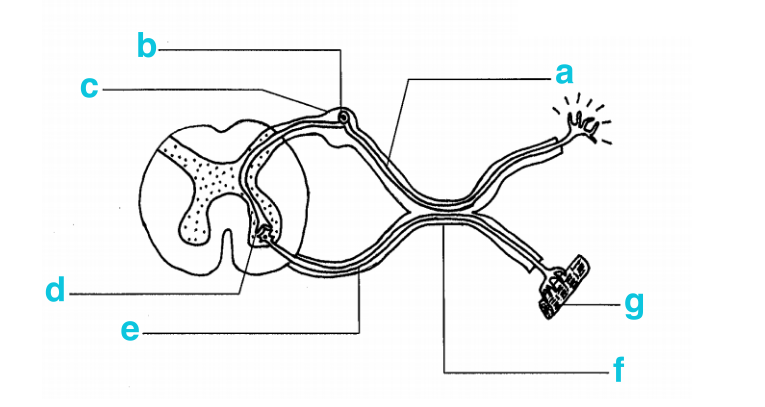
Draggable itemCorresponding Item
spinal nerve
a
posterior root ganglion
b
sensory neuron
c
effector
d
motor neuron
e
cell body of sensory neuron
f
synapse
g
Optional: Still feeling stuck on questions 8-9? Check out this video before you move on...

1

Brainstorm: Why might it be beneficial that reflex arcs do not require input from the brain to elicit a response? In other words, why do you think we evolved to have reflex arcs that react to stimuli without the brain needing to be involved?

Part 3: Reflexes.... Why?

We've all been to the doctor and experienced the patellar tendon reflex test. We know why we have reflexes, but why do doctors test them?

Read the following link: Strange Reflexes and What They Say About your Health
(Note that I am not a doctor and that this website is not intended to act as Dr. Google!! If you have serious concerns about your reflexes, talk with your doctor!)
1

Babies are born with certain reflexes and have them for their entire lives.

1

Which reflex did you find the most interesting / stuck out to you the most? Why?