APS Unit 6 Review

Last updated over 4 years ago
25 questions
Things to focus on for Unit 6:
t-model procedures
- 1-sample t-test and interval (Ch23)
- 2-sample t-test and interval (Ch24)
- Matched pairs t-test (Ch25)

Hypothesis tests (if you are asked if there is evidence of something):
- hypotheses with defined parameter (an groups if applicable)
- conditions and test named
- mechanics (work shown for 1-sample), t-statistic, degrees of freedom, and p-value clearly stated
- conclusion- Decision about null hypothesis, linked to the p-value, evidence statement in context.

Confidence intervals (if you are asked to estimate a population parameter):
- Conditions and interval named
- mechanics- degrees of freedom, interval clearly shown, (if 2-sample or matched) which was subtracted from which
- conclusion- "I am ___% confident that the true....." in context.

Chapter 21 concepts still needed:
- Type 1 and Type 2 errors and consequences of them
- how alpha and confidence level are connected
- interpret p-value (definition; not the conclusion to a hypothesis test)
- interpret confidence level (for example, what does the 95% level mean; not the conclusion to the interval)
1

Which of the following is true about Student's t-models?
1. They are unimodal, symmetric, and bell-shaped
2. They have fatter tails than the Normal model
3. As the degrees of freedom increase, the t-models look more and more Normal

1

A researcher found that a 98% confidence interval for the mean hours per week spent studying was (13,17). Which is true?
1. There is a 98% chance that the mean hours per week spent studying by college students is between 13 and 17 hours.
2. 98% of college students study between 13 and 17 hours a week.
3. Students average between 13 and 17 hours per week on 98% of the weeks.

1

A professor was curious about her students' GPAs. She took a random sample of 15 students and found a mean GPA of 3.01 with a standard deviation of 0.534. Which of the following formulas gives a 99% confidence interval for the mean GPA of the professor's students?
If your calculator doesn't have the invt function, use the "show your work" box to say how you would find the t* and write what the rest of the formula would be.

1

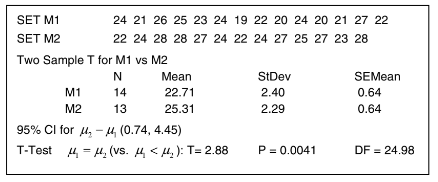
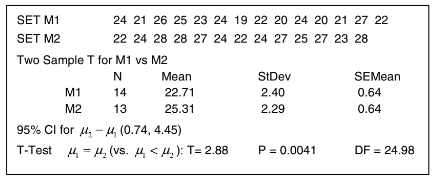
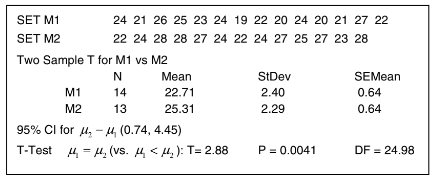
A philosophy professor wants to find out whether the mean age of men in his large lecture class is equal to the mean age of the women in his classes. After collecting data from a random sample of his students, he tested the following hypotheses:
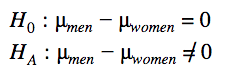
The p-value for the test was 0.003. Which is true?
1

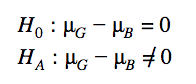
Absorption rates into the body are important considerations when manufacturing a generic version of a brand-name drug. A pharmacists read that the absorption rate into the body of a new generic drug (G) is the same as its brand-name counterpart (B). She has a researcher friend of hers run a small experiment to test the following:
Which of the following would be a Type 1 error?

1

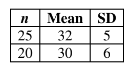
The two samples whose statistics are given in the table below are thought to come from populations with equal variances. What is the pooled estimate of the population standard deviation? (Use the test function in your calculator and scroll down to find Sxp for this; we haven't bothered with this calculation)

1

At one SAT test site students taking the test for a second time volunteers to inhale supplemental oxygen for 10 minutes before the test. In fact, some received oxygen, but others (randomly assigned) were given normal air. Test results showed that 42 of 66 students who breathed oxygen improved their SAT scores, compared to only 35 of 63 students who did not get the oxygen. Which procedure should we use to see if there is evidence that breathing that breathing extra oxygen helps test-takers think more clearly?

1

A survey asked people "On what percent of days to do you get more than 30 minutes of vigorous exercise?" Using their responses we want to estimate the difference in exercise frequency between men and women. We should use a

1

Two agronomists analyzed the same data, testing the same null hypothesis about the proportion of tomato plants suffering from blight. One rejected the null hypothesis, but the other did not. Assuming neither made a mistake in calculations, which of these explations could account for the differences in their conclusions?
1. One agronomist wrote a 1-sided alternative hypothesis, but the other used 2-sided
2. They wrote identical hypotheses, but the one who rejected the null used a higher significance level
3. They wrote identical hypotheses, but the one who rejected the null used a lower significance level

1

An elementary school principal wants to know the mean number of children in families whose children attend this school. He checks all the families using the school's registration records, and we use the computer to create a 95% interval based on a t-distribution. This procedure was not appropriate. Why?

The following will be referenced in #11-14

A pharmaceutical company has developed a new drug to reduce cholesterol. A regulatory agency will recommend the new drug for use if there is convincing evidence that the mean reduction in cholesterol level after one month of use is more than 20 mg/dl, because a mean reduction of this magnitude would be greater than the mean reduction for the current most widely used drug.

The pharmaceutical company collected data by giving the new drug to a random sample of 50 people from the population of people with high cholesterol. The reduction in cholesterol level after one month of use was recorded for each individual in the sample, resulting in a sample mean reduction and standard deviation of 24 mg/dl and 15 mg/dl, respectively.
1

A pharmaceutical company has developed a new drug to reduce cholesterol. A regulatory agency will recommend the new drug for use if there is convincing evidence that the mean reduction in cholesterol level after one month of use is more than 20 mg/dl, because a mean reduction of this magnitude would be greater than the mean reduction for the current most widely used drug.
The pharmaceutical company collected data by giving the new drug to a random sample of 50 people from the population of people with high cholesterol. The reduction in cholesterol level after one month of use was recorded for each individual in the sample, resulting in a sample mean reduction and standard deviation of 24 mg/dl and 15 mg/dl, respectively.
What conditions must be checked, and what procedure should we use? (Check all that apply)

1

A pharmaceutical company has developed a new drug to reduce cholesterol. A regulatory agency will recommend the new drug for use if there is convincing evidence that the mean reduction in cholesterol level after one month of use is more than 20 mg/dl, because a mean reduction of this magnitude would be greater than the mean reduction for the current most widely used drug.
The pharmaceutical company collected data by giving the new drug to a random sample of 50 people from the population of people with high cholesterol. The reduction in cholesterol level after one month of use was recorded for each individual in the sample, resulting in a sample mean reduction and standard deviation of 24 mg/dl and 15 mg/dl, respectively.

A regulatory agency decides to use an interval to estimate the population mean reduction in cholesterol level for the new drug. Provide the 95% confidence interval.

1

A pharmaceutical company has developed a new drug to reduce cholesterol. A regulatory agency will recommend the new drug for use if there is convincing evidence that the mean reduction in cholesterol level after one month of use is more than 20 mg/dl, because a mean reduction of this magnitude would be greater than the mean reduction for the current most widely used drug.
The pharmaceutical company collected data by giving the new drug to a random sample of 50 people from the population of people with high cholesterol. The reduction in cholesterol level after one month of use was recorded for each individual in the sample, resulting in a sample mean reduction and standard deviation of 24 mg/dl and 15 mg/dl, respectively.

Conclude/Interpret your interval.

1

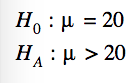
Because the 95% confidence interval includes 20, the regulatory agency is not convinced that the new drug is better than the current best-seller. The pharmaceutical company tests the following hypotheses:
where mu represents the population mean reduction in cholesterol level for the new drug.
The test procedure resulted in a t-statistic of 1.89 and a p-value of 0.033. Because the p-value was less than 0.05, the company believes that there is convincing evidence that the mean reduction in cholesterol level for the new drug is more than 20 mg/dl. Explain why the confidence interval and the hypothesis test led to different conclusions.

The following will be referenced in #15-18

Hoping to improve the gas mileage of their cars, a car company has made an adjustment in the manufacturing process. Random samples of automobiles coming off the assembly line have been measured each week that the plant has been in operation. The data from before and after the manufacturing adjustments were made are on the table. It is believed that the measurements of gas mileage are normally distributed.
1

What conditions must be checked, and what procedure should we use? (Check all that apply)

1

Hoping to improve the gas mileage of their cars, a car company has made an adjustment in the manufacturing process. Random samples of automobiles coming off the assembly line have been measured each week that the plant has been in operation. The data from before and after the manufacturing adjustments were made are on the table. It is believed that the measurements of gas mileage are normally distributed.
What is the t-statistic?

1

Hoping to improve the gas mileage of their cars, a car company has made an adjustment in the manufacturing process. Random samples of automobiles coming off the assembly line have been measured each week that the plant has been in operation. The data from before and after the manufacturing adjustments were made are on the table. It is believed that the measurements of gas mileage are normally distributed.
What is the p-value?

1

Hoping to improve the gas mileage of their cars, a car company has made an adjustment in the manufacturing process. Random samples of automobiles coming off the assembly line have been measured each week that the plant has been in operation. The data from before and after the manufacturing adjustments were made are on the table. It is believed that the measurements of gas mileage are normally distributed.

What should we conclude? Check all that apply.

The following will be referenced in #19-20
A packing company considers hiring a national training consultant in hopes of improving productivity on the packing line. The national consultant agrees to work
with 18 employees for one week as part of a trial before the packing company makes a
decision about the training program. The average cases per day is recorded before the training, then again after the training. The training program will be implemented if the average product packed increases by more than 10 cases per day per employee. The packing company manager will test a hypothesis using α = 0.05.
1

Which hypotheses should we check?

1

What conditions must be checked, and what procedure should we use? (Check all that apply)

1

A packing company considers hiring a national training consultant in hopes of improving productivity on the packing line. The national consultant agrees to work
with 18 employees for one week as part of a trial before the packing company makes a
decision about the training program. The average cases per day is recorded before the training, then again after the training. The training program will be implemented if the average product packed increases by more than 10 cases per day per employee. The packing company manager will test a hypothesis using α = 0.05.

How many degrees of freedom will our model have?

1

A packing company considers hiring a national training consultant in hopes of improving productivity on the packing line. The national consultant agrees to work
with 18 employees for one week as part of a trial before the packing company makes a
decision about the training program. The average cases per day is recorded before the training, then again after the training. The training program will be implemented if the average product packed increases by more than 10 cases per day per employee. The packing company manager will test a hypothesis using α = 0.05.

After one week, the mean difference for the 18 employees is 11.3 cases with a standard deviation of 2.8 cases. What is the t-statistic?

1

A packing company considers hiring a national training consultant in hopes of improving productivity on the packing line. The national consultant agrees to work
with 18 employees for one week as part of a trial before the packing company makes a
decision about the training program. The average cases per day for each employee is recorded before the training, then again after the training. The training program will be implemented if the average product packed increases by more than 10 cases per day per employee. The packing company manager will test a hypothesis using α = 0.05.

After one week, the mean difference for the 18 employees is 11.3 cases with a standard deviation of 2.8 cases. What is the p-value?

1

What should the company conclude? Check all that apply.

1

In reality, the truth is that the training program is not effective. Was an error made? If so, which type? What would the consequence be for the company? Check all that apply.