Which type of statement is represented by the symbollic representation given below?
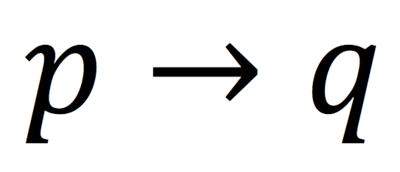
Which type of statement is represented by the symbollic representation given below?
Read the conditional statement below. Then provide the converse.
If the moon is full, then the vampires are prowling.
Read the conditional statement below. Then provide the inverse.
If you do not understand geometry, then you do not know how to reason deductively.
Read the conditional statement below. Then provide the converse.
You cannot skateboard if you do not have a sense of balance. (you might rewrite into the if/then form first)
Read the conditional statement below. Then provide the inverse.
If it rains, then I do not go fishing.
Read the conditional statement below. Then provide the contrapositive.
If I have a Siberian Husky, then I have a dog.
Read the conditional statement below. Then provide the contrapositive.
If there is a thunderstorm, then our pond floods.
Read the conditional statement below. Then identify the hypothesis.
If angles are congruent, then the measures of the angles are equal.
Read the conditional statement below. Then identify the conclusion.
If angles are congruent, then the measures of the angles are equal.
Read the conditional statement below. Then identify the hypothesis.
If Johnny is late to school, then his mom will have to drive him.
Read the conditional statement below. Then identify the conclusion.
If Johnny is late to school, then his mom will have to drive him.
Read the conditional statement below. Then identify the hypothesis.
The angles are supplementary if they add up to 180 degrees.
Read the conditional statement below. Then identify the conclusion.
The angles are supplementary if they add up to 180 degrees.
Is this statement true?
If I like animals, then I will get a dog.
If it is true, select true. If it is not, select false.
Using your reponse from question 13 above, if you answered 'false', write a counterexample. If you answered true, write true.
Read the following statement. Then identify the hypothesis.
If you like fried chicken, then you like KFC.
Read the following statement. Then identify the conclusion.
If you like fried chicken, then you like KFC.
Which type of statement is represented by the symbollic representation given below?
Which type of statement is represented by the symbollic representation given below?
Which type of statement is represented by the symbollic representation given below?
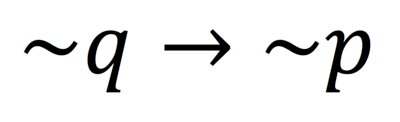
Which type of statement is represented by the symbollic representation given below?
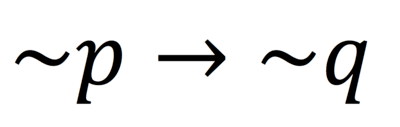
How would you describe the Law of Detachment symbolically?
Use the Law of Detachment to determine what you can conclude from the given information, if possible.
If you passed the final, then you pass the class.
You passed the final.
If a conclusion is possible, write it below. If a conclusion is not possible, write "not possible."
Use the Law of Detachment to determine what you can conclude from the given information, if possible.
If your parents let you borrow the car, then you will go to the movies with your friend.
You will go to the movies with your friend.
If a conclusion is possible, write it below. If a conclusion is not possible, write "not possible."
How would you describe the Law of Syllogism symbolically?
Use the Law of Syllogism to write a new conditional statement that follows from the pair of true statements, if possible.
If x < -2, then |x| > 2.
If x > 2, then |x| > 2.
If a conclusion is possible, write it below. If a conclusion is not possible, write "not possible."
Use the Law of Syllogism to write a new conditional statement that follows from the pair of true statements, if possible.
If a figure is a rhombus, then the figure is a parallelogram.
If a figure is a parallelogram, then the figure is a quadrilateral.
If a conclusion is possible, write it below. If a conclusion is not possible, write "not possible."
If the school cafeteria sells pizza today, then Greg is going to eat four pieces.
The school is selling pizza today.
Using deductive reasoning, what statement can you make based on this information?