Log in
Sign up for FREE
arrow_back
Library

LT 1.09 Life cycle of star

star
star
star
star
star
Last updated about 4 hours ago
21 questions
Required
1
Required
1
Required
1
Required
1
Required
1
Required
1
Required
1
Required
1
Required
1
Required
2
Required
2
LT 1.09: I can explain how elements are formed in the life cycle of a star.
Question 1
1.

Stars get the energy to burn from what process?

Question 2
2.

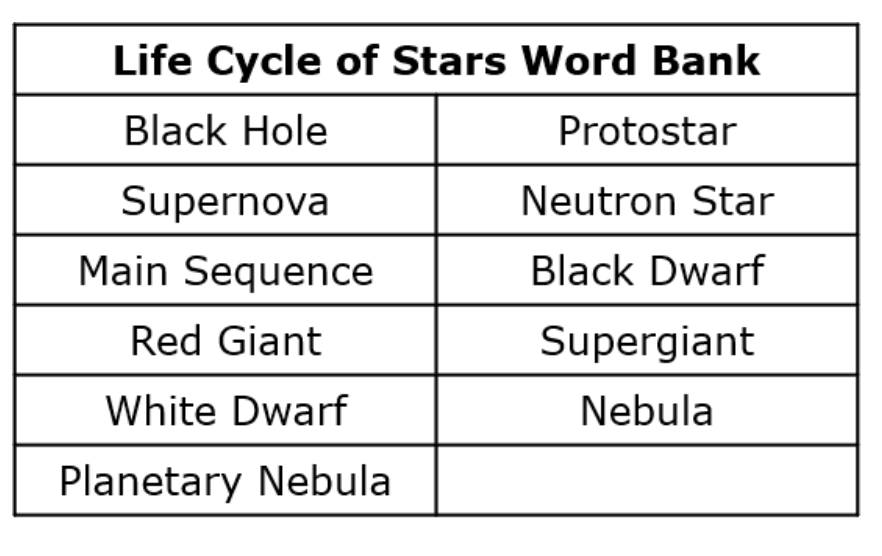
List the stages in order of the life cycle of an average mass star such as the Sun. Use the word bank below to help. (Hint: Some of the words will NOT be used.)

Question 3
3.

What stage follows the 'main sequence' in a low - medium mass star's cycle?

Question 4
4.

What end state does a low-medium mass star usually achieve after exhausting its fuel?

Question 5
5.

What does a high mass star become at the end of its life cycle?

Question 6
6.

What high-energy events accompany the death of high mass stars?

Question 7
7.

During a supernova explosion, what heavier elements are formed?

Question 8
8.

Which stage in the life cycle of a star involves the production of heavier elements like Carbon and Oxygen?

Question 9
9.

Which statement is true about the life cycle of a star?

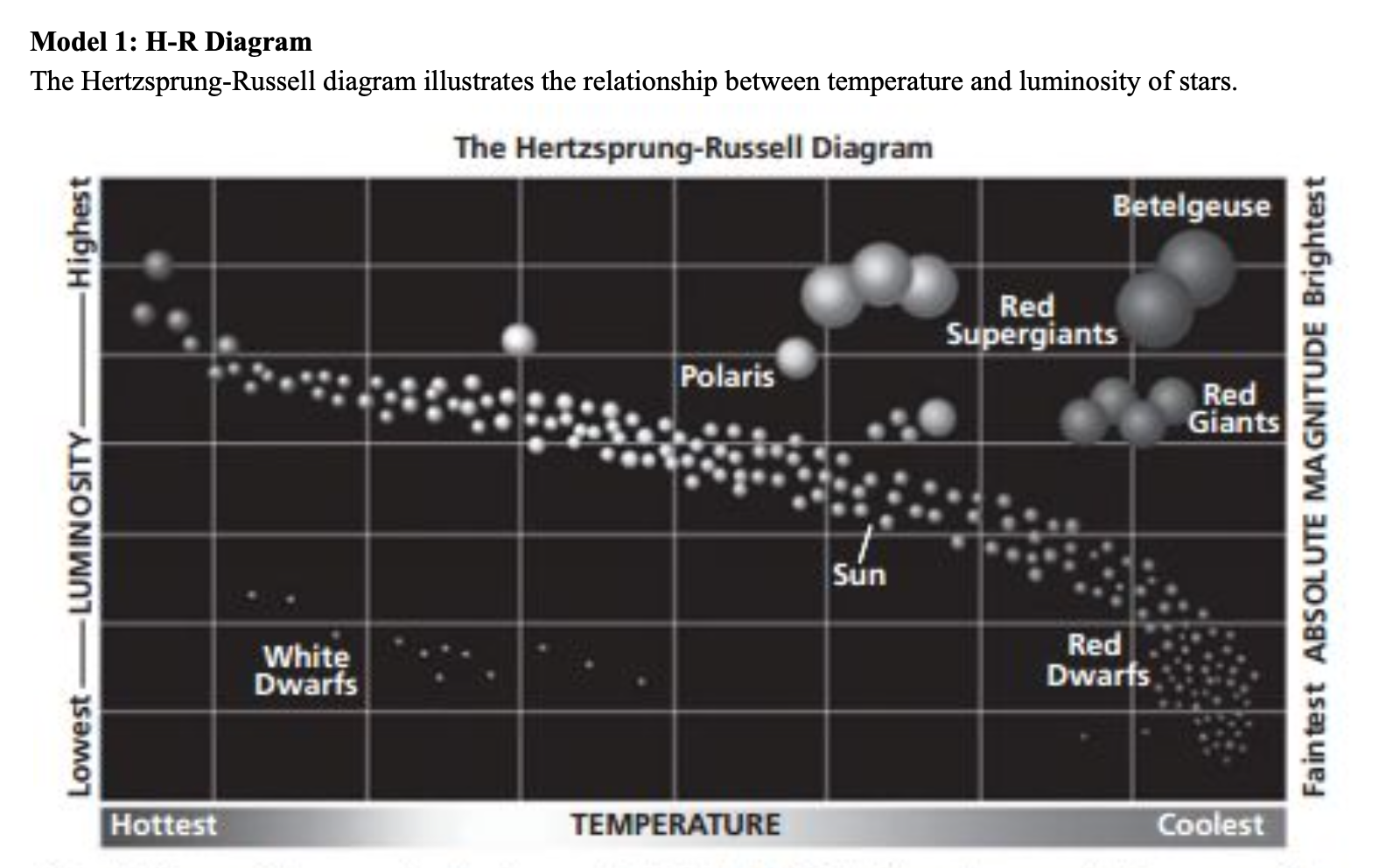
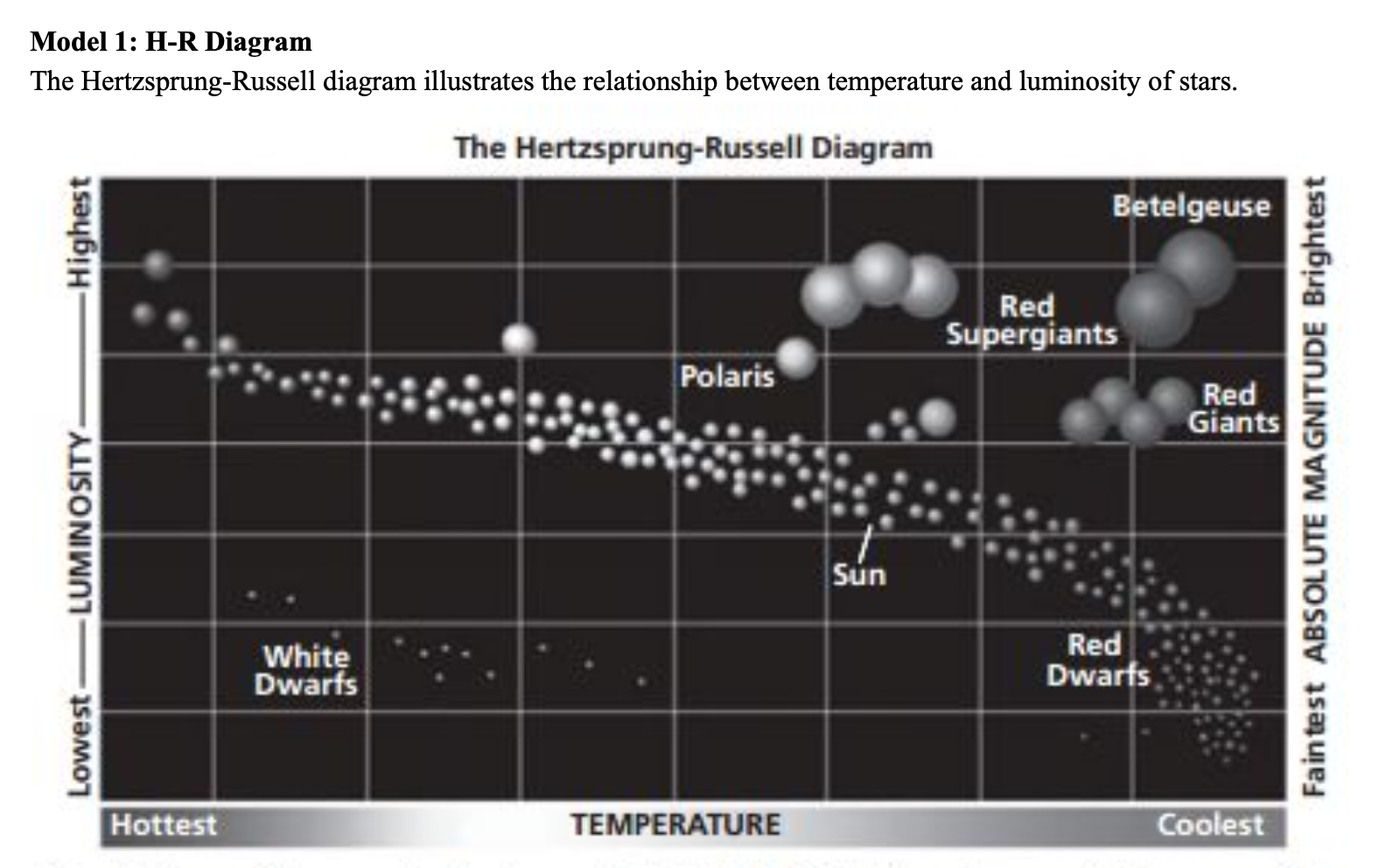
How are stars plotted on the H-R diagram?
Astronomers refer to brightness as ​luminos​ity. Luminosity is actually a measure of the total amount of energy a star gives off each second. When the surface temperatures of stars are plotted against their luminosity, a consistent pattern is revealed. The graph that illustrates this pattern is called the Hertzsprung-Russell diagram, or H-R diagram.
The hottest stars are located on the left side of the H-R diagram and are blue. Stars become progressively cooler the farther to the right they are located on the diagram. The coolest stars are located on the right side of the diagram and are red. The brightest stars are located at the top of the diagram, and the dimmest stars are located at the bottom.
Required
1
Required
1
Required
1
Required
1
Required
1
Question 15
15.

On the H-R diagram, draw a circle around the area where the very brightest stars are located?
On the H-R diagram, draw a square around the area where the coolest and dimmest stars are located?

Question 16
16.
What is the largest star identified on this diagram?_______ Is it hot or cool?_______
Most stars fall within a band that runs diagonally through the middle of the H-R diagram. This band extends from hot, bright blue stars at the upper left to cool, dim red stars at the lower right. It is called the main sequence. The main sequence is the region of the diagram where stars spend most of their lives. Stars within this band are actively fusing hydrogen and are called ​main-sequence stars.
The sun is a main-sequence star. When nuclear fusion ends in the sun, it will become a giant and will move to the upper right corner of the H-R diagram. When outer layers of the giant are lost to space, the sun will become a white dwarf and move to the bottom of the diagram.
Required
1
Required
1
Question 18
18.

What do all of the stars in the main-sequence have in common, in terms of their life cycle?

Required
1
Question 19
19.

The sun is now in the main-sequence. What will cause the sun to become a giant?

Required
1
Required
1
Question 10
10.

What does luminosity measure?

Question 11
11.

Where can you find the hottest stars on the diagram?

Question 12
12.

What color are the hottest stars?

Question 13
13.

Where can you find the coolest stars on the diagram?

Question 14
14.

What color are the coolest stars?

Question 17
17.

What region of the diagram do stars spend most of their lives?

Question 20
20.

How will the sun change in terms of temperature and brightness as it moves from a main-sequence star to become a red giant?

Question 21
21.

At the end of their life cycles, most low-mass stars become white dwarfs. White dwarfs are the collapsed cores of giant stars. How will the sun change in terms of temperature and brightness as it moves from a red giant to a white dwarf star?