Log in
Sign up for FREE
arrow_back
Library

SS8H5

star
star
star
star
star
Last updated about 5 years ago
13 questions
Note from the author:
1
1
Analyze government policies regarding slavery, such as the three-fifths clause, the Missouri Compromise (1820) and the Compromise of 1850
1
Analyze government policies regarding slavery, such as the three-fifths clause, the Missouri Compromise (1820) and the Compromise of 1850
1
Describe pro-slavery and anti-slavery positions and explain how debates over slavery influenced politics and sectionalism
1
Analyze the ideological breakdown that resulted from different events and issues, such as Virginia-Kentucky resolutions, the Hartford Convention, nullification/states' rights, political party division, the Dred Scott decision, John Brown raids
1
Explain why the 1860 election led to the secession of the southern states
1
1
1
1
1
1
1
Practice review for GA standard SS8H5
Question 1
1.

This term means "to leave or withdraw"

Question 2
2.

How did the Compromise of 1850 settle the dispute over California becoming a new state?

Question 3
3.

How did the Fugitive Slave Act increase tension between the North and South?

Question 4
4.

Why did violence erupt in Kansas in 1855 over the issue of slavery?

Question 5
5.

How did the Supreme Court rule in the case of Dred Scott, the slave who was suing for his freedom?

Question 6
6.

Why were Southerners so angry over the election of Abraham Lincoln to the presidency in 1960?

Question 7
7.

Which is the best definition for "emancipation"?

Question 8
8.

When tariffs on imported goods were approved by the federal legislative branch, Southern states wanted to nullify the law. What may have been Georgia's reaction?

Question 9
9.

Which battle was the first major battle of the Civil War fought in GA, and was over control of the south's railroads?

Question 10
10.

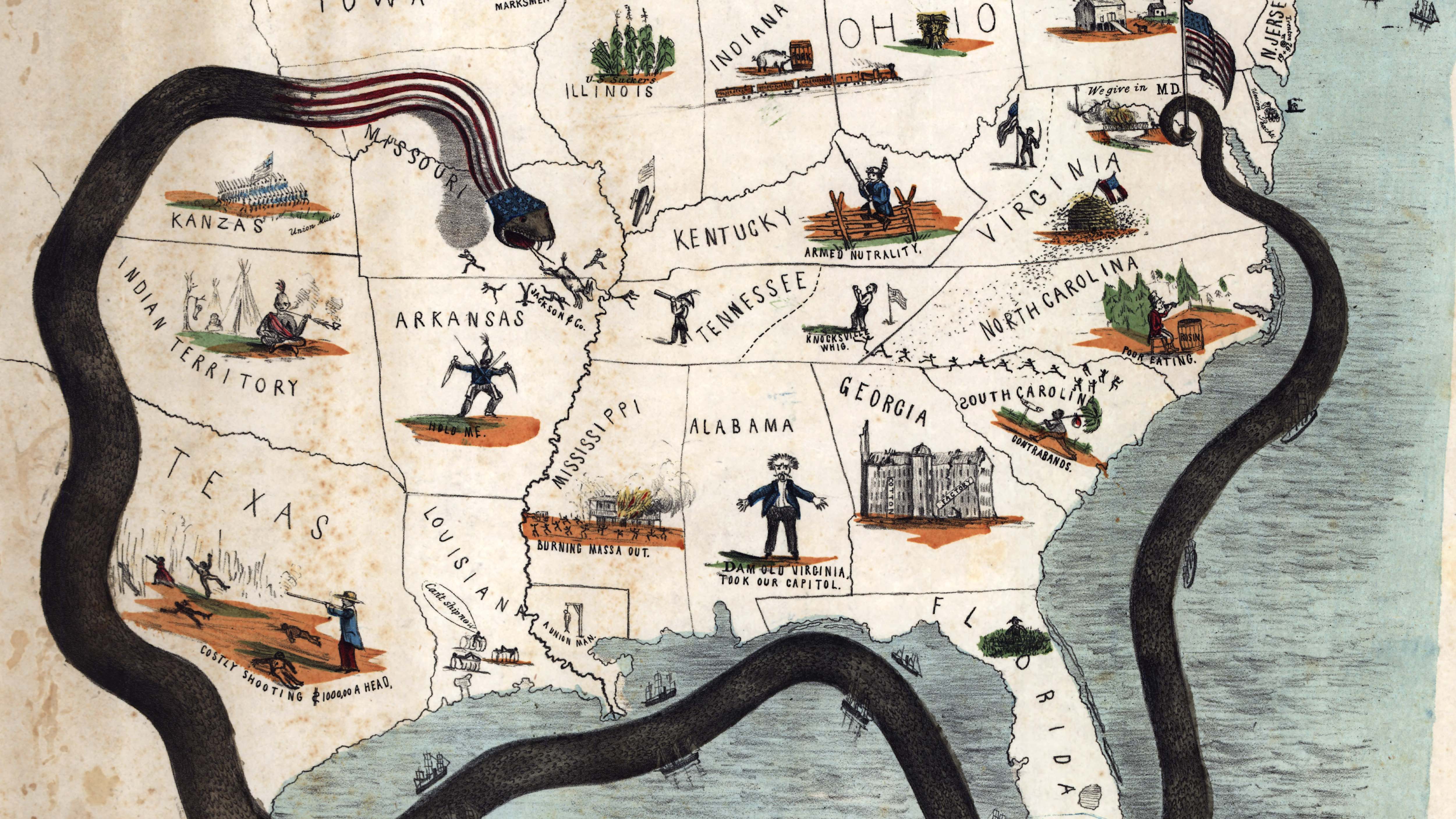
Why was control of the Mississippi River an important goal of the Union strategy in
the West?
Question 11
11.

What was William Sherman's goals with the Atlanta Campaign and the March to the Sea?

Question 12
12.

Which of the following is true of the Emancipation Proclamation?

Question 13
13.

The most notorious Confederate Civil War prison, known for over crowding and high death toll.

California was not admitted as a state – they were told they would need to wait until after the Civil War was over to apply again.
The law angered Northerners because they now had to help recapture runaways, but pleased the South because they viewed slaves as property.
The President sent in U.S. troops to force residents of Kansas to free their slaves.
The Supreme Court decided that slavery was illegal in all cases and Dred Scott, along with all other slaves, were freed.
Southerners believed that Lincoln would abolish slavery as president, even though he’d stated that he only wanted to keep it from spreading.
Confederacy would not be able to split Union forces if they lost control of the river.