#511 - HHMI Mendelian Genetics
star
star
star
star
star
Last updated over 5 years ago
70 Nsɛmmisa
1
1
1
1
1
1
1
1
1
3
1
1
1
1
1
3
1
1
1
1
1
1
1
1
1
1
1
1
1
1
1
1
1
1
1
1
1
1
1
1
1
1
1
1
1
1
1
1
1
1
1
1
1
1
2
1
1
1
1
1
1
1
1
1
1
1
1
1
1
1
INTRODUCTION
Hemoglobin is a protein found in red blood cells (RBCs) that transports oxygen throughout the body. The hemoglobin protein consists of four polypeptide chains: two alpha chains and two beta chains. Sickle cell disease (also called sickle cell anemia) is caused by a genetic mutation in the DNA sequence that codes for the beta chain of the hemoglobin protein. The mutation causes an amino acid substitution, replacing glutamic acid with valine. Due to this change in amino acid sequence, the hemoglobin tends to precipitate (or clump together) within the RBC after releasing its oxygen. This clumping causes the RBC to assume an abnormal “sickled” shape.
Individuals who are homozygous for the normal hemoglobin allele (HBA) receive a normal hemoglobin allele from each parent and are designated AA. People who are homozygous for normal hemoglobin do not have any sickled RBCs. Individuals who receive one normal hemoglobin allele from one parent and one mutant hemoglobin, or sickle cell allele (HBS), from the other parent are heterozygous and are said to have sickle cell trait. Their genotype is AS. Heterozygous individuals produce both normal and mutant hemoglobin proteins. These individuals do not have sickle cell disease, and most of their RBCs are normal. However, due to having one copy of the sickle cell allele, these individuals do manifest some sickling of their RBCs in low-oxygen environments. People with sickle cell disease are homozygous for the sickle cell allele (SS genotype); they have received one copy of the mutant hemoglobin allele from each parent. The resulting abnormal, sickle-shaped RBCs in these people block blood flow in blood vessels, causing pain, serious infections, and organ damage.
PROCEDURE
1. Watch the short film The Making of the Fittest: Natural Selection in Humans. While watching, pay close attention to the genetics of sickle cell trait and the connection to malaria infection.
2. Answer the following questions regarding genetics, probability, pedigrees, and the chi-square statistical analysis test.
Two people with sickle cell trait have children.
Fill out the Punnett square.
What percent of children will have normal RBCs in both high- and low-oxygen environments?
What percent of children will have sickle cell disease?
What is the chance that a child will carry the HbS gene but not have sickle cell disease?
What are the chances that these parents will have three children who are homozygous for normal RBCs? (Show
your work.)
What are the chances that these parents will have three children who have both normal and mutant
hemoglobin beta chains? (Show your work.)
What are the chances that all three of their children will show the disease phenotype? (Show your work.)
What are the chances that these parents will have two children with sickle cell trait and one with sickle cell
disease? (Show your work.)
In the cross above, if you know that the child does not have sickle cell disease, what is the chance that the child has sickle cell trait?
An individual who has sickle cell trait has children with an individual who does not have the HbS allele.
In the Punnett square, show all the possible genotypes of their children. State the genotype and phenotype
ratios of the offspring. - show your work!
What are the genotypes of the parents?
What are the chances that any one of this couple’s children will have sickle cell disease?
If this couple lives in the lowlands of East Africa, what are the chances that one of their children would be
resistant to malaria if exposed to the malaria parasite?
What are the genotypes of the parents?
What is the genetic makeup of the gametes the mother can produce?
What is the genetic makeup of the gametes the father can produce?
In the Punnett square, show all the possible genotypes of their children. Then summarize the genotype and
phenotype ratios of the possible offspring.
What are the chances that any one of this couple’s children will have sickle cell disease?
If this couple moves to the lowlands of East Africa and has children, which of their children would be more likely
to survive? Explain your answer.
In humans, blood type is a result of multiple alleles: IA, IB, and iO. A few simple rules of blood type genetics are that
• IA is dominant over iO,
• IB is dominant over iO, and
• IAIB are codominant.
Two parents who are heterozygous for type A blood and have sickle cell trait have children. Answer the following questions.
What is the genotype of the parents? Remember - this is 2 genes!
What are the genetic makeups of all the possible gametes they can produce?
Complete the dihybrid Punnett square to determine the frequency of the different phenotypes in the offspring.
(Note: Consider blood type and normal versus mutant hemoglobin in the various phenotypes.)
Now try a different way of solving a dihybrid cross. Because of Mendel’s (second) law of independent assortment, you can work with the blood type gene and the hemoglobin gene separately. Set up two monohybrid crosses with the following parents: the mother is heterozygous for type B blood and has sickle cell trait, while the father has type AB blood and also has sickle cell trait.
What are the chances that a child of this couple will have type B blood and sickle cell trait? (Show your work.)
What are the chances that a child will have type AB blood and will not have sickle cell disease? (Show your work.)
What are the chances that a child will have type B blood and sickle cell disease? (Show your work.)
What are the chances that a child will have type B blood and at least some normal hemoglobin? (Show
your work.)
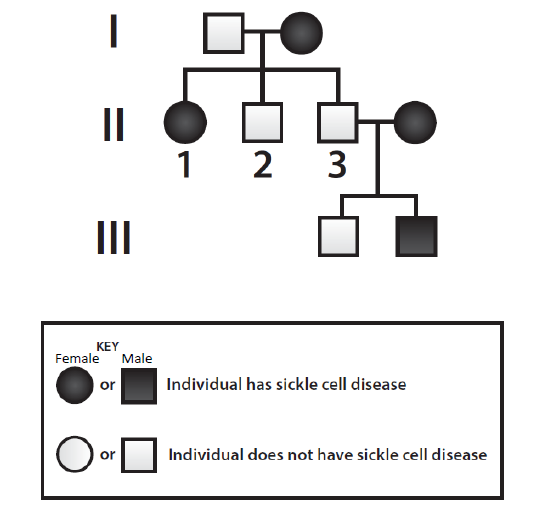
The following pedigree traces sickle cell disease through three generations of a family. Use the pedigree to answer the following questions.
What is the genotype of the father in the first generation?
What is the genotype of the daughter in the second generation?
What is the genotype of individual 3 in the second generation? How do you know? You can mark on the diagram or explain in words
If the couple in the second generation has another child, what are the chances the child will have sickle cell disease?
If the couple in the second generation has another child, what are the chances the child will carry the sickle cell trait?
If the couple in the second generation has another child, what are the chances the child will have normal hemoglobin?
If the entire family moves to the lowlands of East Africa, four of the five males in the pedigree will have two
genetic advantages over the other individuals in the family. Explain the two advantages.
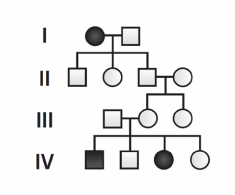
The following pedigree traces sickle cell disease through four generations of a family living in New York City. Use the pedigree to answer the following questions.
What is the genotype of the mother in the first generation?
What are the possible genotypes of the father in the first generation?
Why can't you tell for sure about the father in the first generation?
What can you say about the genotype of all the children of the couple in the first generation? Explain your answer.
Regarding the answer to Question 7c, based on where the family resides, why would this genotype be
considered a disadvantage?
What are the genotypes of the parents in the third generation? Explain how you know.
What is the possible genotype or genotypes of the mother in the second generation?
If the couple in the third generation has another child, what are the chances the child will have sickle cell disease?
If the couple in the third generation has another child, what are the chances the child will carry sickle cell trait?
If the couple in the third generation has another child, what are the chances the child be homozygous for normal RBCs?
If the couple in the third generation has another child, what are the chances the child be resistant to malaria and not have sickle cell anemia?
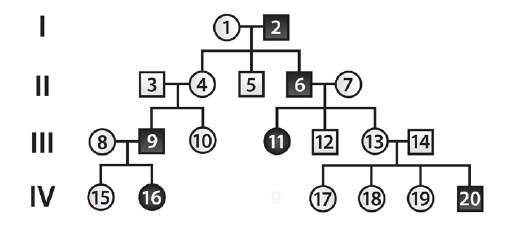
The following pedigree traces sickle cell disease through four generations of a family living in the highlands of
eastern Africa. Use the pedigree to answer the following questions.
What are the genotypes of Individual 1?
(If more than one genotype pertains, include all possibilities.)
What are the genotypes of Individual 2?
(If more than one genotype pertains, include all possibilities.)
What are the genotypes of Individual 7?
(If more than one genotype pertains, include all possibilities.)
What are the genotypes of Individual 10?
(If more than one genotype pertains, include all possibilities.)
What are the genotypes of Individual 13?
(If more than one genotype pertains, include all possibilities.)
What are the genotypes of Individual 17?
(If more than one genotype pertains, include all possibilities.)
If individuals 13 and 14 have another child, what are the chances that the child will have sickle cell disease?
If the same couple has three more children, what are the chances that the three children will have sickle cell
trait? (Show your work.)
Based on where this family lives, is the sickle cell trait genotype a genetic advantage? Explain.
If individuals 8 and 9 have four more children, what are the chances that two of the children will be homozygous
for normal RBCs? Explain why.
Imagine that you are a genetic counselor, and a couple planning to start a family comes to you for information.
Jerome was married before, and he and his first wife have a daughter with sickle cell disease. The brother of his
current wife, Michaela, died of complications from sickle cell disease, but neither of her parents has the disease.
Draw a pedigree representing this family. Be sure to clearly label Jerome and Michaela.
What is the probability that Jerome and Michaela will have a baby with sickle cell disease? Note that neither
Jerome nor Michaela has sickle cell disease. (Show your work.)
Natasha and Demarcus are planning on having children. Each has a sister with sickle cell disease. Neither Natasha nor Demarcus nor any of their parents have the disease, and none of them has been tested to see if they have sickle cell trait.
Draw a pedigree representing this family. Be sure to clearly label Natasha and Demarcus.
Based on this incomplete information, calculate the probability that if this couple has a child, the child will have
sickle cell disease. Show your work.
Multiple couples living in a small village in the eastern African lowlands, all of whom are heterozygous for the HbS allele, have 500 children among them. Of these children, 139 are homozygous for HbA, 279 are heterozygous for HbS, and 82 suffer from sickle cell disease. Are these data statistically significant? Explain using a chi-square statistical analysis test.
Fill in the values in the Chi Sq table
What is the chi-square value (χ2)?
Calculate the degrees of freedom (df)
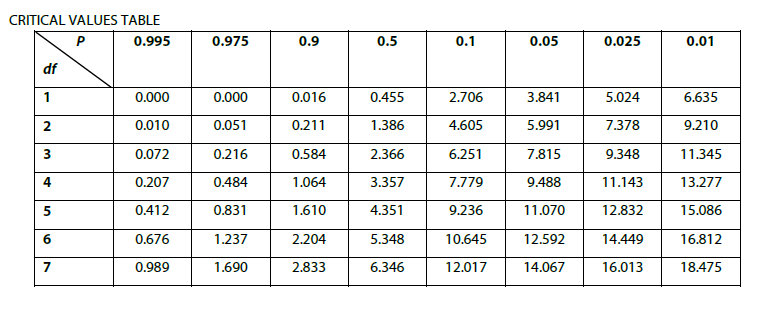
Which critical value should we compare to χ2?
What do we know about our data? Explain the significance.
Which of the children have the greatest chance of survival? Explain why.
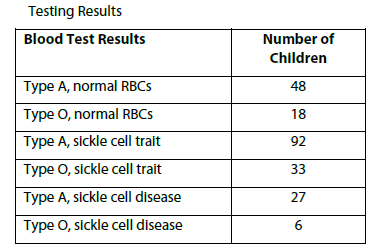
Suppose there are 50 couples with the same blood type and hemoglobin genotypes. They live on a small, isolated Pacific island on which very few mosquitoes have been identified. All the individuals are heterozygous for type A blood and have sickle cell trait. The 50 couples had 224 children over the years. The children were all tested for blood type and for the presence of the sickle cell allele. Here are the results.
Are these data significant? Explain using a chi-square statistical analysis test. (Use the table below if you need
assistance.)
Fill in the Chi sq table.
What is χ2?
Calculate df.
Which critical value should we compare to χ2?
What do we know about our data? Explain the significance.
From what you know about hemoglobin, sickle cell disease, and blood type, what selection pressure is acting
on this population of children and causing the null hypothesis to be rejected? Explain your answer. (Hint: Look
at the actual differences between the observed and expected numbers.)