Log in
Sign up for FREE
arrow_back
Library

Gizmo: Building DNA

star
star
star
star
star
Last updated about 3 hours ago
22 questions
Vocabulary
Prior Knowledge Questions: (Do these BEFORE using the Gizmo.)
Required
0
Required
0
Gizmo Warm-up:
Required
0
Required
0
Activity A: Build a DNA molecule
1
Required
1
Required
1
Required
1
Required
1
Required
1
Activity B: DNA replication
Required
1
Required
1
Required
1
Required
1
Required
1
Required
1
Required
1
Building DNA Assessment Questions
Required
1
Required
1
Required
1
Required
1
Required
1
Construct a DNA molecule, examine its double-helix structure, and then go through the DNA replication process. Learn how each component fits into a DNA molecule, and see how a unique, self-replicating code can be created.
Double helix – the shape of DNA, resembling a twisted ladder.
DNA – material in the cell that contains genetic information.
  • DNA stands for deoxyribonucleic acid.
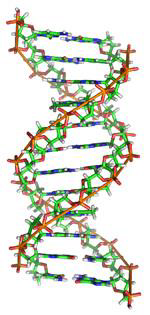
  • The DNA molecule has the shape of a double helix, or twisted ladder. The sides are composed of a sugar (deoxyribose) and phosphate groups. The “rungs” of the ladder are composed of pairs of nitrogenous bases.
  • The two sides of a replicating DNA molecule are called the leading strand and the lagging strand.
DNA helicase – an enzyme the unwinds and unzips the double-sided DNA strand to produce two single DNA strands.
DNA polymerase – an enzyme that helps attach nucleotides to single-sided DNA strands, resulting in two identical completed DNA strands.
Enzyme – a protein that facilitates a specific chemical reaction in the body.
Mutation – an error that occurs during DNA replication.
  • Mutations can be harmful, helpful, or neutral. Most mutations are neutral.
  • Examples of mutations include point mutations, insertions, and deletions.
Nitrogenous base – a component of DNA that forms the “rungs” in the DNA structure.
  • There are four nitrogenous bases in DNA: adenine, thymine, cytosine, and guanine.
  • Each “rung” of DNA is composed of a bonded pair of nitrogenous bases. Adenine bonds to thymine while cytosine bonds to guanine.
Nucleotide – a subunit of a nucleic acid molecule that consists of a sugar, a phosphate, and a nitrogenous base.
Replication – the process of duplication.
  • During DNA replication, a double-stranded DNA molecule divides into two single strands. New nucleotides bond to each single strand. The end result is two identical strands of DNA.
DNA is an incredible molecule that forms the basis of life on Earth. DNA molecules contain instructions for building every living organism on Earth, from the tiniest bacterium to a massive blue whale. DNA also can make copies of itself. This allows living things to grow and reproduce.
Question 1
1.

Look at the DNA molecule. What does it look like?

This shape is called a double helix.
Question 2
2.

Based on this image, how do you think a DNA molecule makes a copy of itself?

Click here for the Building DNA Gizmo


The Building DNA Gizmo allows you to construct a DNA molecule and go through the process of DNA replication.
Question 3
3.
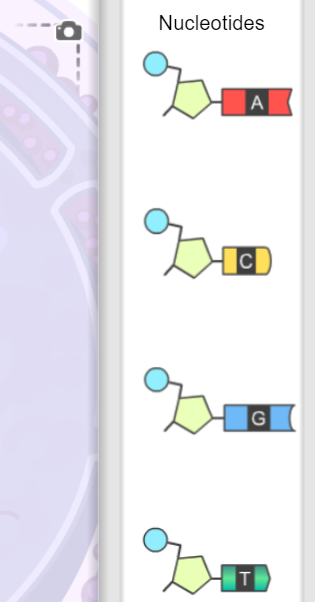
Look on the right side of the Gizmo. What is the name for the components that make up a DNA molecule?
_______
A nucleotide consists of three parts: a phosphate group (blue circle), a sugar called deoxyribose (tan pentagon), and a nitrogenous base (shown in assorted colors of red, yellow, blue, and green).
Question 4
4.

How many different nitrogenous bases do you see?

The names of these nitrogenous bases are adenine (A), cytosine (C), guanine (G), and thymine (T).

Question: What is the structure of DNA?

Question 5
5.

Build: Follow the steps given in the Gizmo to construct a molecule of DNA. (Note: For simplicity, this DNA molecule is shown in two dimensions, without the twist.)

Stop when the hint reads: “The DNA molecule is complete.”

Take a picture: Click the camera icon to take a snapshot of your DNA molecule. Right-click the image and select Copy Image. Paste the image into the "show your work" area and label this image “Original DNA molecule.”

Explain: Describe the structure of the DNA molecule you made.
Question 6
6.

What makes up the sides (backbone) of the DNA molecule?

Question 7
7.

What makes up the “rungs” of the DNA molecule?

Question 8
8.
Fill in: Type the name (not just the letter) of the nitrogenous base that joins to each of the bases:

Adenine (A) joins to _______
Thymine (T) joins to _______
Cytosine (C) joins to _______
Guanine (G) joins to _______
Question 9
9.

Practice: The left side of a DNA molecule is shown in the "Show Your Work" area. Draw a complementary right side of the molecule.

Question 10
10.

Challenge: This DNA strand consists of eight pairs of nitrogenous bases. How many different sequences of eight bases can you make? Explain how you found your answer.

Question: How does DNA make a copy of itself?

Question 11
11.

Observe: An enzyme is a protein that facilitates certain cell processes. Drag the blue DNA helicase enzyme onto the DNA strand.

What does this DNA helicase enzyme do to the DNA molecule?

Question 12
12.

Observe: Drag the yellow DNA polymerase molecule onto the DNA strand. DNA polymerase adds complementary nucleotides to create new double-stranded DNA molecules. Notice two groups of nucleotides on the right.

Drag the correct nucleotide to the bottom of the left strand, where the DNA polymerase is located. What happens?

Question 13
13.

Continue adding nucleotides to both strands. What happens to the DNA polymerase molecule each time you add a nucleotide?

Question 14
14.

Complete the two DNA molecules. How do these molecules compare to each other?

Question 15
15.

Compare: Click the camera icon to take a snapshot of the DNA molecules, then paste the image in "Show Your Work" area. Label this image “Daughter DNA molecules.”

How do these molecules compare to the original molecule that you started with?

Question 16
16.

Congratulations! You have completed the process of replication, where one “parent” DNA strand divides to form two identical “daughter” DNA strands.

Think and discuss: Why is DNA replication such an important process?

Question 17
17.

Extend your thinking: Sometimes errors called mutations occur during DNA replication. What are some of the possible consequences of mutations?

Question 18
18.

Which pair of nitrogenous bases will form a bond in a DNA molecule?

Question 19
19.

What three components make up a nucleotide?

Question 20
20.

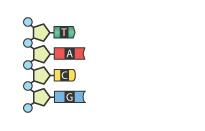
Which nitrogenous bases are needed to complete the DNA strand pictured below? Give your answer in order, from top to bottom.

Question 21
21.

When one DNA molecule is replicated, the result is two DNA molecules. What is true of the second DNA molecule?

Question 22
22.

What is the role of enzymes in the DNA replication process?