Log in
Sign up for FREE
arrow_back
Library

Meiosis Practice

star
star
star
star
star
Last updated about 5 years ago
24 questions
8
1
1
1
1
1
1
1
1
1
1
1
1
1
1
1
1
1
1
1
1
1
1
1

Meiosis Practice

Practice with the concepts and vocab that were presented in today's class by completing this formative. You will have an idea of how you did immediately (minus the few open ended questions). If you struggle as for help in zoom!
PART 1- Phase Identification
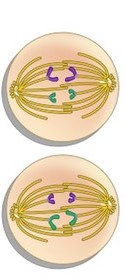
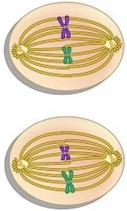
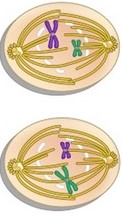
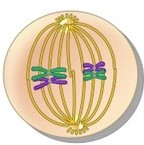
Use your notes, the class slides, or your book to help you identify the phases. Match the image of each phase on the left to the correct phase name on the right.
Question 1
1.

Match the number of each phase in the diagram above to the phase of meiosis that is shown.

Draggable itemarrow_right_altCorresponding Item
arrow_right_alt
Prophase I
arrow_right_alt
Anaphase II
arrow_right_alt
Metaphase I
arrow_right_alt
Metapase II
arrow_right_alt
Telophase/cytokinesis II
arrow_right_alt
Anaphase I
arrow_right_alt
Interphase
arrow_right_alt
Prophase II
PART 2- Multiple Choice/Vocab Practice
Use your notes, the class slides, or your book to help you identify the phases. Match the image of each phase on the left to the correct phase name on the right.
Question 2
2.

Gametes are produced by the process of

Question 3
3.

Gametes have

Question 4
4.

What is shown in the image above? Hint it GREATLY increases the genetic variety of the gametes!

Question 5
5.

Chromosomes form tetrads AKA homologous pairs during which phase?

Question 6
6.

At the end of meiosis, there are

Question 7
7.

How many chromosomes are in a human gamete?

Question 8
8.

If a eukaryotic cell has 20 chromosomes and it undergoes meiosis, how many cells will result, and how many chromosomes will they contain?

Question 9
9.

Cells that are ________ possess a single set of chromosomes

Question 10
10.

You have homologous pairs of chromosomes in each of your cells. In what way are these pairs of chromosomes similar?

Question 11
11.

From the list below, which choice represents a correct difference between sperm production and egg production?

Question 12
12.

At the end of meiosis II, the daughter cells created are ____.

Question 13
13.

Though the stages of meiosis have the same names as the stages of mitosis, they exhibit fundamental differences. What are the main differences between the two processes?

Question 14
14.

Meiosis occurs to produce which type of cell or cells. Select ALL that are true!

PART 3- Fill in the Blank with a Word Bank
Use your notes, the class slides, or your book to help you fill in the blank with the term or number that correctly completes the statement.
Completion
Complete each statement with a word from the word bank below. BE SURE TO SPECIFIY IF THE STAGE IS OCCURING IN MEIOSIS I or MEIOSIS II!!!

half double Prophase I Prophase II Metaphase I Metaphase II Anaphase I Anaphase II gametes somatic cells
2 4 19 20 38 40
Question 15
15.

An organism has 38 chromosomes in a body cell. After mitosis each cell has 38 chromosomes. After meiosis each gamete has ____________________ chromosomes.

Question 16
16.

An organism’s gametes have ____________________ the number of chromosomes found in the organism’s body cells.

Question 17
17.

Sister chromatids inside both cells get separated during this phase

Question 18
18.

Tetrads, or homologous pairs, line up along the equator during this phase

Question 19
19.

At the end of meiosis I, ________ daughter cells are created.

PART 4- Karyotype Practice
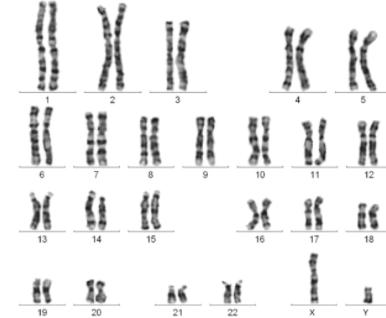
Use what you know to answer the questions about each karyotype.
Question 20
20.

What can you tell about the person that this karyotype is from? Choose ALL that apply.

Question 21
21.

What can you tell about the person that this karyotype is from? Choose ALL that apply.

PART 5- Short Answer
Answer the questions below completely to the best of you ability.
Question 22
22.

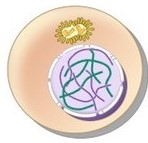
Why does meiosis have two cell divisions? (HINT: Think of chromosome number) Why is this important for reproduction?

Question 23
23.

Explain why the daughter cells produced by meiosis are genetically different from each other, whereas the daughter cells produced by mitosis are not.

Question 24
24.

When in life does meiosis occur in girls? In boys?