Select the rule that describes the translation of triangle ABC to triangle A'B'C'.
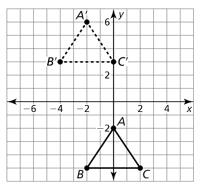
Select the rule that describes the translation of triangle ABC to triangle A'B'C'.
Select the rule that describes the translation of triangle ABC to triangle A'B'C'.
Identify the coordinates of segment AB after it is rotated 90 degrees counterclockwise if A(-2, 4) and B(1, 2).
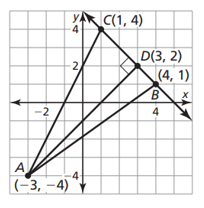
Find the shorest distance from point A to line BC estimated to the nearest tenth.
In the standard (x, y) coordinate plane, the coordinates of D are (d, k). What would the coordinates be if D were rotated 180 degrees about the origin?
If lines are parallel, then same-side interior (consecutive) angles are:
Which graph shows the reflection of the triangle across the x-axis?
Which transformation is a flipped mirror image of the original?
How many lines of symmetry does the shape to the right have?

Choose which best describes the translation of P(-2, 6) to P'(4, 9).
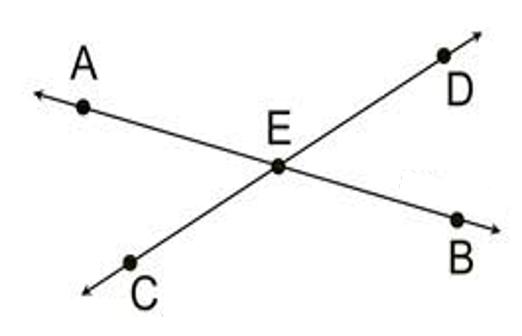
Name a pair of vertical angles from the diagram.
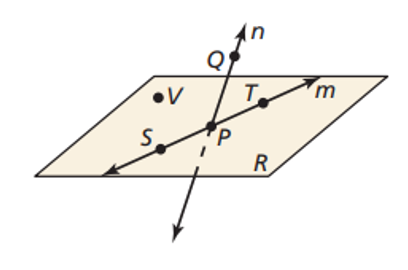
What is another name for line m ?
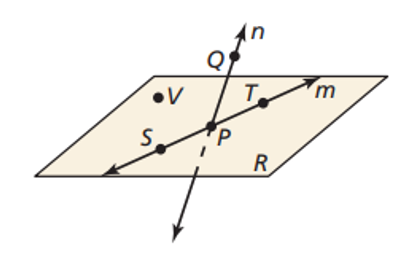
What is another name for plane R ?
Name a pair of opposite rays.
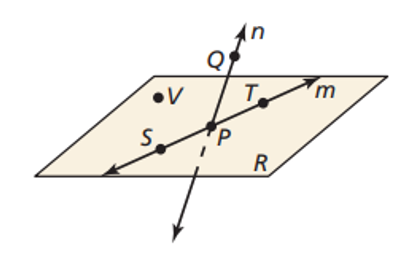
Name a point that is coplanar with plane R.
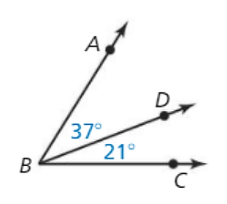
Determine the measure of angle ABC.
Choose the equation of the line that is perpendicular to
Name the angle relationship between the given angle of 140 degrees and angle 1.
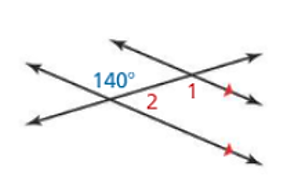
What statement is true about angle 1?
Name the angle relationship between the given angle of angle 1 and angle 2.
What is the measure of angle 2?
Use the translation rule to find the image of quadrilateral ABCD.
Reflect quadrilateral ABCD across the line x = -1.
Graph the composition of transformations from the given triangle ABC with A(-4, -1), B(4, -4), C(1, -4).
1. Rotation 180 degrees about the origin:
2. Reflection over the y-axis.
Determine if the rhombus has line symmetry, rotational symmetry, or both.
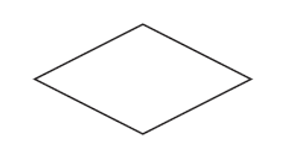
How many lines of symmetry does the rhombus have? If there are none, then type none.
List any angle measure(s) that produce rotational symmetry. If there are none, then type none.
Write an expression for the length of segment AC.
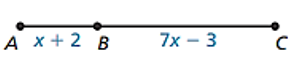
If AC = 63 cm, then what is the value of x?
Determine the length of BC.
Prove: If angle 1 is congruent to angle 2 and angle 3 is congruent to angle 4, then segment AB is parallel to segment CD.
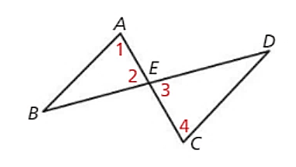
| Draggable item | arrow_right_alt | Corresponding Item |
|---|---|---|
∠2≅∠3 | arrow_right_alt | Given Fact |
segment AB is parallel to segment CD | arrow_right_alt | Vertical Angles are Congruent |
∠1≅∠2 | arrow_right_alt | Given Fact |
∠3≅∠4 | arrow_right_alt | Transitive Property |
∠1≅∠4 | arrow_right_alt | Alternate Interior Angles are Congruent |