8.1 Worksheet
star
star
star
star
star
Last updated over 3 years ago
63 questions
1
A quadrilateral with two pairs of parallel sides is a ______________________
1
The opposite sides of a parallelogram are ______________________
1
The opposite angles of a parallelogram are ______________________
1
The consecutive angles of a parallelogram are ______________________
1
The diagonals of a parallelogram _______________ each other.
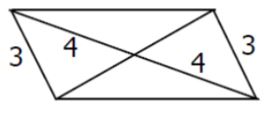
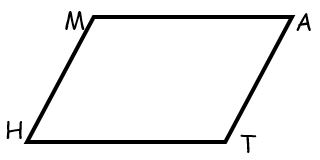
Use the parallelogram MATH for questions 6-9.
1
Which of the following angle pairs are congruent? Check all that apply.
1
Which of the following angle pairs are supplementary? Check all that apply.
1
Which of the following sides are congruent? Check all that apply.
1
Which of the following sides are parallel? Check all that apply.
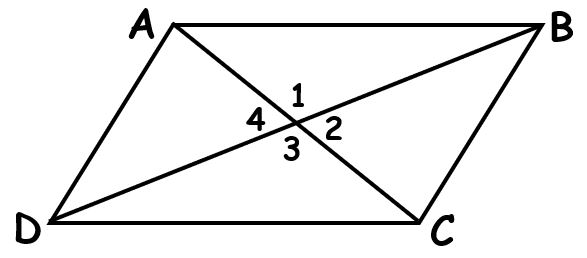
For #10-21, determine whether each statement is true or false about parallelogram ABCD below.
1
\overline{AB}\cong\overline{DC}
1
\angle{ADC}\cong\angle{DCB}
1
\overline{DB}\cong\overline{AC}
1
\angle{DCB}\cong\angle{DAB}
1
\overline{AD}\parallel\overline{BC}
1
m\angle{ADC} + m\angle{DCB} = 180o
1
\overline{DC}\cong\overline{BC}
1
\angle{DAB} + m\angle{DCB} = 180o
1
\angle{1}\cong\angle{2}
1
m\angle{1} + m\angle{2} = 180o
1
\angle{1}\cong\angle{3}
1
m\angle{1} + m\angle{4} = 180o
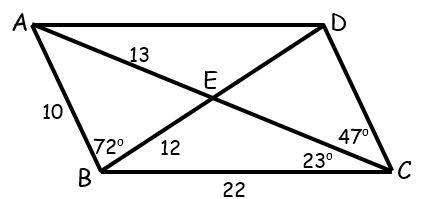
Use parallelogram ABCD below for questions 22-40.
1
What is the length of CD?
1
What is the length of DA?
1
What is the length of AC?
1
What is the length of DB?
1
What is the length of CE?
1
What is the length of DE?
1
What is m\angle{ABC}?
1
What is m\angle{BCE}?
1
What is m\angle{BCD}?
1
What is m\angle{ADC}?
1
What is m\angle{BAD}?
1
What is m\angle{CDE}?
1
What is m\angle{EDA}?
1
What is m\angle{DAE}?
1
What is m\angle{EAB}?
1
What is m\angle{AEB}?
1
What is m\angle{BEC}?
1
What is m\angle{CED}?
1
What is m\angle{DEA}?
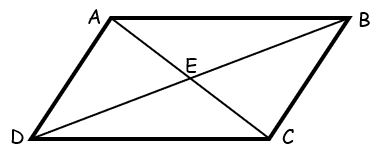
Use parallelogram ABCD below for questions 41-49.
1
If AB = 12 and AE = 6, then DC = ______, and EC = _______. Write your answer as #, #
1
If AE = 9 and AD = 3, then AC = ______, and BC = _______. Write your answer as #, #
1
If BD = 14 and AB = 10, then BE = ______, and DC = _______. Write your answer as #, #
1
If m\angle{ADC} = 42o, then m\angle{ABC} = ______, and m\angle{DAB} = _______. Write your answer as #, #
1
If AB = 2x + 1 and DC = 4x - 19, then find the value of x.
1
If BE = 6x + 1 and DE = 4x + 31, then find the value of x.
1
If AE = x + 1 and AC = 5x - 10, then find the value of x.
1
If AD = 7x - 9 and BC = 4x + 33, then find the value of x.
1
If AB = x + 3, BC = x - 4, and the perimter of ABCD is 6x - 20, then find the value of x.
1
Opposite sides are parallel.
1
Two pairs of consecutive sides are congruent.
1
Diagonals are congruent.
1
All four sides are congruent.
1
Opposite sides are congruent.
1
Two pairs of consecutive angles are congruent.
1
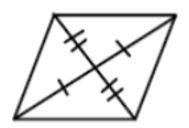
Diagonals bisect each other.
1
Consecutive angles are supplementary.
1
1
1
1
1
1