Log in
Sign up for FREE
arrow_back
Library
APUSH SAT Practice Passage 3
By Haiyen Truong
star
star
star
star
star
Share
share
Last updated over 1 year ago
11 questions
Add this activity
zoom_in
zoom_in
1
title
2
3
4
5
6
zoom_in
1
RPU.01
1
IIUR.01
1
IITE.01
1
RTS.02
1
IIWD.01
1
IIRC.02
7
8
9
10
11
zoom_in
1
IITE.01
1
IIWD.01
1
SQN.01
1
SQN.01
1
SQN.01
Unlike previous practice SAT passages, the answer choices are randomized on this Formative, so be careful when selecting your answer choices!
Graded Questions: #1, 2, 3, 5, 8,
Extra Credit: #6, 7, 9
Question 1
1.
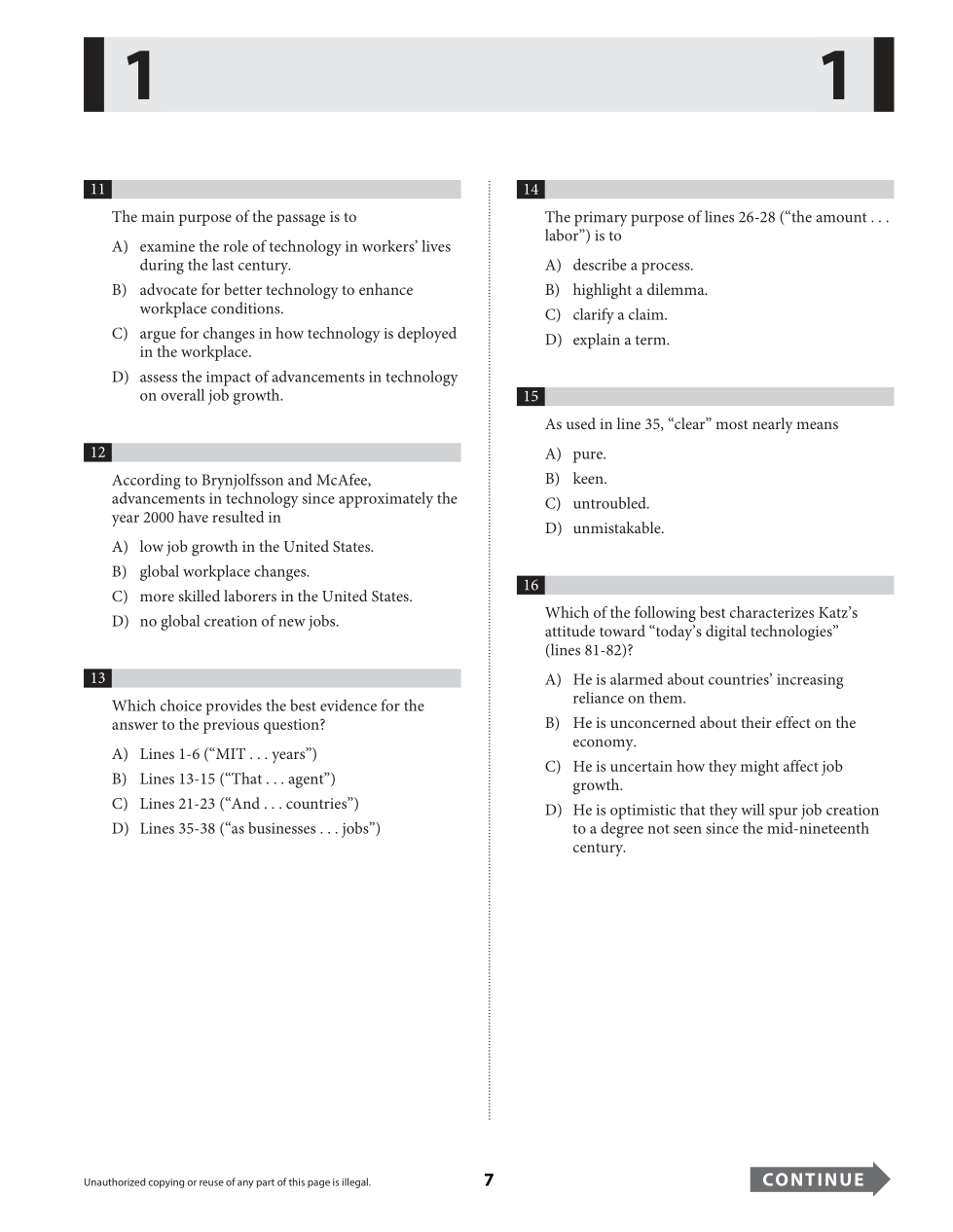
The main purpose of the passage is to
argue for changes in how technology is deployed in the workplace.
assess the impact of advancements in technology on overall job growth.
advocate for better technology to enhance workplace conditions.
examine the role of technology in workers’ lives during the last century.
Question 2
2.
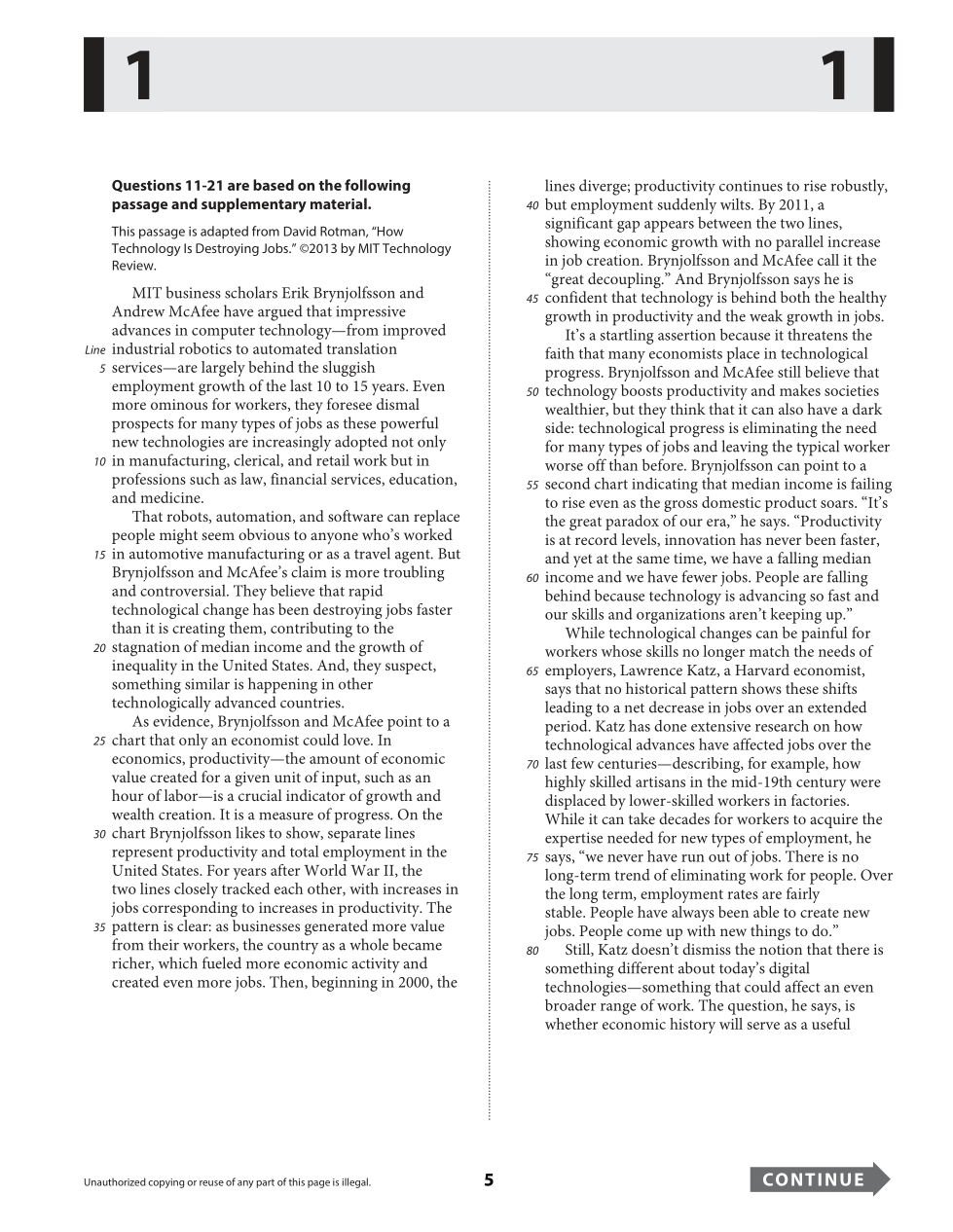
According to Brynjolfsson and McAfee, advancements in technology since approximately the year 2000 have resulted in
global workplace changes.
low job growth in the United States.
no global creation of new jobs.
more skilled laborers in the United States.
Question 3
3.
Which choice provides the best evidence for the answer to the previous question?
Lines 1-6 (“MIT . . . years”)
Lines 13-15 (“That . . . agent”)
Lines 21-23 (“And . . . countries”)
Lines 35-38 (“as businesses . . . jobs”)
Question 4
4.
The primary purpose of lines 26-28 (“the amount . . . labor”) is to
highlight a dilemma.
explain a term.
describe a process.
clarify a claim.
Question 5
5.
As used in line 35, “clear” most nearly means
unmistakable.
pure.
keen.
untroubled.
Question 6
6.
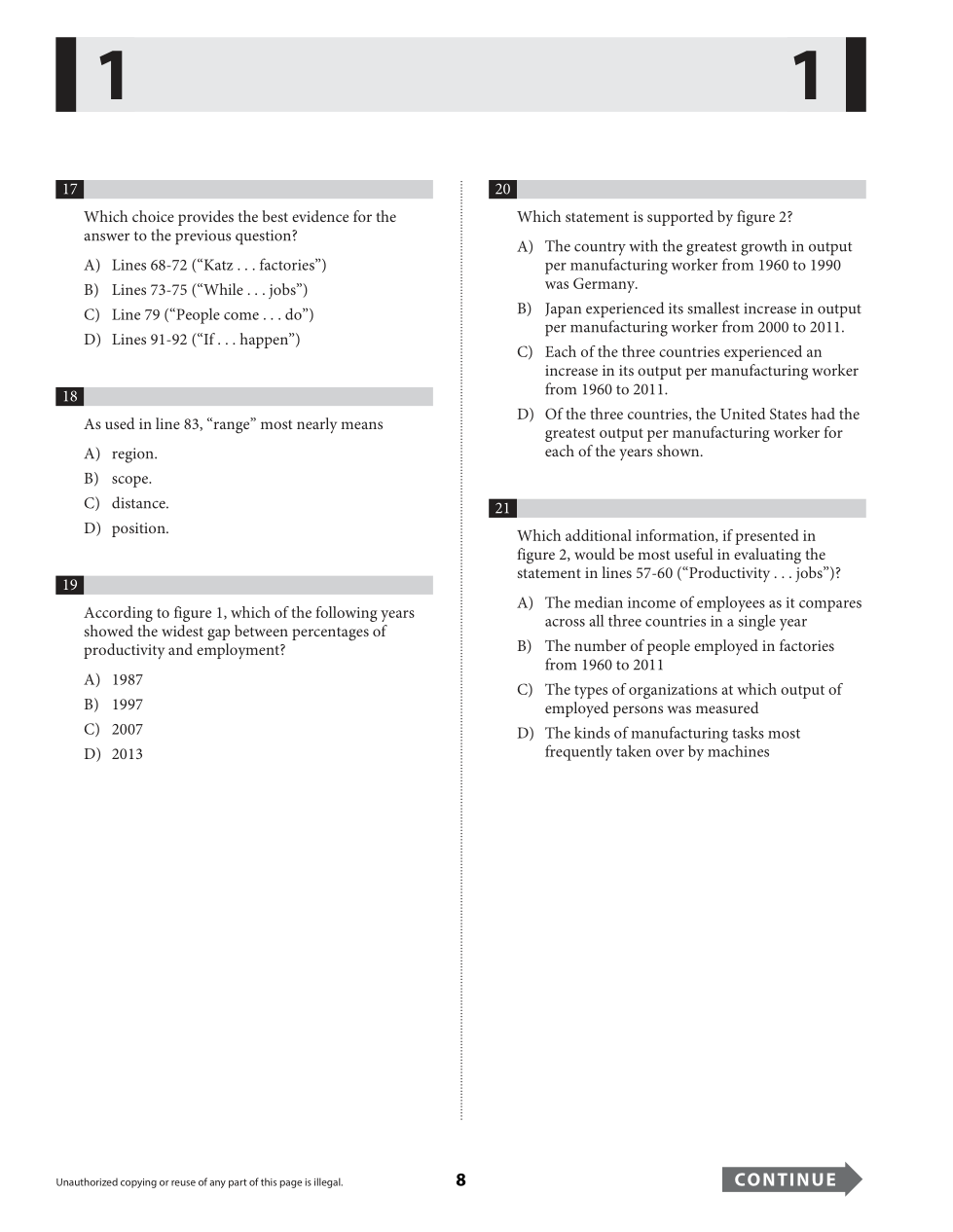
Which of the following best characterizes Katz’s attitude toward “today’s digital technologies” (lines 81-82)?
He is optimistic that they will spur job creation to a degree not seen since the mid-nineteenth century.
He is unconcerned about their effect on the economy.
He is uncertain how they might affect job growth.
He is alarmed about countries’ increasing reliance on them.
Question 7
7.
Which choice provides the best evidence for the answer to the previous question?
Lines 68-72 (“Katz . . . factories”)
Lines 73-75 (“While . . . jobs”)
Line 79 (“People come . . . do”)
Lines 91-92 (“If . . . happen”)
Question 8
8.
As used in line 83, “range” most nearly means
position.
scope.
distance.
region.
Question 9
9.
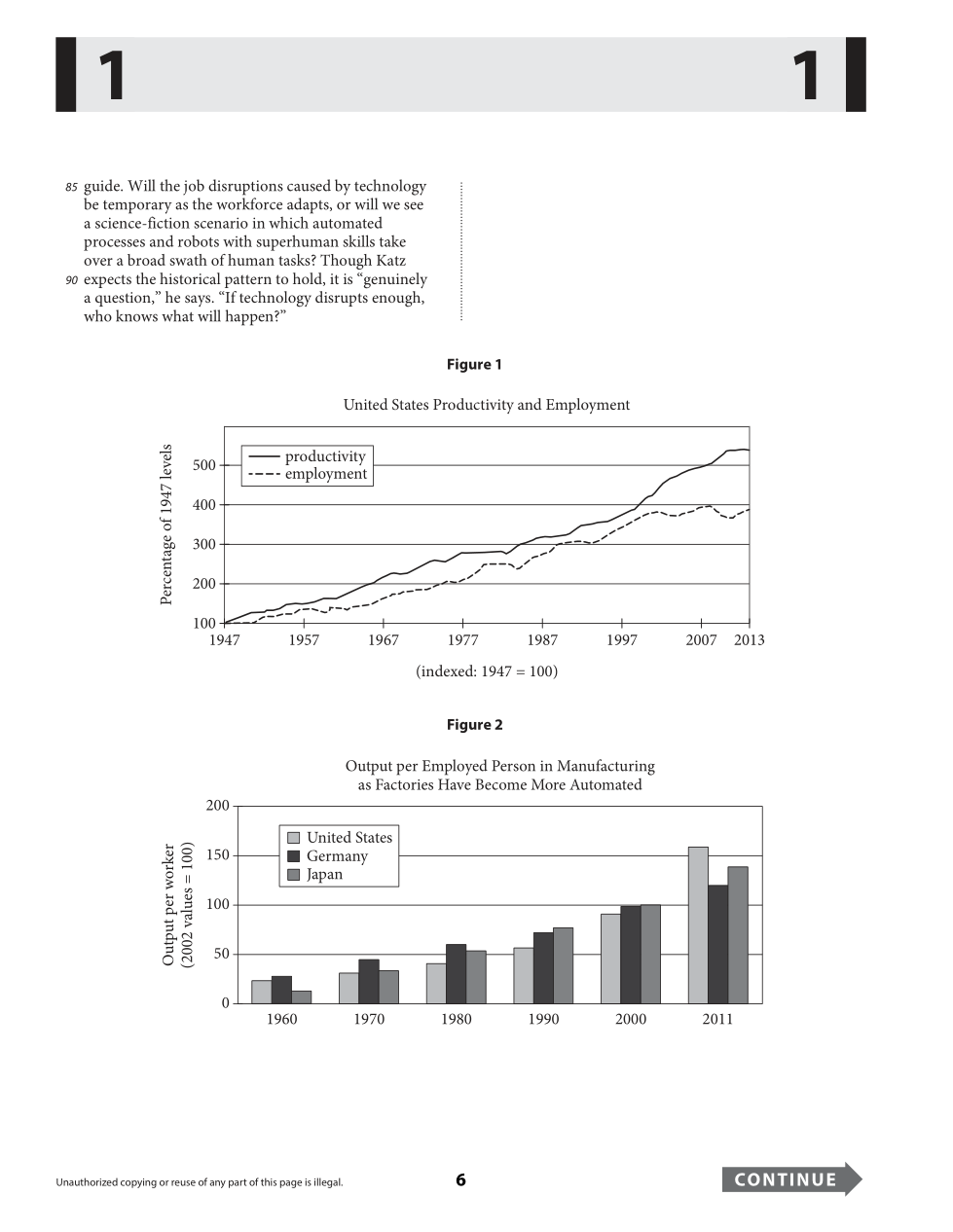
According to figure 1, which of the following years showed the widest gap between percentages of productivity and employment?
1987
1997
2007
2013
Question 10
10.
Which statement is supported by figure 2?
Of the three countries, the United States had the greatest output per manufacturing worker for each of the years shown.
The country with the greatest growth in output per manufacturing worker from 1960 to 1990 was Germany.
Each of the three countries experienced an increase in its output per manufacturing worker from 1960 to 2011.
Japan experienced its smallest increase in output per manufacturing worker from 2000 to 2011.
Question 11
11.
Which additional information, if presented in figure 2, would be most useful in evaluating the statement in lines 57-60 (“Productivity . . . jobs”)?
The kinds of manufacturing tasks most frequently taken over by machines
The number of people employed in factories from 1960 to 2011
The median income of employees as it compares across all three countries in a single year
The types of organizations at which output of employed persons was measured