✨ #15 Writing Activity

Last updated over 4 years ago
7 questions
Should America Have Invested its Resources in Space Travel?

Directions:
1. Re-read “An Account of the Moon Landing” and then read a new text titled “An Argument Against the Moon Mission.”
2. Answer the questions below
Audio for "An Account of the Moon Landing"


An Account of the Moon Landing

(written by EL Education)
July 20, 1969.

1 After years of preparing for it, and centuries of dreaming about it, human beings made it to the moon today.
2 At just before 11 p.m. EST this evening, Commander of the Apollo 11 mission, Neil Armstrong, became the 3 first human to step onto the lunar surface.
4 “That’s one small step for man,” he stated, his crackling voice broadcast in radios across Earth, “one giant 5 leap for mankind.”
6 Astronaut Buzz Aldrin soon joined him, adding his own voice to the excited chorus: “Beautiful, beautiful,
7 beautiful, a magnificent desolation.”

desolation: complete emptimess or destruction (noun)

8 Armstrong and Aldrin spent a little over two hours together on the surface of the moon, leaving long-lasting
9 footprints both on the lunar surface and in the hearts of the humans on Earth who stared breathlessly at
10 their television screens, awaiting NASA’s updates.

lunar: resembling the moon (adjective)

11 Meanwhile, the third Apollo 11 astronaut, Michael Collins, orbited the moon in the Command Module,
12 awaiting good news from Armstrong and Aldrin. Had they made it? Would they return?

orbited: moved around in a circle (past tense verb)

13 Two hours on the moon was plenty of time for Armstrong and Aldrin to collect more lunar data than Earth’s
14 scientists have ever had. They took photos that may resolve many mysteries of the moon’s geology. They 15 collected an astounding fifty pounds of moon rocks and soil, which scientists can use to track the history of 16 the solar scientists. They began experiments whose results will one day reveal whether the moon’s core is 17 more like Earth’s or more like a meteorite’s.

astounding: surprisingly impressive or notable (adjective)

18 When the astronauts planted the stem of the American flag into the moon’s soil, it was in celebration of the 19 nation’s innovation and commitment to knowledge.

innovation: a new method, product or idea (noun)

20 Upon their return to the lunar module, Armstrong and Aldrin received a call from 240,000 miles away:
21 President Nixon wished to congratulate them on their successes.

22 But the journey is not yet over. After spending the night in the lunar module on the moon’s surface, the
23 astronauts must reconnect tomorrow with Collins and the Command Module and begin their descent.
24 Assuming all goes according to plan, the Apollo 11 team will reach the Earth’s surface next Thursday
25 afternoon. Despite their preparation, the astronauts know that a successful return is no guarantee. In outer 26 space, there are no guarantees.

descent: movement downward (noun)

27 July 20, 1969. A profound day in the history of humanity. Ancient astronomers, mathematicians, artists,
28 poets have long turned their heads to the sky, searching for answers that seemed lightyears beyond reach. 29 Today, with the work and courage of the Apollo 11 astronauts, those answers are, for the first time,
30 underfoot."

profound: very great or intense (adjective)
underfoot: present and in the way (adjective)
Audio for NEW article "Argument AGAINST the Moon Mission"

An Argument AGAINST the Moon Mission

(written by EL Education)
1 On July 20, 1969, Neil Armstrong and Buzz Aldrin took humankind’s first steps on the moon. Across the
2 world, people huddled around radios and TVs, listening to fuzzy recordings of the lunar broadcast. The
3 United States had done it! It seemed like celebration was in order. After all, the Apollo 11 mission had ended 4 the Space Race. The United States had been elevated as the world’s leader in space exploration. A new
5 frontier had been uncovered, and science had prevailed.

elevated: made higher than others (past perfect tense verb)
frontier: a limit or border (noun)
prevailed: won (past tense verb)

6 Meanwhile, almost a quarter of a million miles away and back on Earth, black men and women were fighting 7 for their lives in the American Civil Rights movement. Peaceful protests for human rights were being met with 8 fire hoses, dogs, and police batons. Poverty, hunger, and lack of opportunity were hurting black
9 communities. Neil Armstrong famously declared the moon landing as a “giant leap for mankind,” but at the 10 moment it happened, mankind was suffering on Earth. The Apollo 11 mission was not a victory for
11 humankind; instead, it was an expensive and painful reminder of the limits of humans’ empathy and
12 imagination.

13 The moon landing required an incredible investment of money and manpower. Overall, the Apollo program 14 cost about $25 billion. That amount today would be more like $175 billion! The Apollo program also required 15 the ideas and hard work of some of the most brilliant minds on Earth—400,000 minds, to be exact. Nearly
16 half a million engineers, scientists, and technicians contributed their time to the program. That money and 17 thinking could have instead gone toward solving social problems. Imagine if 400,000 brilliant minds—
18 teachers, activists, and lawmakers—had collaborated to address issues of inequality. That would have come 19 with a cheaper price tag, too. The United Nations, for example, estimated in 2008 that it would cost $30
20 billion in today’s money to solve world hunger. That’s a fraction of what it cost to go to the moon! By
21 investing so much in the moon, and so little in the Earth, the United States sent a clear message that people 22 matter less than competition.

investment: a thing that is worth buying because it may be profitable or useful in the future (noun)
collaborated: worked with others on something (past tense verb)

23 That message suggests a profound lack of empathy. When John F. Kennedy delivered a speech in 1961,
24 urging the United States to support his plan to send humans to the moon, national attention moved away
25 from issues on the ground. Also in 1961, black people still did not have the right to vote in America. Schools 26 in the south still separated their black and white students. The Civil Rights Act, which made discrimination
27 based on gender or race illegal, was still three years away. There were problems that required immediate
28 attention and resources. Essentially, the United States chose intergalactic success over basic care for its
29 people.

intergalactic: between two galaxies (adjective)

30 Although a trip to the moon might be seen as a symbol of humans’ imagination and pioneering spirit, the
31 Apollo 11 mission is actually evidence of the opposite. As Civil Rights leader Ralph Abernathy put it, there was 32 “more distance between the races of man than between the moon and the earth.” Instead of supporting
33 America’s twinkly-eyed obsession with space travel, Abernathy asked, “Why is it less exciting to the human
34 spirit to enlarge man by making him brother to his fellow man?” If America wanted an exciting challenge,
35 solving inequality would have been a challenge enough. The Civil Rights movement was complicated. Its
36 success required a combination of legal, social, and philosophical considerations. Solving inequality and
37 eliminating discrimination would have been, in many ways, a more ambitious aim than space travel. A true 38 pioneer would have seen the fight for equality, with all its complexity and impact, as the true goal.

pioneering: involving new ideas or methods (adjective)
enlarge: make bigger or more extensive (verb)
ambitious: having a strong desire and determination to succeed (adjective)

39 The most famous images of the 1969 moonwalk depict two astronauts in puffy space suits. They are
40 surrounded by their own lined footprints: the first footprints the moon had ever seen. An American flag
41 planted in the moon’s soil stands tall and proud. But pride is not what Americans should feel toward the
42 moon landing. We only deserve the glory of the moon if we first take care of the people on Earth.

depict: to show (verb)
1

The first passage makes the arguments that "the moon is beautiful and should be explored," and that "there is so much to learn from the moon through data that was collected there." Are these arguments for or against America's decision to go to the moon? Why?

Sentence starter:

These arguments are for / against America's decision to go to the moon because...

1

The second passage makes the arguments that "by spending more money on space travel, it sent a clear message that people mattered less than competition," and that "black men and women were fighting for their lives in the American Civil Rights Movement." Are these arguments for or against America's decision to go to the moon? Why?

Sentence starter:

These arguments are for / against America's decision to go to the moon because...

1

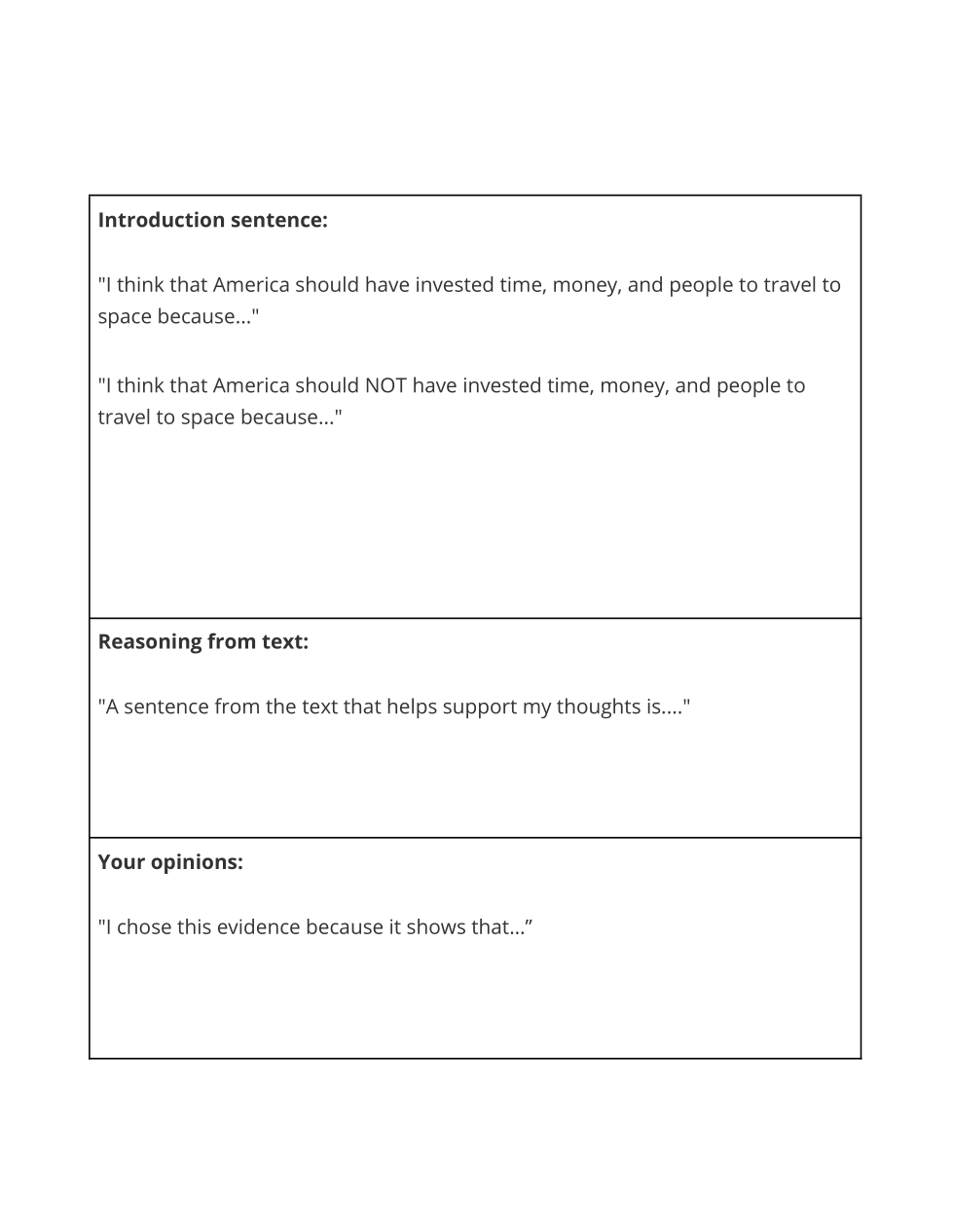
Your introduction sentence:

"I think that America should have invested time, money, and people to travel to space because..."

"I think that America should NOT have invested time, money, and people to travel to space because..."

1

Reasoning from the text:

"A sentence from the text that helps support my thoughts is...."

1

Why you chose this evidence:

"I chose this evidence because..."

15

Do you think America should have invested its resources (time, money, people) in space travel?

Write an argumentative paragraph that states your opinion, gives reasons, and supports those reasons with evidence from at least one of the texts.

Requirements:
- At LEAST 4 sentences
- Give your OPINION
  • "I think that America should have invested time, money, and people to travel to space because..."
  • "I think that America should NOT have invested time, money, and people to travel to space because..."
- Give EVIDENCE from ONE of the texts
  • "A sentence from the text that helps support my thoughts is...."
- Give REASONS why the evidence supports your opinion
  • "I chose this evidence because..."

6

The first passage makes the argument that "the moon is beautiful and should be explored." Is this argument for or against America's decision to go to the moon? Why?

What arguments do they give for and against America’s choice to go to the moon?

Sort them into "for" and "against" going to the moon categories.

Draggable itemCorresponding Item
there is so much to learn from the moon through data that was collected there
This is a reason we SHOULD go to the moon (For!)
by spending more money on space travel, it sent a clear message that people mattered less than competition
This is a reason we SHOULD NOT go to the moon (Against!)
black men and women were fighting for their lives in the American Civil Rights Movement
This is a reason we SHOULD NOT go to the moon (Against!)
the moon is beautiful and should be explored
This is a reason we SHOULD go to the moon (For!)
Audio for NEW article "Argument AGAINST the Moon Mission"

desolation: complete emptimess or destruction (noun)
lunar: resembling the moon (adjective)
orbited: moved around in a circle (past tense verb)
astounding: surprisingly impressive or notable (adjective)
innovation: a new method, product or idea (noun)
descent: movement downward (noun)
profound: very great or intense (adjective)
underfoot: present and in the way (adjective)

An Argument AGAINST the Moon Mission

(written by EL Education)
1 On July 20, 1969, Neil Armstrong and Buzz Aldrin took humankind’s first steps on the moon. Across the
2 world, people huddled around radios and TVs, listening to fuzzy recordings of the lunar broadcast. The
3 United States had done it! It seemed like celebration was in order. After all, the Apollo 11 mission had ended 4 the Space Race. The United States had been elevated as the world’s leader in space exploration. A new
5 frontier had been uncovered, and science had prevailed.

6 Meanwhile, almost a quarter of a million miles away and back on Earth, black men and women were fighting 7 for their lives in the American Civil Rights movement. Peaceful protests for human rights were being met with 8 fire hoses, dogs, and police batons. Poverty, hunger, and lack of opportunity were hurting black
9 communities. Neil Armstrong famously declared the moon landing as a “giant leap for mankind,” but at the 10 moment it happened, mankind was suffering on Earth. The Apollo 11 mission was not a victory for
11 humankind; instead, it was an expensive and painful reminder of the limits of humans’ empathy and
12 imagination.

13 The moon landing required an incredible investment of money and manpower. Overall, the Apollo program 14 cost about $25 billion. That amount today would be more like $175 billion! The Apollo program also required 15 the ideas and hard work of some of the most brilliant minds on Earth—400,000 minds, to be exact. Nearly
16 half a million engineers, scientists, and technicians contributed their time to the program. That money and 17 thinking could have instead gone toward solving social problems. Imagine if 400,000 brilliant minds—
18 teachers, activists, and lawmakers—had collaborated to address issues of inequality. That would have come 19 with a cheaper price tag, too. The United Nations, for example, estimated in 2008 that it would cost $30
20 billion in today’s money to solve world hunger. That’s a fraction of what it cost to go to the moon! By
21 investing so much in the moon, and so little in the Earth, the United States sent a clear message that people 22 matter less than competition.

23 That message suggests a profound lack of empathy. When John F. Kennedy delivered a speech in 1961,
24 urging the United States to support his plan to send humans to the moon, national attention moved away
25 from issues on the ground. Also in 1961, black people still did not have the right to vote in America. Schools 26 in the south still separated their black and white students. The Civil Rights Act, which made discrimination
27 based on gender or race illegal, was still three years away. There were problems that required immediate
28 attention and resources. Essentially, the United States chose intergalactic success over basic care for its
29 people.

30 Although a trip to the moon might be seen as a symbol of humans’ imagination and pioneering spirit, the
31 Apollo 11 mission is actually evidence of the opposite. As Civil Rights leader Ralph Abernathy put it, there was 32 “more distance between the races of man than between the moon and the earth.” Instead of supporting
33 America’s twinkly-eyed obsession with space travel, Abernathy asked, “Why is it less exciting to the human
34 spirit to enlarge man by making him brother to his fellow man?” If America wanted an exciting challenge,
35 solving inequality would have been a challenge enough. The Civil Rights movement was complicated. Its
36 success required a combination of legal, social, and philosophical considerations. Solving inequality and
37 eliminating discrimination would have been, in many ways, a more ambitious aim than space travel. A true 38 pioneer would have seen the fight for equality, with all its complexity and impact, as the true goal.

39 The most famous images of the 1969 moonwalk depict two astronauts in puffy space suits. They are
40 surrounded by their own lined footprints: the first footprints the moon had ever seen. An American flag
41 planted in the moon’s soil stands tall and proud. But pride is not what Americans should feel toward the
42 moon landing. We only deserve the glory of the moon if we first take care of the people on Earth.

elevated: made higher than others (past perfect tense verb)
frontier: a limit or border (noun)
prevailed: won (past tense verb)
investment: a thing that is worth buying because it may be profitable or useful in the future (noun)
collaborated: worked with others on something (past tense verb)
intergalactic: between two galaxies (adjective)
pioneering: involving new ideas or methods (adjective)
enlarge: make bigger or more extensive (verb)
ambitious: having a strong desire and determination to succeed (adjective)
depict: to show (verb)