
This is the free-body diagram for
This is the free-body diagram for
Conceptual Physics level
The Newton is a unit of
A box of textbooks is pulled to the right by a force of 10 Newtons and to the left by a force of 5 Newtons. The net force is
A kilogram is a measure of an object's
What must happen to the net force acting on a 10 kilogram object in order to double the acceleration?
If the net force acting on an object is zero, the acceleration is
A 10 Newton falling object is encountering a 4 Newton force of air resistance. The net force acting on the object is
A 10 Newton falling object is encountering a 4 Newton force of air resistance. The acceleration of the object is
A 10 Newton falling object is encountering a 4 Newton force of air resistance. The mass of the object is
The weight of an object is measured in
The magnitude of the weight of a 3 kilogram mass on the surface of the earth is
The acceleration of gravity on the moon is only 1.7 m/s2. How much would a 10 kilogram mass weigh on the moon?
What is the weight of an object on the moon if it has a weight of 200 Newtons on earth. The acceleration due to gravity on the moon is 1.7 m/s2.
According to Newton's second law, Force and acceleration are
According to Newton's second law, mass and acceleration are
This is the free-body diagram for
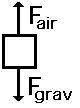
This is the free-body diagram for
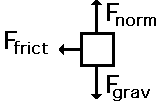
This is the free-body diagram for
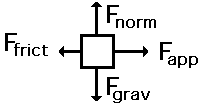
This is the free-body diagram for
A 50 kilogram box is being pushed to the right by an applied force of 200 Newtons. The friction acting on this box is at a maximum of 150 Newtons. What is the weight of this box?
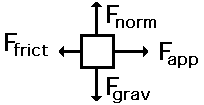
A 50 kilogram box is being pushed to the right by an applied force of 200 Newtons. The friction acting on this box is at a maximum of 150 Newtons. What is the normal force exerted on this box by the floor?
A 50 kilogram box is being pushed to the right by an applied force of 200 Newtons. The friction acting on this box is at a maximum of 150 Newtons. What is the net force acting on this box?
A 50 kilogram box is being pushed to the right by an applied force of 200 Newtons. The friction acting on this box is at a maximum of 150 Newtons. What is the acceleration of this box?
A 50 kilogram box is being pushed to the right by an applied force of 100 Newtons. The friction acting on this box can be a maximum of 150 Newtons. What is the net force acting on this box?
Which of these forces is usually larger?
Friction is caused by:
1. The interlocking of the two rubbing surfaces together.
2. Electrostatic forces between the atoms of each material.
3. microfiber repulsion.