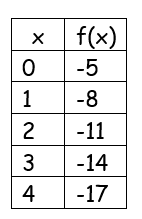
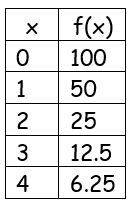
Describe what is happening to f(x) as x increases:
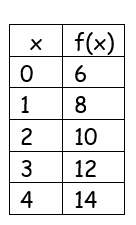
Describe what is happening to f(x) as x increases:
Describe what is happening to f(x) as x increases:
Write an equation for f(x)
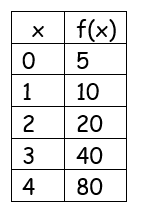
Describe what is happening to f(x) as x increases:
Write an equation for f(x)
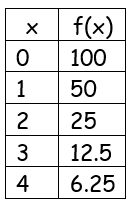
Describe what is happening to f(x) as x increases:
Write the equation of f(x), if possible
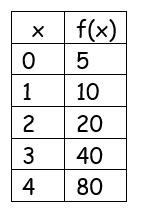
Describe what is happening to f(x) as x increases:
Write the equation of f(x), if possible.
You were likely unable to write the equation for the last two tables. They are exponential functions. In AA3-3, we will study graphing exponential functions in the form:
However, for now, we will write exponential functions centered at the origin so (h,k) is (0,0). As a result, we will write exponential functions in the form:
-- a is the starting value (f(0))
-- b is the rate of growth or decay (what we are multiplying by each time)
-- x is the number of times something occurs. It is often, but not always, an amount of time.
Because f(x) increases as x increases, this function is a model of exponential growth.
Write the exponential equation for this table:
Because f(x) decreases as x increases, this function is a model of exponential decay.
Write the exponential equation for this table:
Complete the table for f(x)=4(3)x by evaluating f(0), f(1), f(2), and f(3).
Don't forget (anything)0 = 1.
Depending on the calculator, you use the ^ button or ab or xy to create an exponent.
Is f(x) = 4(3)x a model for exponential growth or decay?
Complete the table for f(x)=4(0.75)x by evaluating f(0), f(1), f(2), and f(3).
Don't forget (anything)0 = 1.
Depending on the calculator, you use the ^ button or ab or xy to create an exponent.
Is f(x) = 4(0.75)x a model for exponential growth or decay?
Predict whether f(x) =
Complete the table for f(x)=
Don't forget (anything)0 = 1.
Depending on the calculator, you use the ^ button or ab or xy to create an exponent.
Is f(x) =
How do you know if an exponential function will model growth or decay?
Match each exponential function:
| Draggable item | arrow_right_alt | Corresponding Item |
|---|---|---|
neither | arrow_right_alt | f(x)=8(1.7)x |
neither | arrow_right_alt | f(x)=8(0.7)x |
growth | arrow_right_alt | f(x)=8( |
growth | arrow_right_alt | f(x)= |
decay | arrow_right_alt | f(x)=8(0)x |
growth | arrow_right_alt | f(x)=8(1)x |
decay | arrow_right_alt | f(x)=1(8)x |