01.20.21 HW - Protection of the CNS

Last updated almost 5 years ago
18 questions

Protection of the Central Nervous System


Objectives
  • distinguish between the dura mater, arachnoid mater, and pia mater
  • explain the role and importance of the blood brain barrier
  • determine the location and role of cerebrospinal fluid in the nervous system
  • investigate the effects that drugs can have on the nervous system

As you learned in the previous activity on the brain, the CNS is crucial to the operation of the body, and any compromise in the brain and spinal cord can lead to severe difficulties. The CNS has a privileged blood supply, as suggested by the blood-brain barrier, which you were introduced to in the activity on glial cells. The function of the tissue in the CNS is crucial to the survival of the organism, so the contents of the blood cannot simply pass into the central nervous tissue. To protect this region from the toxins and pathogens that may be traveling through the blood stream, there is strict control over what can move out of the general systems and into the brain and spinal cord. Because of this privilege, the CNS needs specialized structures, such as the meninges, for circulation. This begins with a unique arrangement of blood vessels carrying fresh blood into the CNS. Beyond the supply of blood, the CNS filters that blood into cerebrospinal fluid (CSF), which is then circulated through the cavities of the brain and spinal cord called ventricles.
Part 1: The Blood Brain Barrier

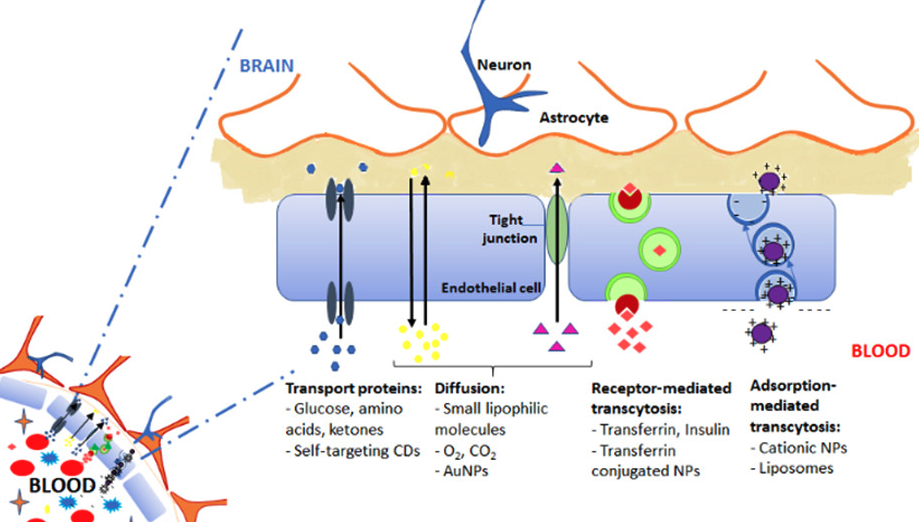
The Central Nervous system, made up of the brain and the spinal cord, is protected in part by the Blood Brain Barrier (the BBB).


As you watch the video, answer questions
1

What is the BBB?

1

Which of the following best describes the BBB and what it does?

1

Match the part of the BBB with its description.

Draggable itemCorresponding Item
Cells that line the blood vessels
endothelial cells
Proteins that fill the spaces between endothelial cells
tight junctions
A part of a glial cell that forms a "bridge" between the bloodstream and neurons
astrocytic end feet
1

Which of the following substances are allowed to move through the BBB?

1

The diagram below is another depiction of the blood brain barrier


Use the diagram to determine which of the following statements are true:

1

A student writes the following statement:

"The presence of the blood brain barrier is detrimental to humans because it does not allow for the passage of helpful medicines."

Do you agree or disagree with the student? Justify your answer with evidence from the video!

Part 2: The Meninges

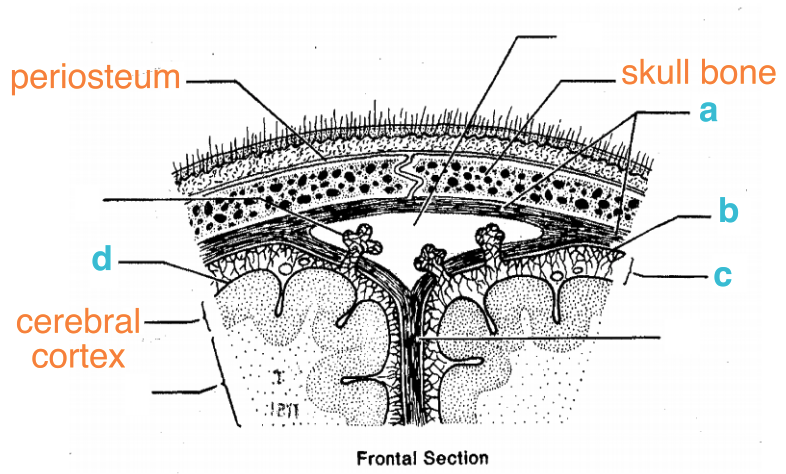
The outer surface of the CNS is covered by a series of membranes composed of connective tissue called the meninges, which protect the brain. The dura mater is a thick fibrous layer and a strong protective sheath over the entire brain and spinal cord. It is anchored to the inner surface of the cranium and vertebral cavity. The arachnoid mater is a membrane of thin fibrous tissue that forms a loose sac around the CNS. Beneath the arachnoid is a thin, filamentous mesh called the arachnoid trabeculae, which looks like a spider web, giving this layer its name. Directly adjacent to the surface of the CNS is the pia mater, a thin fibrous membrane that follows the convolutions of gyri and sulci (the "bumps and grooves") in the cerebral cortex.

Like a thick cap covering the brain, the dura mater is a tough outer covering. The name comes from the Latin for “tough mother” to represent its physically protective role. It encloses the entire CNS and the major blood vessels that enter the cranium and vertebral cavity. It is directly attached to the inner surface of the bones of the cranium and to the very end of the vertebral cavity.There are infoldings of the dura that fit into large crevasses of the brain.

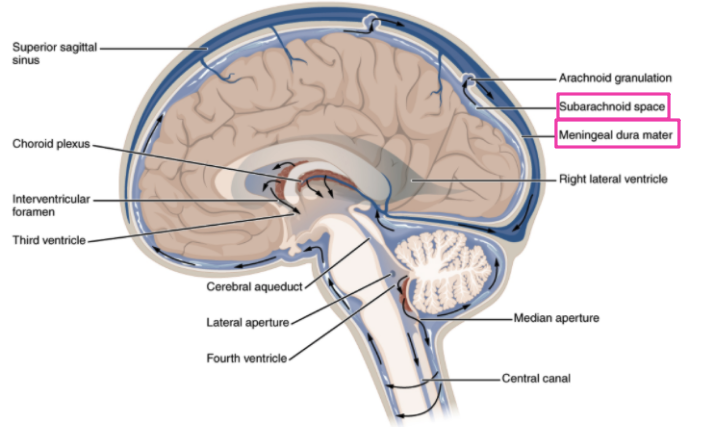
The middle layer of the meninges is the arachnoid mater, named for the spider-web–like trabeculae between it and the pia mater. The arachnoid defines a sac-like enclosure around the CNS. The trabeculae are found in the subarachnoid space, which is filled with circulating Cerebrospinal fluid (CSF). The subarachnoid space is filled with circulating CSF, which also provides a liquid cushion to the brain and spinal cord. Similar to clinical blood work, a sample of CSF can be withdrawn to find chemical evidence of neuropathology or metabolic traces of the biochemical functions of nervous tissue.

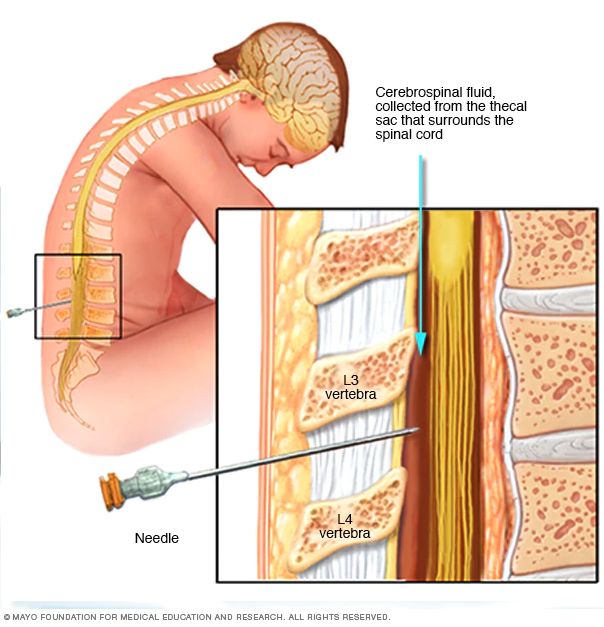
The outer surface of the CNS is covered in the thin fibrous membrane of the pia mater. It is thought to have a continuous layer of cells providing a fluid-impermeable membrane. The name pia mater comes from the Latin for “tender mother,” suggesting the thin membrane is a gentle covering for the brain. The pia extends into every convolution of the CNS. At the end of the spinal cord, a thin filament extends from the inferior end of CNS at the upper lumbar region of the vertebral column to the sacral end of the vertebral column. Because the spinal cord does not extend through the lower lumbar region of the vertebral column, a needle can be inserted through the dura and arachnoid layers to withdraw CSF. This procedure is called a lumbar puncture or spinal tap and avoids the risk of damaging the central tissue of the spinal cord. Blood vessels that are nourishing the central nervous tissue are between the pia mater and the nervous tissue.

1

Which of the following best describes what meninges are and what do they do?

1

The illustration below is a frontal view of the parietal lobes of the brain, its meninges, and the skull and hair surrounding it. (You do not need to know what each structure is, just the structures identified in orange and in blue.)


Consider the reading above and the structures labeled in orange as you categorize the meningeal layers, their translations, and related structures.

  • "tender mother"
  • "spider mother"
  • space below the arachnoid mater
  • d
  • b
  • a
  • c
  • "tough mother"
  • pia mater
  • arachnoid mater
  • dura mater
  • subarachnoid space
1

Where is cerebrospinal fluid (CSF) located?

1

Examine the picture below, paying close attention to the arrows and the structures outlined in pink.

Circulation of Cerebrospinal Fluid

According to the diagram, which of the following statements is correct?

Meningitis (mening = meninges, -itis= inflammation of) is a condition that is most common in babies and college students. Watch the two videos below, then answer questions 11-12.

Meningitis in Young Children:

Meningitis in College Students:
1

What is meningitis?

1

In order to test a person for meningitis, doctors often complete a procedure called the lumbar puncture (aka "spinal tap"). A rendition of a lumbar puncture is shown below:


According to the picture, what is collected and tested during a lumbar puncture?

1

Considering what you know about the meninges, explain your answer for #12. (Resist the urge to google - just think through what you know about the meninges and the BBB!)

Part 3: Drugs and the Nervous System

Watch the video below about the effects that drugs have on the nervous system.


Use the video to answer questions 14-
1

What must drugs get through in order to affect neurons and synapses?

1

What usually happens to "leftover" neurotransmitters?

1

What effects can drugs have on neurotransmitters?

1

Your next project will be about the effects of one specific drug (your choice, can be pharmaceutical, illicit, or recreational) on one specific neurotransmitter.

Brainstorm: List three drugs that you might be interested in researching.

(You are not roped into doing this particular drug for your project, this is just a space to start thinking about it!)

1

Pick one of the drugs that you wrote down for #17.

Do a small amount of research using reliable sources (yes, wikipedia is completely reliable for something like this!!)

What neurotrasmitter is affected by this drug, and how does the drug affect the neurotransmitter?