Log in
Sign up for FREE
arrow_back
Library

Unit 7 Day 5 Ch 9 Sampling & Bias Quiz

star
star
star
star
star
Last updated almost 5 years ago
19 questions
4
4
4
4
4
4
4
4
2
4
4
4
4
4
8
10
4
4
6
Question 1
1.

Question 2
2.

Question 3
3.

Question 4
4.

Question 5
5.

Question 6
6.

Question 7
7.

Question 8
8.

Question 9
9.

What is the parameter of interest in this survey?
(what are we interested in finding out? Read the given information carefully in #8)

Question 10
10.

Question 11
11.

Draggable itemarrow_right_altCorresponding Item
arrow_right_alt
arrow_right_alt
arrow_right_alt
arrow_right_alt
Question 12
12.

Question 13
13.

Question 14
14.

What kind of bias is present in question #13?

Question 15
15.

Draggable itemarrow_right_altCorresponding Item
arrow_right_alt
arrow_right_alt
arrow_right_alt
arrow_right_alt
Question 16
16.

Draggable itemarrow_right_altCorresponding Item
arrow_right_alt
arrow_right_alt
arrow_right_alt
arrow_right_alt
arrow_right_alt
Question 17
17.

Question 18
18.

Question 19
19.

How many people attended the different NFL playoff games each year over the last 20 seasons?

Is this a statistical question?
Yes
No
How much did you spend on lunch yesterday?

Is this a statistical question?
Yes
No
How many days are in January?

Is this a statistical question?
Yes
No
What types of cellular devices do students use at AHHS?

Is this a statistical question?
Yes
No
Use the following information for #5 & 6
On July 5-8, 2014, The Gallup organization telephoned a random sample of 1,028 adults in all 50 U.S. states and Washington DC. They had a 98% response and found that 41% supported a decrease in immigration.

The population of interest is all U.S. adults.
True
False
In #5, is 41% a parameter or a statistic?

Explain.
Select both answers.
It is a value calculated based on the sample data.
It is a value calculated based on the population data.
Statistic
Parameter
Use this information for #7 - 9
A political scientist surveys 400 voters randomly selected from the list of all registered voters in a community. The purpose is to estimate the proportion of registered voters who will vote in an upcoming election.

What is the population of interest in this survey?
Registered voters who will vote in the upcoming election
Voters
400 voters
All registered voters
All registered voters in a community.
A political scientist surveys 400 voters randomly selected from the list of all registered voters in a community. The purpose is to estimate the proportion of registered voters who will vote in an upcoming election.

What is the sample in this survey?
400 voters
All registered voters
All registered voters in a community.
Registered voters who will vote in the upcoming election
Voters
A school district has three high schools. The district decides to randomly test high school students for attention deficit disorder (ADD). The school board creates a list of all of the students from the three high schools and randomly samples 250 students from that list.
Is this a simple random sample?
(hint: think about the specific requirement we discussed in class re. SRS)
Yes, because the students were chosen at random.
Yes, because with this method they could randomly choose any 250 high school students from throughout the district.
No, because we can’t guarantee that there are students from each school in the sample.
No, because we can’t guarantee that there are students from each high school grade in the sample.
A large medical professional organization with membership consisting of doctors, nurses, and other medical employees wanted to know how its members felt about HMOs (health maintenance organizations).
Name the type of sampling plan they used in each of the following scenarios:
They randomly selected ten cities from all cities in which its members lived, and then surveyed all members in those cities.
Stratified
They randomly chose 1500 employees from a list of all the employees in the network: doctors, nurses and all other employees combined.
Cluster
They randomly selected 500 members from each of the lists of all doctors, all nurses, and all other employees and surveyed those 1500 members.
Systematic
They randomly choose a starting point from the first 50 names in an alphabetical list of members (doctors, nurses, and other medical employees), then chose every 50th member in the list starting at that point.
Simple Random Sample (SRS)
A chemistry professor who teaches a large lecture class gives a survey to those present in class about how he can make the class more interesting.
The survey is conducted in a way that student's answers are anonymous.
He is hoping he can get more students to attend his class.
This survey method suffers primarily from which type of bias?
Why?
Select two correct answers.
Answering the survey in the presence of the professor might alter a student's response.
Response Bias
Nonresponse Bias
Not all students who take his class would be present at that particular lecture.
Voluntary Response Bias
All students present that day would respond to the survey.
Undercoverage Bias
A college group is investigating student opinions about funding of the military. They phone a random sample of students at the college, asking each person one of these questions (randomly chosen):

A: “Do you think that funding of the military should be increased?”

B: “Do you think that funding of the military should be increased so that the United States can better protect its citizens?”

Which question do you expect will elicit greater support for increased military funding?
Explain.

Select both answers.
Question A
The wording would cause the person to be more in support of funding for the military by mentioning protecting the citizens, everyone wants to be protected.
The wording is neutral and does not influence a person to respond in favor or against.
Question B
The wording would cause the person to be more against the funding for the military by mentioning protecting the citizens.
Name the type of bias primarily present in each of the situations below:

Carefully read each scenario. Each type of bias will be used.
A survey about the food in the school cafeteria was conducted by passing out questionnaires to students as they entered the cafeteria. A drop box for completed forms was on a table be the cash register. Of 275 surveys handed out, 169 were returned to the box.
Response Bias
A political party mailed questionnaires to all registered voters in Texas, asking whether or not the party should support the death penalty. The voters mailed the completed questionnaires back in an envelope provided.
Nonresponse Bias
The magazine Harley Davidson Today sent a survey to its subscribers asking whom they admire most in America.
Voluntary Response Bias
A uniformed police officer interviews a group of 50 college freshmen. He asks each his/her name and if he/she has used an illegal drug in the last month.
Undercoverage Bias & Convenience Bias
Randomization in sample selection is very important in the collection of data to ensure the sample is representative of the population we are studying.

How is randomization included in each of the sampling methods?
Systematic
There is no randomization in this method.
Stratified Random Sample
The subjects are each randomly chosen with a Random Number Generator. Each one has an equal chance of being chosen.
Convenience Sample
Subjects are first grouped by similar characteristics, then a set amount are randomly chosen from each group.
Simple Random Sample (SRS)
Subjects are grouped into smaller representative groups, then a set amount of groups are randomly chosen and each member of the group is surveyed.
Cluster Sample
A random starting point is selected by a random number generator then every nth person is part of the sample
A music teacher wants to conduct a survey of practice time of his 60 students.
He wants to select an SRS of six students using a random number table.

Use the random number table below to select the numbers for the SRS of 6 students, begin with the top row.
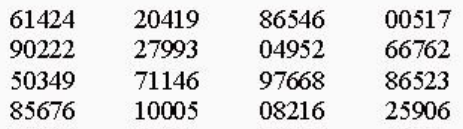

Select the list of numbers that correspond to the six chosen students.
61, 42, 42, 04, 19, 86
61, 42, 04, 19, 54, 60
42, 04, 19, 54, 60, 05
42, 42, 04, 19, 54, 05
14, 24, 20, 41, 46, 51
A music teacher wants to conduct a survey of practice time of his 60 students.
He wants to select an SRS of six students using a random number table.

He used the random number table below to select the numbers for the SRS of 6 students:


The numbers he selected were: 42, 42, 04, 19, 54, 60

Look at the random number table and the numbers that he chose.

Evaluate his list of numbers:
He skipped a number so his list is not random.
He didn't start with the first group of numbers on the left.
He repeated a number that causes him to only have 5 students.
He chose the numbers correctly to identify the 6 students in the study.
A botanist wants to create a sample of size 10 from 60 plants that are arranged in an array of 10 rows of 6 plants each.
She numbers the plants in each row from one to six.
For each of the 10 rows, she rolls a six-sided number cube and selects the plant corresponding to the number rolled.

Which statements are true? Check all that apply.
The sample is an SRS.
The sample is not done with randomization.
Each plant has an equal chance of being selected.
The sample is done with randomization.
The sample is a Stratified Random Sample