#17 Analyze Word Definitions (Ch 2-3)

Last updated over 4 years ago
22 questions
Goal:
I can use context to determine the meanings of multiple-meaning words as they are used in chapters 2–3 of Hidden Figures?

Directions:
With your partners, discuss and complete questions 1–4.

Part 1: What do the words mean?

Without looking at a dictionary, talk with your partner what these words usually mean.

Using your own words, write the definitions you and your partner decide upon
1

What does computer (noun) usually mean?

1

What does black (adjective) usually mean to you?

1

What does hands (plural noun) usually mean to you?

1

What does pyramid (noun) usually mean to you?

Part 2: Finishing the Sentence

Look at the pages in the text where your words can be found.

- Skim and scan the pages for the quotations below
- Fill in the blanks using words from the text.

Page 13:


WANTED: Female Mathematicians

Each of the engineers at the Langley Memorial Aeronautical Laboratory required
the support of a number of other workers: craftsmen to build the airplane
models, mechanics to maintain the test tunnels, and “number crunchers” to
process the data that was collected during the tests. For the engineers, a plane
was basically a complex physics experiment. Physics is the science of matter,
energy, and motion. Physics meant math, and math meant mathematicians. At
the Langley Laboratory, mathematicians meant women.

Female mathematicians had been on the job at Langley since 1935. And it
didn’t take long for the women to show that they were just as good or even better
at computing than many of the male engineers. But few of the women were
granted the title “mathematician,” which would have put them on equal footing
with some male employees. Instead, they were classified as “subprofessionals,”
a title that meant they could be paid less.


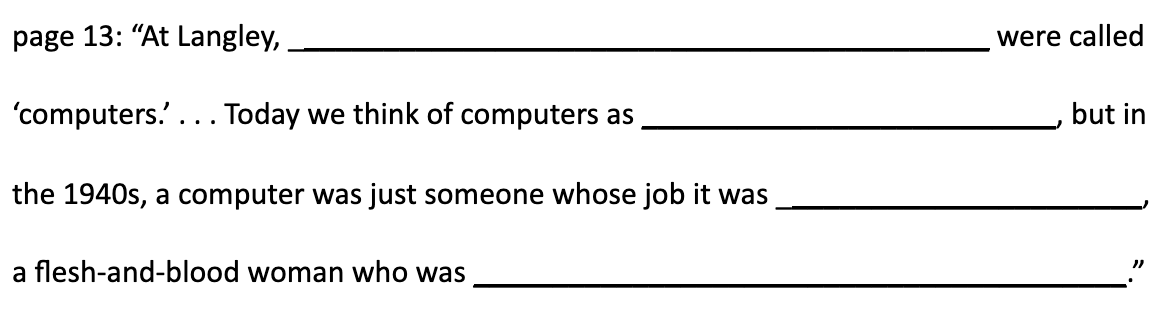
At Langley, the female mathematicians were called “computers.” They did
the computations to turn the results of the raw data gathered by the engineers
into a more useful form. Today we think of computers as machines, but in the
1940s, a computer was just someone whose job it was to do computations, a
flesh-and-blood woman who was very good with numbers.

In 1943, it was difficult for the Langley Laboratory to find as many qualified
women as they needed. A recruiter from the National Advisory Committee for
Aeronautics visited colleges in search of young women with analytical or
mathematical skills.
1

Fill in the blank using words from the text.

1

Fill in the blank using words from the text.

1

Fill in the blank using words from the text.

1

Fill in the blank using words from the text.

Page 24:

Jobs, Good Jobs, and Very Good Jobs

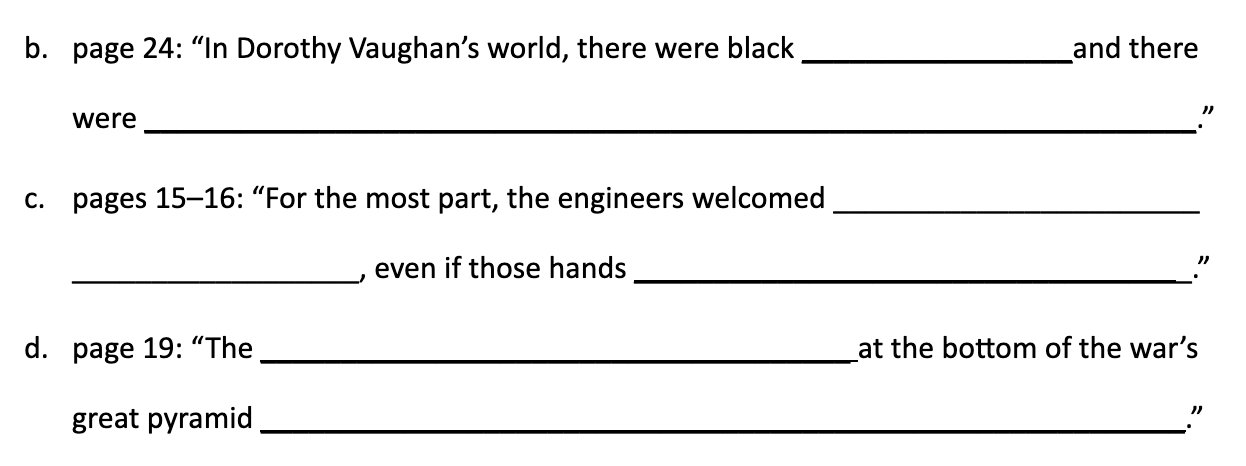
In Dorothy Vaughan’s world, there were black jobs, and there were good black jobs. Sorting laundry, making beds in white people’s houses, working in tobacco plants—those were black jobs.
Owning a barbershop or a small business, working in the post office or on the railroad—those were good black jobs.

Being a teacher or a preacher, a doctor or a lawyer—those were very good black jobs.
But the job at the aeronautical laboratory was something entirely new, something so unusual it hadn’t been dreamed of yet. It was an opportunity that had the potential to change the future of Dorothy’s family. Even if the war ended in six months or a year, earning a much higher salary for that brief time could help her save money for her children’s education.

That spring, Dorothy Vaughan filled out and mailed two job applications, one to work at the Camp Pickett laundry and one to work as a mathematician at Langley. The application for the laundry job was straightforward. There was such demand for laundry workers that she couldn’t imagine not being hired.

The other application asked for Dorothy’s work history, references, schools attended, languages spoken. One question asked: “How soon could you be ready to start work?”

She filled in the blank: 48 hours.

If she got the job, she could be ready to go in forty-eight hours. Because a
chance like that might never come around again.
1

Fill in the blank using words from the text.

1

Fill in the blank using words from the text.

Page 15-16:

The Human Computers

When the managers couldn’t satisfy the demand with only white employees, the
government decided to hire African Americans. A civil rights leader named A.
Philip Randolph encouraged President Roosevelt to sign an executive order—a
law that ordered the desegregation of the federal government and defense
industry and created the Fair Employment Practices Committee. This executive
order opened up new and exciting opportunities for African Americans, allowing
them to work side by side with white people during the war.

The federal government also helped create special training classes at black
colleges, where people could learn the skills they would need to be successful in
the war jobs. Black newspapers like the Norfolk Journal and Guide published
articles telling their readers to apply for these new job openings. And there were
many applicants! The applications were not supposed to consider race—a recent
law had done away with the requirement that the application must include a
photo—but it wasn’t hard for employers to figure out which job candidates were
black. African Americans did not have access to white colleges and universities,
so black applicants came from black colleges, such as West Virginia State
University, Howard University, Hampton Institute, and Arkansas Agricultural,
Mechanical & Normal College. Many of the African-American candidates had
years of teaching experience as well as math and science degrees.

Once hired, the black mathematicians were assigned to a separate work space
in the Warehouse Building on the west side of the Langley campus. The East
Area Computers were all white; the West Area Computers were all black, except
for the supervisor and her assistant, who were white women.

There had always been African-American employees at Langley, but they had
worked as janitors, cafeteria workers, mechanic’s assistants, and
groundskeepers. Hiring black mathematicians—that was something new. For the
most part, the engineers welcomed extra hands, even if those hands were black.
The Langley Laboratory was operating around the clock to test airplanes to be
flown by American soldiers in the war: everyone had a job to do.

Hampton, Virginia, where the Langley campus was located, was very much a
southern town. State law and Virginia custom meant that African Americans did
not ride the same buses or eat in the same cafeterias or use the same bathrooms
as whites. The Langley staff had to prepare for the arrival of the African-
American mathematicians. One of the tasks: creating metal bathroom signs that
read “Colored Girls.”

For the black women, the experience of working at a laboratory offered the
chance to do interesting work that would help support the war effort. Walking
into an unfamiliar environment wasn’t easy for the women of the new West Area
Computing Office, but each of them was eager for the opportunity to help their
country and prove that they, too, could be excellent mathematicians.
1

Fill in the blank using words from the text.

1

Fill in the blank using words from the text.

Page 19:

There was no escaping the heat during the summer of 1943, especially for the
African-American women working in Camp Pickett’s laundry boiler plant.
Camp Pickett was an army training center in central Virginia that processed
eighteen thousand bundles of laundry each week. Inside the facility, the heat and

humidity were so intense that the workers stepped outdoors into the 100-plus-
degree summer heat to get relief.

The job at the plant was hard work. Some of the women loaded the soldiers’
dirty laundry into the boilers. Others heaved the sopping clothes into the dryers.
Another team worked the pressing machines, like cooks at a giant griddle. The
laundry workers existed at the bottom of the war’s great pyramid of employees.
They earned forty cents an hour—among the lowest wages of all war workers—
but for women with few employment options, even that modest sum felt like a
windfall.

Dorothy Vaughan considered applying for a job at the laundry. The thirty-
two-year-old taught math at the black high school in Farmville, Virginia, about

thirty miles from Camp Pickett. Her family was better off financially than many
others—her husband’s parents owned a barbershop, a pool hall, and a service
station in town—but Dorothy wanted to find a job to earn extra money. While
teaching offered status, it didn’t pay well. Virginia’s white public school
teachers earned some of the lowest salaries in the United States, and black
teachers in Virginia earned 50 percent less than that. Dorothy could earn twice
her teacher’s salary by working at the laundry.

Some women with Dorothy’s education might have seen taking the laundry
job as an unthinkable choice. Wasn’t the purpose of a college degree to get away
from dirty and difficult work? In addition, the camp was far enough away from
Farmville that Dorothy would have to live in employee housing during the week
and only go home on weekends.

But Dorothy didn’t care. She would do whatever was necessary to save
enough money so that her four children might be able to get the best education
possible. She knew that schooling was the best way to prepare her children to
live in a world that would require more of them than white children, and attempt
to give them less in return.
1

Fill in the blank using words from the text.

1

Fill in the blank using words from the text.

Part 3: Think Again

Without looking at a dictionary, write a different definition of each word based on how it is used in the text.
1

What does the word computer (noun) mean in Hidden Figures?

1

What does the word black (adjective) mean in Hidden Figures?

1

How is the word hands (plural noun) used in Hidden Figures?

1

What does the word pyramid (noun) mean in Hidden Figures?

Part 4: Analyze

Complete the questions that analyze how the words are used.
1

What are the similarities between your original and modified definitions of the word computer?
What are the differences?

1

The author uses the word black figuratively in quotation B (the sentence from question 9 and 10).
In your own words, what is the author saying about the jobs that were available for black people?

1

The author uses the word hands twice in quotation C. (from questions number 11, 12)
How are the two uses different from each other?

1

What does the author’s figurative use of the word pyramid in quotation D (look back on questions 13, 14)
suggest about attitudes toward laundry workers?