Practice Problems for Linkage and Recombination, Genetic Maps
Question 1
You are doing a genetics experiment with the fruit fly. In the “P” generation, you cross two true-breeding flies. The female parent is brown and wingless and the male parent is black with normal wings. All of the flies in the F1 generation are brown and have normal wings.
Indicate the alleles associated with dominant phenotypes by uppercase letters and alleles associated with recessive phenotypes by lowercase letters. Assume the genes are not found on a sex chromosome. Indicate the color alleles as “B” and “b” the wing alleles by the letters “N” and “n”.
1 point
1
Question 1
1.
The genotypes of the female fly in the P generation
1 point
1
Question 2
2.
The genotypes of the male fly in the P generation
1 point
1
Question 3
3.
The genotypes of the fly in the F1 generation
click here to check your work before continuing....
1 point
1
Question 4
4.
You now take an F1 female and cross her to a true-breeding black, wingless male. This male’s genotype is:
You count 1600 offspring in the F2 generation. If the wing and the color traits were NOT linked and no recombination occurred, you would expect to count:
1 point
1
Question 5
5.
______ # of brown, winged flies (of the genotype BbNn)
1 point
1
Question 6
6.
________ # of black, winged flies (of the genotype bbNn)
1 point
1
Question 7
7.
________ # of brown, wingless flies (of the genotype Bbnn)
1 point
1
Question 8
8.
________ # of black, wingless flies (of the genotype bbnn)
stop - click here to check your work - remember - this is an unlinked dihybrid cross - simple stuff!
NOW - imagine the same cross, the F2 generation of the original parents, except NOW the traits are linked and no recombination is occurring. What would you expect?
1 point
1
Question 9
9.
______ # of brown, winged flies (of the genotype BbNn)
1 point
1
Question 10
10.
________ # of black, winged flies (of the genotype Bbnn)
1 point
1
Question 11
11.
________ # of brown, wingless flies (of the genotype bbNn)
1 point
1
Question 12
12.
________ # of black, wingless flies (of the genotype bbnn)
STOP - click here to check your work. No really - many people get this wrong here so CHECK YOUR WORK : )
BUT when you do count the F2 generation, instead you got
85 brown winged flies
728 black winged flies
712 brown wingless flies
75 black wingless flies
what the heck happened?
RECOMBINATION
Not fully linked and yet not fully sorting independently. It's in between.
Genes are on the same chromosome (so they are linked) but crossing over IS happening, so they are recombining. How can we measure this? - we calculate recombination frequency - use the example we did in class and the formula to calculate this.
1 point
1
Question 13
13.
What is the genetic distance between the color and wing genes? Show your work.
1 point
1
Question 14
14.
A series of fruit fly matings shows that the recombination frequency between the gene for wing (see prior problem) and the gene for antenna length is 5% (i.e. the genetic distance between them is 5 centimorgans). List all possible recombination frequencies between the gene for color and the gene for antenna length. Draw the possible gene maps
last one - stop here and check your work - after this you are on your own : )
Question 2
You are working with a hypothetical fly and have found color and wing mutants. Preliminary work indicates that the mutant traits are recessive and the associated genes are not sex-linked, but beyond that you have no information. You first look at 2 genes, each with two alleles: "B or b" for body color and "W or w" for wing surface. The red body phenotype is dominant to the yellow body phenotype and smooth wings are dominant to crinkled wings.
1 point
1
Question 15
15.
You cross a true-breeding yellow-bodied, smooth-winged female with a true-breeding red-bodied, crinkle-winged male. What will be the phenotype(s) of the F1 progeny?
1 point
1
Question 16
16.
You cross several pairs of F1 siblings. What ratio of phenotypes do you expect in the offspring?
1 point
1
Question 17
17.
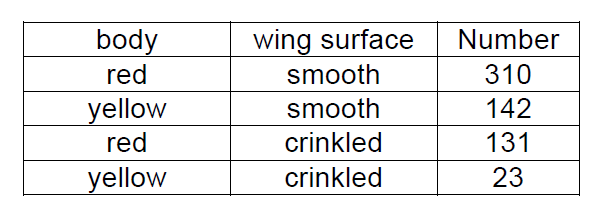
The actually data is shown below. Does this date match your expectation? If not, explain why there is a difference in the expected and actual numbers.
1 point
1
Question 18
18.
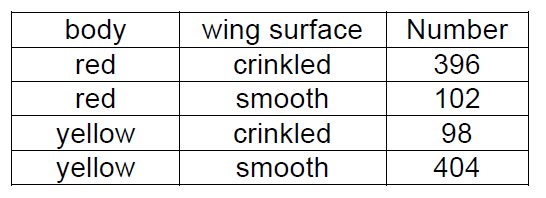
To determine the recombination frequency between these two genes, you perform several crosses where you cross an F1 from part (a) with a yellow-bodied, crinkle-winged fly. This is called a TEST CROSS (when you cross with a known recessive to determine the genotype of the dominant phenotype parent. You need to KNOW this term.
You get the following results.
What is the distance between the genes for body color and wing surface in map units?
1 point
1
Question 19
19.
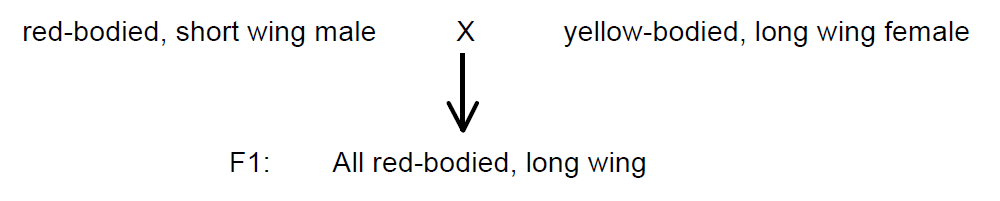
You decide to turn your attention to a different gene, one that controls wing length. This gene has two alleles, L or l where long wings are dominant to short wings. Remember that the red body phenotype is dominant to the yellow body phenotype. You again mate two true-breeding lines:
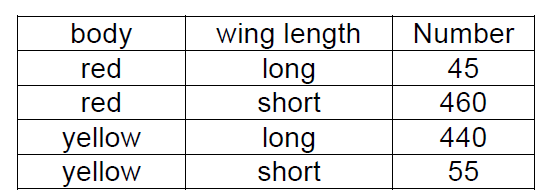
To determine the recombination frequency between these two genes, you perform several crosses where you cross an F1 from part (d) with a yellow-bodied, short-winged fly. You get the following results.
What is the distance between the genes for body color and wing length in map units?
1 point
1
Question 20
20.
Given your answers to parts (c) and (d), what can you say about the relationship between the gene for wing length and the gene for wing surface?
1 point
1
Question 21
21.
Based on the preceding, what are the two possible arrangements of the three genes? Indicate the map distance between genes for each arrangement.
1 point
1
Question 22
22.
In a final mapping experiment, you cross a true-breeding red-bodied, short and crinkle-winged male with a true-breeding yellow-bodied, long and smooth-winged female.