Momentum OALH

Last updated almost 5 years ago
48 questions
Do Now
1

Draw the forces acting on a car at rest.

1

Give the equation for stopping distance.

1

State Newton’s First Law.

1

Define ‘reproducible results’.

1

Sketch a graph which shows a directly proportional relationship.

1

Define inertial mass.

Key Knowledge
1

Define momentum.

1

Define ‘conservation of momentum’.

1

Give the equation for momentum.

1

Define momentum.

1

Define ‘conservation of momentum’.

1

Give the equation for momentum.

Recall Quiz
1

1. Which of the following equations is incorrect?

1

2. What is momentum?

1

3. What is the unit of momentum?

1

4. What does conservation of momentum mean?

1

5. What is the momentum of a system at rest?

Application tasks
1

We do: The objects in the video both have a mass of 1.5 kg. Explain, using the idea of momentum, why the two objects stop moving after they collide.
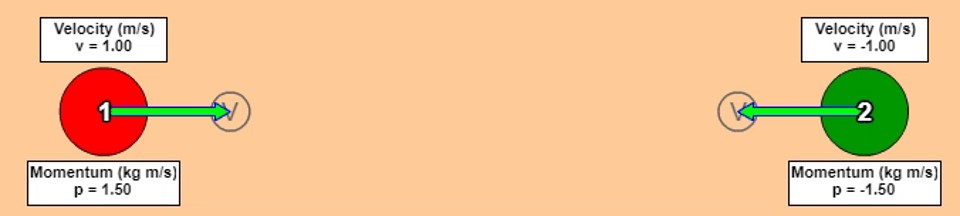
In a closed system, the total momentum _________ an event is _____________the total momentum ___________ an event.
Therefore, the total momentum _____________ the objects collide is ________________the total momentum ________________ the objects collide.
Before the objects collide, they have _____________ but opposite momentums, so total momentum is ____________.
After colliding, they are at rest, so total momentum is still ___________, and momentum is ______________.
1

You do:
The objects in the video both have a mass of 1.5 kg. Explain how momentum is conserved after the collision.

1

We do: Calculate the momentum of an object if its velocity is 76 metres per second and its mass is 80 kilograms.

1

We do: Calculate the mass of an object if it is moving at a velocity of 6 metres per second and its momentum is 44 kilogram metres per second.

1

We do: Calculate the velocity of an object if its momentum is 13 kilogram metres per second and its mass is 50 kilograms.

1

1. Calculate the momentum of an object if its velocity is 90 metres per second and its mass is 64 kilograms.

1

2. Calculate the momentum of an object if its velocity is 78 metres per second and its mass is 24 kilograms.

1

3. Calculate the momentum of an object if its velocity is 36 metres per second and its mass is 50 kilograms.

1

4. Calculate the momentum of an object if its velocity is 84 metres per second and its mass is 36 kilograms.

1

5. Calculate the mass of an object if it is moving at a velocity of 6 metres per second and its momentum is 44 kilogram metres per second.

1

6. Calculate the mass of an object if it is moving at a velocity of 8 metres per second and its momentum is 51 kilogram metres per second.

1

7. Calculate the mass of an object if it is moving at a velocity of 56 metres per second and its momentum is 29 kilogram metres per second.

1

8. Calculate the mass of an object if it is moving at a velocity of 34 metres per second and its momentum is 24 kilogram metres per second.

1

9. Calculate the velocity of an object if its momentum is 13 kilogram metres per second and its mass is 50 kilograms.

1

10. Calculate the velocity of an object if its momentum is 3 kilogram metres per second and its mass is 7 kilograms.

1

11. Calculate the velocity of an object if its momentum is 81 kilogram metres per second and its mass is 56 kilograms.

1

12. Calculate the velocity of an object if its momentum is 84 kilogram metres per second and its mass is 31 kilograms.

1

13. Calculate the momentum of an object if its velocity is 34 metres per second and its mass is 11 kilograms.

1

14. Calculate the momentum of an object if its velocity is 55 metres per second and its mass is 48 kilograms.

1

15. Calculate the momentum of an object if its velocity is 41 metres per second and its mass is 68 kilograms.

1

16. Calculate the momentum of an object if its velocity is 53 metres per second and its mass is 76 kilograms.

Exam Questions
1

Q1.
(a) In any collision, the total momentum of the colliding objects is usually conserved.
(i) What is meant by the term ‘momentum is conserved’?

1

(ii) In a collision, momentum is not always conserved.
Why?

1

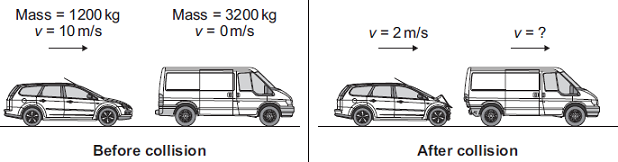
(b) The diagram shows a car and a van, just before and just after the car collided with the van.
(i) Use the information in the diagram to calculate the change in the momentum of the car.
Show clearly how you work out your answer and give the unit.

1

(ii) Use the idea of conservation of momentum to calculate the velocity of the van when it is pushed forward by the collision.
Show clearly how you work out your answer.

1

Q2.
Quantities in physics are either scalars or vectors.
(a) Use the correct answers from below to complete the sentence.
acceleration
direction
distance
speed
time
Velocity is __________________________ in a given ________________ .

1

(b) Which quantities are scalars and which quantities are vectors?
Momentum
Acceleration
Distance
Force
Time

1

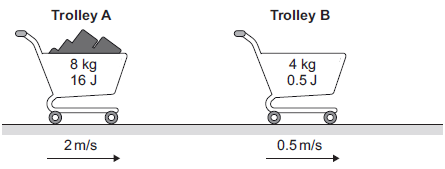
(c) The diagram shows two supermarket trolleys moving in the same direction.
Trolley Ais full of shopping, has a total mass of 8 kg and is moving at a velocity of 2 m / s with a kinetic energy of 16 J.
Trolley Bis empty, has a mass of 4 kg and is moving at a velocity of 0.5 m / s with a kinetic energy of 0.5 J.
(i) Calculate the momentum of both trolley A and trolley B.
Give the units.

1

(ii) The trolleys in the diagram collide and join together. They move off together.
Calculate the velocity with which they move off together.

1

(iii) In a different situation, the trolleys in the digram move at the same speeds as before but now move towards each other.
Calculate the total momentum and the total kinetic energy of the two trolleys before they collide.

Plenary
1

True or false.
1. In a closed system, the total momentum before an event is greater than the total momentum after the event.
2. Momentum equals mass times acceleration.
3. The unit of momentum is kg m/s
4. Two objects which collide will have a lower total momentum than they had before the collision.
5. Objects that have a velocity of 0 m/s have no momentum.