01.14.21 - The Peripheral Nervous System
star
star
star
star
star
Last updated over 5 years ago
26 Nsɛmmisa
1
1
1
1

1
1
1
1
1
1
1
1
1
1
1
1

1
1
1
1
1
1
1
1
1
1
Objectives:
distinguish between the functions of the somatic and autonomic nervous systems
distinguish between the message pathways of the somatic and autonomic nervous systems
distinguish between the "large scale" and cellular characteristics of the sympathetic and parasympathetic nervous systems
categorize scenarios as either sympathetic or parasympathetic responses
How are you doing today?
What do you need from me (your teacher) to do your best in class today?
Using your own words, describe the pathway of a nerve signal through one neuron and to another. Use the following words in your answer:
axon
nucleus
dendrite
myelin sheath
Node of Ranvier
synapse
neurotransmitter
ion
Think back to unit one:
What do the terms ventral and dorsal mean?
I know what you're thinking. "This formative is supposed to be about the peripheral nervous system! Why are we learning about the spinal cord? Isn't that part of the central nervous system?
Yes. Yes it is.
However, in order for us to be able to understand what really happens in the peripheral nervous system, we need to first learn about some basics structures in the spinal cord. This will help us as we start learning about the spinal nerves of the peripheral nervous system.
Let's get a glimpse into the spinal cord. Watch the first 4:15 of the video below, then answer questions 5-9.
(Remember - you don't need to watch the whole thing!!)
Categorize the following as characteristics of either the ventral root or the dorsal root.
Efferent (information goes away from the CNS)
Houses motor neurons
Houses sensory neurons
Afferent (information goes towards the CNS)
Ventral root
Dorsal root
What is the spinal nerve trunk?
The illustration below is the cross section of the spinal cord at a point where spinal nerves join. It is surrounded by boney tissue of the vertebral column.
Consider the video from above. Examine the illustration, then match the terms with where you think they should be labeled:
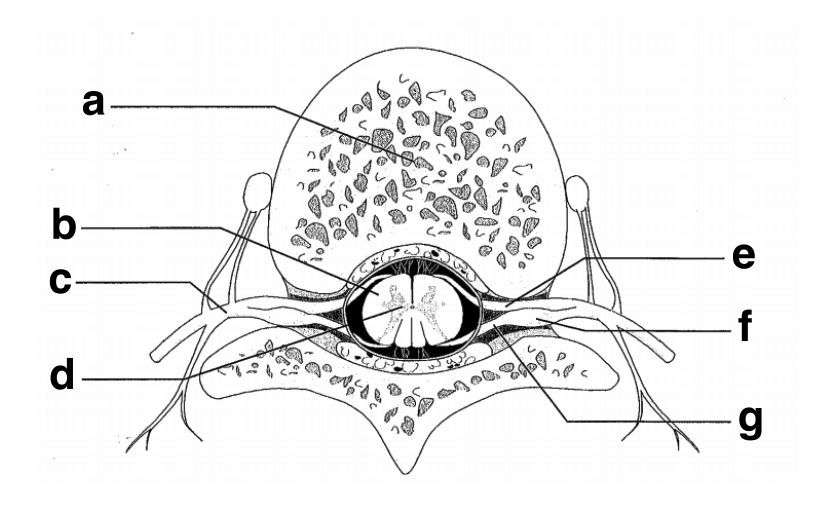
(hint: think about which direction the spinous processes of your vertebrae are pointing on your own body!)
| Draggable item | arrow_right_alt | Corresponding Item |
|---|---|---|
f | arrow_right_alt | vertebra |
a | arrow_right_alt | spinal nerve |
b | arrow_right_alt | posterior root ganglion |
e | arrow_right_alt | posterior root |
c | arrow_right_alt | anterior root |
g | arrow_right_alt | gray matter |
d | arrow_right_alt | white matter |
The definition for the term 'ganglion' is as follows:
ganglion - a structure containing a number of nerve cell bodies, often forming a swelling on a nerve fiber.
Given this definition, what do you think is likely to be inside the ganglion?
The illustration below shows a 3D view of the vertebral column and spinal cord and the associated spinal nerves.
Consider your answers to the question above, then open the 'show your work' box. Label the diagram with the following terms:
vertebra
spinal cord
spinal nerve
anterior root
posterior root
posterior root ganglion
intervertebral disk
Now that we have a better idea of what the spinal cord and spinal nerves look like, let's revisit the divisions of the nervous system. Read the following excerpt, then answer questions 10-
The nervous system can be divided into portions on the basis of anatomy, on the basis of function or using a combination of both. Most schemes begin by distinguishing between the central nervous system or CNS, which includes the brain and spinal cord, and the peripheral nervous system, which includes all other nervous-system tissue. The PNS in turn is divided into the somatic and autonomic nervous systems (SNS and ANS), with these terms translating to "voluntary" and "involuntary" respectively. (NOTE: Despite the translation, the somatic nervous system is NOT always voluntary, such as with somatic reflex arcs.) Finally, the ANS can be divided into the parasympathetic and sympathetic nervous systems on the basis of the type of involuntary responses generated within each.
The somatic nervous system includes everything under your voluntary control as well as one involuntary function, the somatic reflex arc (this is what a doctor tests for when tapping the tendon under your knee with rubber hammer). The SNS includes both afferent (sensory) nerves that transmit various types of information (e.g., smells, pressure and pain) to the the brain for processing and efferent (motor) nerves that direct the muscles under your control, such as those in your legs and arms, to execute certain movements, such as throwing or running.
The nerves of the SNS are classified on the basis of location. For example, there are 12 pairs of cranial nerves, which originate in the head and supply the muscles of the eyes, throat and other areas within the head with both motor and sensory fibers; and 31 pairs of spinal nerves, all of which service the voluntary muscles of the trunk, pelvis, arms and legs. The neurotransmitter chemical acetylcholine is an excitatory neurotransmitter in the SNS, meaning that it tends to stimulate movements.
The autonomic nervous system vs. somatic nervous system distinction is functional: While most of the somatic nervous system is under your conscious control, none of the autonomic nervous system is. Of course, the two systems interact, with involuntary nervous-system responses permitting more energetic purposeful movements and so on. The neurotransmitter chemical acetylcholine is an inhibitory neurotransmitter in the SNS, meaning that its presence tends to damp out movements. Digestion, the beating of your heart and various internal secretions results from activities of the ANS.
The sympathetic branch of the ANS has CNS components in the chest, abdomen and back. Its signals are processed in structures called peripheral ganglia (singular: ganglion) that lie close to the spinal cord.
The parasympathetic branch of the ANS has its CNS portion in the head and the lower end of the spinal cord. It also has peripheral ganglia, but these are close to the target organs of nervous signals rather than close to the spine.
Which of the following best describes the somatic nervous system?
Which of the following best describes the autonomic nervous system?
What do the terms afferent and efferent mean?
motor
take information to muscles and glands
sensory
take information to the CNS
afferent neurons
efferent neurons
The neurotransmitter acetylcholine plays different roles between the somatic and autonomic nervous system. Match the branch with the role.
| Draggable item | arrow_right_alt | Corresponding Item |
|---|---|---|
autonomic NS | arrow_right_alt | Excitatory neurotransmitter |
somatic NS | arrow_right_alt | Inhibitory neurotransmitter |
The diagram below displays the "inside" of the ventral root. Examine the diagram, paying special attention to the differences between the somatic and autonomic neurons.
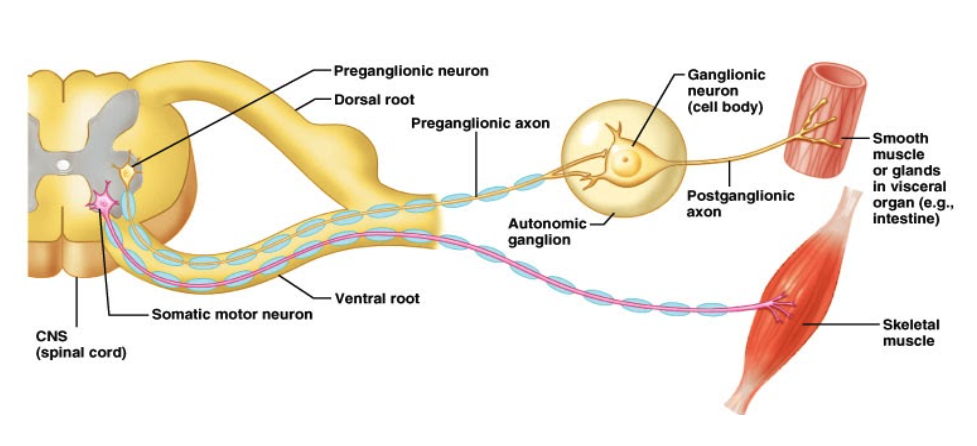
Examine the diagram, then use the diagram and reading to answer questions
The axons of both the somatic and autonomic neurons are surrounded by myelin
What type(s) of tissue are being affected by the different branches?
smooth muscle
skeletal muscle
glands
somatic cells
autonomic cells
What are two structural differences you see between the somatic pathway and the autonomic pathway?
The autonomic nervous system regulates many of the internal organs through a balance of two aspects, or divisions. In addition to the endocrine system, the autonomic nervous system is instrumental in homeostatic mechanisms in the body. The two divisions of the autonomic nervous system are the sympathetic division and the parasympathetic division. The sympathetic system is associated with the fight-or-flight response, and parasympathetic activity is referred to by the epithet of rest and digest. Homeostasis is the balance between the two systems. At each target effector, dual innervation determines activity. For example, the heart receives connections from both the sympathetic and parasympathetic divisions. One causes heart rate to increase, whereas the other causes heart rate to decrease.
The diagram below shows where the spinal nerves for the sympathetic and parasympathetic nervous systems originate. Examine the diagram, then consider it and the reading as you answer questions 17-
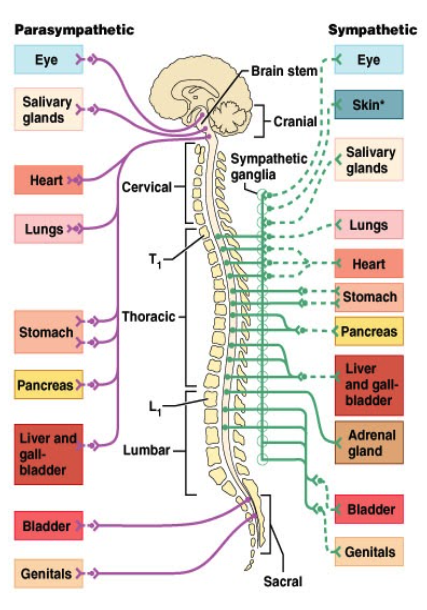
The sympathetic division of the nervous system innervates different tissues from the parasympathetic division of the nervous system.
Match the following branches of the nervous system with the best description
| Draggable item | arrow_right_alt | Corresponding Item |
|---|---|---|
"rest and digest" | arrow_right_alt | sympathetic |
"fight or flight" | arrow_right_alt | parasympathetic |
The spinal nerves for the sympathetic and parasympathetic divisions originate from different regions of the spinal cord. Categorize the regions below.
lumbar region
brain stem
thoracic region
sacral region
Sympathetic
Parasympathetic
Consider your answers for #18. Why do you think we evolved to have the spinal nerves for the parasympathethc and sympathetic nervous systems come from different regions of the spinal cord? (Think about the locations and what each branch controls!)
Which of the following branches of the nervous system was responsible for the man moving out of the way of the car? (from the video at the beginning)
Categorize the following nervous responses as either sympathetic or parasympathetic responses. Resist the urge to google - just think about whether or not each response would help you "fight or flight" or "rest and digest".
Hint: Keep in mind that 'constriction' is when something gets smaller and 'dilation' is when something gets bigger.
stimulation of digestive organs
stimulates production of saliva
constriction of pupils
dilation of bronchioles in the lungs
constriction of blood vessels servicing smooth muscles
dilation of blood vessels servicing skeletal muscles
constriction of blood vessels servicing skeletal muscles
dilation of blood vessels servicing smooth muscles
increased heart rate
increased breathing rate
decreased blood pressure
increased blood pressure
liver releases sugar into the blood
sympathetic nervous system
parasympathetic nervous system
Pick one of the sympathetic responses from above. Explain why you think this response would be beneficial in "fighting or flighting."
Pick one of the parasympathetic responses from above. Explain why you think this response would be beneficial in "resting and digesting."
Examine the diagram below outlining the differences between the cell messaging between the sympathetic and parasympathetic nervous systems.
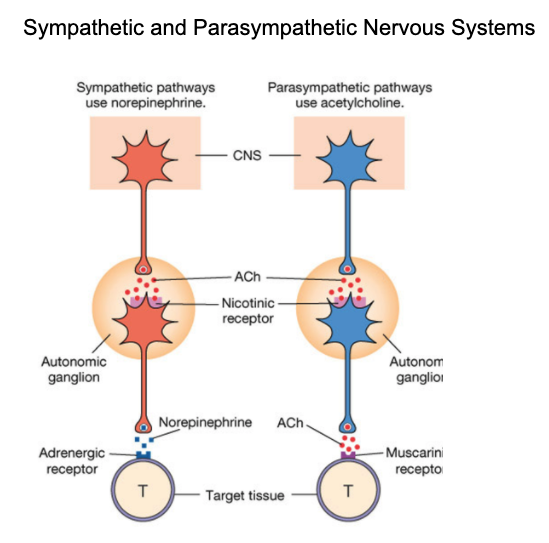
Acetylcholine is used in both the sympathetic and parasympathetic nervous systems
Consider what you know about the neurotrasmitters norepinephrine (aka epinephrine) and acetylcholine (ACh).
Are these neurotransmitters excitatory or inhibitory in the parasympathetic and sympathetic responses? Explain your answer.