01.20.21 - The Brain
star
star
star
star
star
Last updated over 5 years ago
25 Nsɛmmisa
1
1
1
1
1

1
1
1
1
1
1
1
1
1
1
1
1
1
1
1
1
1
1
1
1
Objectives:
determine and classify the locations and main functions of the brain stem, the diencephalon, the cerebellum, and the cerebrum
identify the major lobes of the cerebral cortex
identify and distinguish between the main structures and functions of the brain stem, diencephalon, and the cerebellum
What was the highlight of your long weekend?
What are you looking forward to this week?
What are you anxious or not looking forward to this week?
Categorize the following parts of the nervous system as either in the central nervous system or the peripheral nervous system.
Spinal cord
Brain
Motor neurons
Sensory neurons
Sympathetic neurons
Central Nervous System
Peripheral Nervous System
Today, we will briefly dive into the structures and function of the brain. What do you already know and what are you hoping to learn about?
The brain and the spinal cord are the central nervous system, and they represent the main organs of the nervous system. The spinal cord is a single structure, whereas the adult brain is described in terms of four major regions: the cerebral cortex, the diencephalon, the brain stem, and the cerebellum. A person’s conscious experiences are based on neural activity in the brain. The regulation of homeostasis is governed by a specialized region in the brain. The coordination of reflexes depends on the integration of sensory and motor pathways in the spinal cord.
In questions 6-20, We're going to spend a little bit of time looking at each of these regions of the brain. We will investigate them in the order that they are listed above.
Think back to the bone unit (so so long ago...)
The picture below shows the different lobes of the cerebral cortex. Conveniently, these lobes roughly match up with the bones of the skull that they are protected by. Considering this, match the lobes with their name.
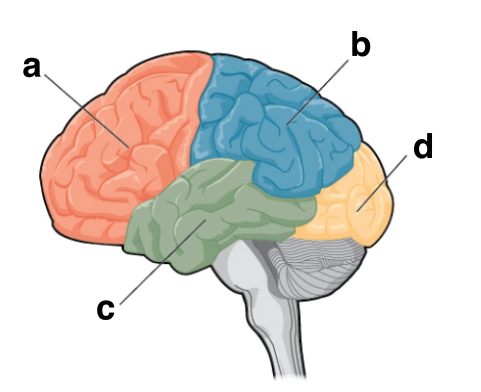
| Draggable item | arrow_right_alt | Corresponding Item |
|---|---|---|
temporal lobe | arrow_right_alt | a |
frontal lobe | arrow_right_alt | b |
occipital lobe | arrow_right_alt | c |
parietal lobe | arrow_right_alt | d |
What is the benefit of the "wrinkles" seen on the cerebral cortex?
Match the following regions and functions of the brain with the lobe that does the function.
auditory processing (hearing)
spatial processing and minipulation (physical orientation)
somatosensory cortex (senses)
prefrontal cortex (thinking and problem solving)
motor cortex (movement)
visual processing (seeing)
language reception and comprehension
Frontal Lobe
Parietal Lobe
Occipital Lobe
Temporal Lobe
The lobes of the brain function independentely of one another
A person is walking on a large patch of ice when they slip and fall backwards. They hit the most posterior part of their head on the ice. Which of the following symptoms do you think they might experience?
Watch the following (amazing) video about Phineas Gage, a construction foreman from the 1800s who survived an iron rod going through his skull and brain.
Which of the following best describes what happened to Phineas Gage?
(The following excerpt is an adapted version of the Openstax textbook)
The diencephalon is the one region of the adult brain that retains its name from embryologic development. The etymology of the word diencephalon translates to “through brain.” It is the connection between the cerebrum and the rest of the nervous system, with one exception. The rest of the brain, the spinal cord, and the PNS all send information to the cerebrum through the diencephalon. Output from the cerebrum passes through the diencephalon. The single exception is the system associated with olfaction, or the sense of smell, which connects directly with the cerebrum. In the earliest vertebrate species, the cerebrum was not much more than olfactory bulbs that received peripheral information about the chemical environment (to call it smell in these organisms is imprecise because they lived in the ocean).
The diencephalon is deep beneath the cerebrum. The diencephalon can be described as any region of the brain with “thalamus” in its name. The two major regions of the diencephalon are the thalamus itself and the hypothalamus.
The thalamus is a collection of nuclei that relay information between the cerebral cortex and the periphery, spinal cord, or brain stem. All sensory information, except for the sense of smell, passes through the thalamus before processing by the cortex. Axons from the peripheral sensory organs synapse in the thalamus, and thalamic neurons project directly to the cerebrum. It is a requisite synapse in any sensory pathway, except for olfaction. The thalamus does not just pass the information on, it also processes that information. For example, the portion of the thalamus that receives visual information will influence what visual stimuli are important, or what receives attention. The cerebrum also sends information down to the thalamus, which usually communicates motor commands. This involves interactions with the cerebellum and other nuclei in the brain stem.
Inferior and slightly anterior to the thalamus is the hypothalamus, the other major region of the diencephalon. The hypothalamus is a collection of nuclei that are largely involved in regulating homeostasis. The hypothalamus is the executive region in charge of the autonomic nervous system and the endocrine system. Other parts of the hypothalamus are involved in memory and emotion.
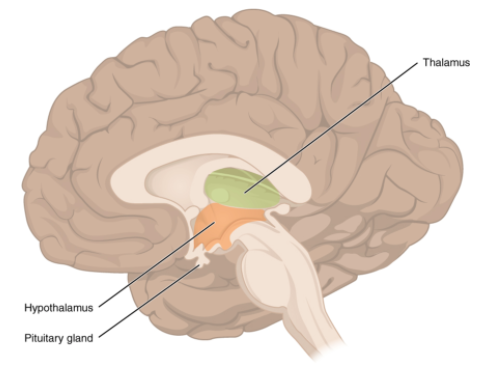
Consider the reading above as you answer questions 12-14.
Information from the sense of ________ does NOT pass through the diencephalon.
Categorize the following characteristics as a function of the thalamus or the hypothalamus.
filters importance of information
relays sensory information to the cerebral cortex
controls sympathetic nervous system
controls parasympathetic nervous system
relays motor commands to motor neurons
Thalamus
Hypothalamus
The diencephalon could be thought of as the ________ of the brain.
Which of the following best describes the function of the brain stem?
As you watch the video, categorize the following functions with the part of the midbrain
"bridge" in Latin
involved in auditory processing
ensures cardiovascular and respiratory systems are functioning
responsible for reflexive actions
production of tears and saliva
produces the neurotransmitter dopamine
most superior part of the brainstem
most inferior part of the brainstem
receives sensations from and controls motor movement of the face
involved in eye movements and visual processing
Medulla oblongata
Pons
Midbrain
Which function of the cerebellum is the oldest / most well known?
All functions of the cerebellum are currently known and understood.
Using the diagram below and what you learned from the previous set of questions, match the letter with the area of the brain.
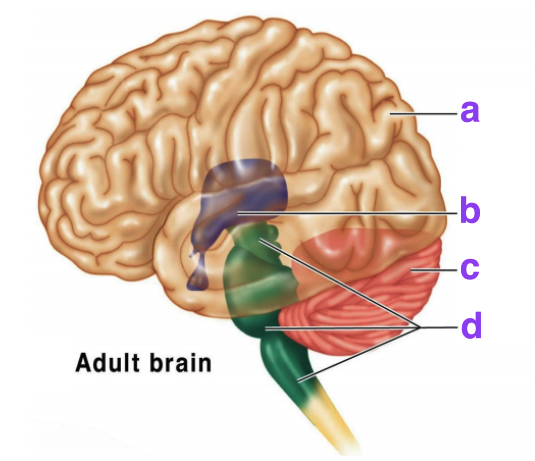
controls basic life functions; maintains homeostasis
brainstem
relays information to parts of the cerebral cortex
coordinates movement; responsbile for some complex learning
cerebral cortex
cerebellum
responsbile for critical thinking, characteristics such as personality
diencephalon
a
b
c
d
Examine the diagram below comparing the brains of a fish, a frog, a bird, and a human. Pay close attention to the terms introduced in this formative (cerebellum, cerebrum/ cerebral cortex, and medulla).
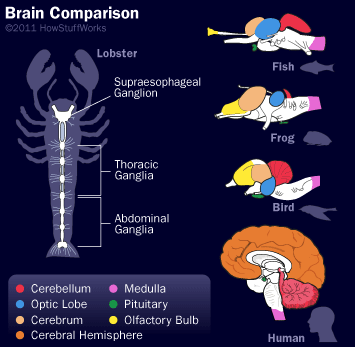
Which part of the brain is the most consistently sized between the four animals listed above? Why do you think this is?
Which part of the brain is the most differently between the four animals listed above? Why do you think this is?
Below are two different, yet similar, articles outlining current scientists' understanding of COVID-19's effect on nervous tissue. Pick ONE of the articles below:
COVID's Role in Smell and Taste: What Scientists Do and Don't Know (Nature)
Mysteries of COVID Smell Loss Finally Yield Some Answers (Scientific American)
What are three interesting things you learned in the article?
According to the article, what leads to a person's loss of smell when they are diagnosed with COVID-19?
What is the most interesting thing you learned about the brain in this formative?
What questions do you still have about the brain?