Planets share common characteristics including having mass and rotating on an axis. Which of the following is also a characteristic of planets?
1 point
1
Question 2
2.
The Earth, other planets, and the Sun are all a part of our solar system. How is the Sun different from other parts of our solar system?
1 point
1
Question 3
3.
Which statement best describes an asteroid?
1 point
1
Question 4
4.
Which statement best describes comets?
1 point
1
Question 5
5.
Which of the following includes the main components of a galaxy?
1 point
1
Question 6
6.
At 8:00 P.M . on a clear night, Tom observed groups of stars in the night sky. Three hours later on the same night, the groups of stars appeared in a different location in the night sky. Which of the following explains why the groups of stars appeared in a different location in the night sky after three hours?
1 point
1
Question 7
7.
Which statement explains why Florida, Texas, and California will have different times when the sun rises in the morning?
1 point
1
Question 8
8.
The planets of our solar system are divided into inner planets and outer planets. Which statement describes how inner planets are different from outer planets?
1 point
1
Question 9
9.
Which statement best describes how Mars is different from Jupiter?
1 point
1
Question 10
10.
Many of the stars that are visible in the night sky are much larger than our Sun in size. Those same stars appear much smaller when we see them. Why do the other stars in our galaxy look so much smaller than the Sun?
1 point
1
Question 11
11.
There are many different galaxies that make up our universe. What is the name of the galaxy in which our solar system is located?
1 point
1
Question 12
12.
Jupiter is a large planet within our solar system. Jupiter has many moons that orbit around it, and many of it’s moons are larger than Mercury. Why are Jupiter’s moons not considered planets?
1 point
1
Question 13
13.
Lilly and Raelyn were drawing a model of the order of the planets. They drew the model below.
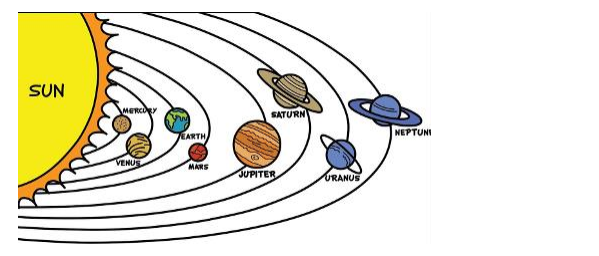
Which objects could they include that would be found between Mars and Jupiter?
1 point
1
Question 14
14.
While looking at the sky one night, Fred saw a streak of light. Fred's father told him that the light was produced by a small chunk of rock passing through Earth's atmosphere. Which of these terms best describes what Fred saw?
1 point
1
Question 15
15.
What is the correct of order of planets from closest to the sun to furthest?
1 point
1
Question 16
16.
It takes the Earth about ___________ to revolve around the sun and about ________________ to rotate on it's axis.
1 point
1
Question 17
17.
Although astronomers have many different ways of conducting experiments and investigations, they all start out the same way. Which of these would a scientist do first in any scientific investigation?
1 point
1
Question 18
18.
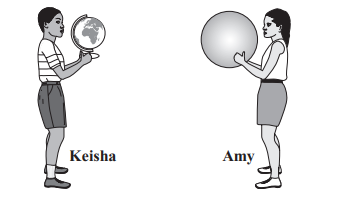
Keisha wants to show Amy what happens during one Earth day. Keisha holds a small globe representing Earth and Amy holds a large ball representing the Sun.
What should Keisha do to show Amy what happens during one Earth day?