Your friend says that there is a kind of glue that only dries when it is exposed to a special type of light.
Can light cause glue to dry?
No. Light can only change things by warming them up, so it cannot cause glue to dry.
Yes. The glue can take in energy from the light, causing it to dry.
Yes. Light can pull energy out of the glue, causing it to dry.
No. Light is not a physical thing, so it cannot change physical things like glue.
Santiago’s teacher showed him a kind of cloth that changes color if it is placed out in the sun, but does not change color if it is placed under a desk lamp.
Why will light from the sun change the color of the cloth when the light from the desk lamp does not?
Because light from the sun carries colored molecules, and light from the desk lamp does not.
Because light from the sun pulls energy out of the cloth, and light from the desk lamp does not.
Because the sun gives off a type of light that carries energy, and light from the desk lamp does not.
Because the cloth can take in energy from the light from the sun but not from the light from the desk lamp.
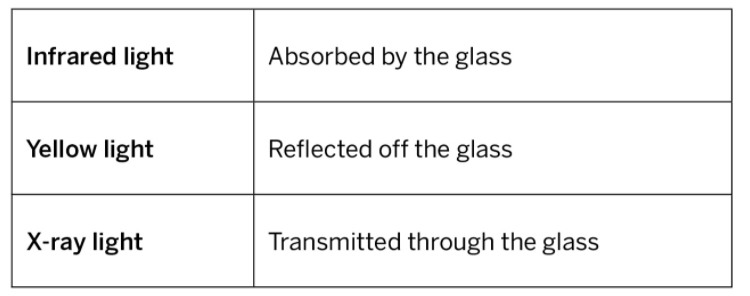
Pedro has a special type of glass that he wants to melt down to make some models. He wonders if light can cause the glass to melt. The table below shows what happens when different types of light hit the glass.
Based on this information, which type of light might cause the glass to melt?
The infrared light can cause the glass to melt.
The yellow light can cause the glass to melt.
The X-ray light can cause the glass to melt.
Any of these types of light can cause the glass to melt, because all light carries energy that can cause materials to change.
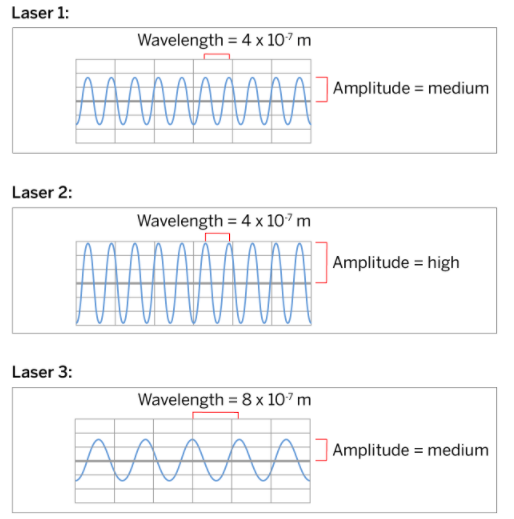
These graphs show the wavelength and amplitude of light coming from three lasers. Could any of these lasers be giving off different types of light?
No. All three lasers must be giving off the same type of light because all three are lasers, and the same kind of light source gives off the same type of light.
Yes. Laser 3 is giving off a different type of light because Laser 3 has a different wavelength than Lasers 1 and 2.
Yes. Laser 2 is giving off a different type of light because Laser 2 has a different amplitude than Lasers 1 and 3.
Yes. All three lasers must be giving off different types of light because every light source gives off its own type of light.