1
1
1
1
1
1
1
1
1
1
1
1
1
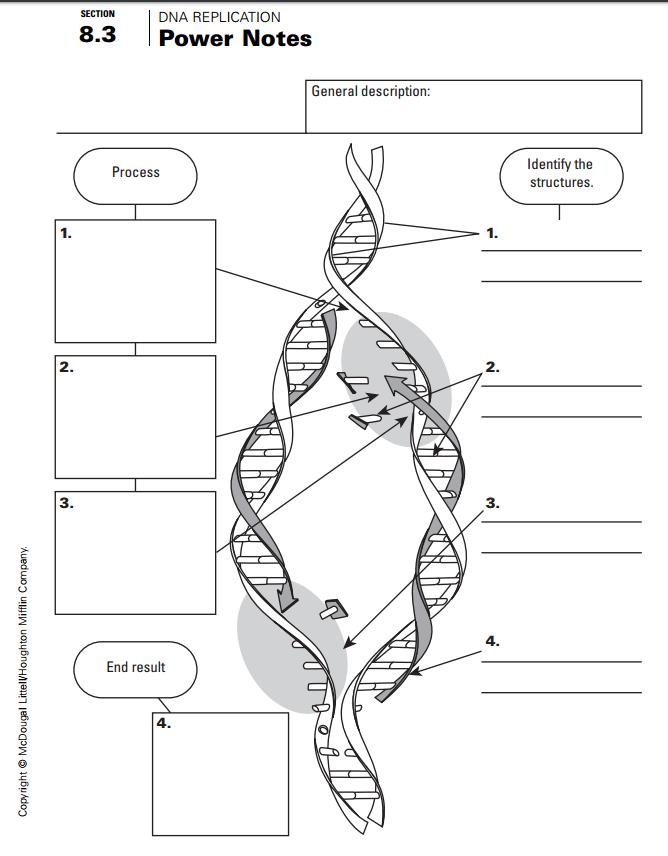
Every cell needs its own complete set of DNA, and the discovery of the three-dimensional structure of DNA immediately suggested a mechanism by which the copying of DNA, or DNA replication, could occur. Because the DNA bases pair in only one way, both strands of DNA act as templates that direct the production of a new complementary strand. DNA replcation takes place during the S stage of the cell cycle.
The process of DNA replication is very similar in both eukaryotes and prokaryotes, but we will focus on eukaryotes.
During the S stage of the cell cycle, the DNA is loosely organized in the nucleus. Certain enzymes start to unzip the double helix at places called origins of replication. The double helix unzips in both directions along the strand. Eukaryotic chromosomes are very long, so they have many origins of replication to help speed the process. Other proteins hold the two strands apart.
The unzipping exposes the bases on the DNA strands and enables free-floating nucleotides to pair up with their complementary bases. DNA polymerases bond the nucleotides together to form new strands that are complementary to the original template strands.
The result is two identical strands of DNA. DNA replication is described as semiconservative because each DNA molecule has one new strand and one original strand.
DNA polymerase not only bonds nucleotides together, it also has a proofreading function. It can detect incorrectly paired nucleotides, clip them out, and replace them with the correct nucleotides. Uncorrected errors are limited to about one per 1 billion nucleotides.
Please mark up the diagram as directed
Please mark up the diagram as directed
Please mark up the diagram as directed
Label the diagram as directed
Please mark up the diagram as directed
Please mark up the diagram as directed
Please mark up the diagram as directed
If you are copying it TOWARDS the replication fork, all in one piece, which words apply? Choose all
General Description box: Insert description of the process of DNA Replication and where it occurs
Identify the Structures
Identify the Structures
Identify the Structures
Identify the Structures
Process: The first step in replication is when enzymes attach at the replication fork
Process: The first step in replication is when enzymes attach at the origin of replication, each helicase proceeding in a different direction
Process: Free-floating phosphates pair with the exposed nitrogen bases on both sides of the original strand.
DNA Polymerase adds bases onto the 3' end of existing nucleotides
Process: The DNA polymerase bonds the new nucleotides together to form the new strand which is bonded to one side of the original strand.
Two identical double-stranded DNA molecules made. Each molecule has one of the original strands and one of the new strands.
Briefly describe what semiconservative means in relationship to the way DNA is copied.
What are major functions that DNA polymerase performs?