Log in
Sign up for FREE
arrow_back
Library

Chapter 8 Review

star
star
star
star
star
Last updated over 3 years ago
79 questions
1
1
1
1
1
1
1
1
1
1
1
1
1
1
1
1
1
1
1
1
1
1
1
1
1
1
1
1
1
1
1
1
1
1
1
1
1
1
1
1
1
1
1
1
1
1
1
1
1
1
1
1
1
1
1
1
1
1
1
1
1
1
1
1
1
1
1
1
1
1
1
1
1
1
1
1
1
1
1
Question 1
1.

Match the properties on the left with their quadrilateral on the right. Many properties will be used more than once.

  • Opposite sides are parallel
  • Diagonals are congruent
  • Four right angles
  • All sides are congruent
  • Diagonals bisect each other
  • Diagonals are perpendicular
  • Opposite angles are bisected
  • Parallelogram
  • Rhombus
  • Rectangle
  • Square
  • Trapezoid
  • Isosceles Trapezoid
  • Kite
Question 2
2.

Match the properties on the left with their quadrilateral on the right. Many properties will be used more than once.

  • One pair of parallel sides
  • Consecutive angles are supplementary
  • One diagonal bisects the other
  • Diagonals do not bisect each other
  • Consecutive sides are equal
  • Opposite angles are congruent
  • Base angles are congruent
  • Parallelogram
  • Rhombus
  • Rectangle
  • Square
  • Trapezoid
  • Isosceles Trapezoid
  • Kite
For questions 3-6, select all possible answers that complete the statement.
Question 3
3.

If a quadrilateral is a parallelogram, then one pair of opposite sides are _______________

Question 4
4.

If a quadrilateral is a parallelogram, then its consecutive angles are _______________

Question 5
5.

If a quadrilateral is a parallelogram, then its diagonals _______________ each other.

Question 6
6.

If a quadrilateral is a parallelogram, then by definition, both pairs of opposite sides are _______________

For questions 7-11, determine whether the information given could be used to prove a quadrilatral is a parallelogram.
Question 7
7.

The diagonals bisect each other

Question 8
8.

Opposite angles are supplementary

Question 9
9.

Both pairs of opposite sides are congruent

Question 10
10.

Consecutive sides are congruent

Question 11
11.

One pair of opposite sides is parallel and congruent

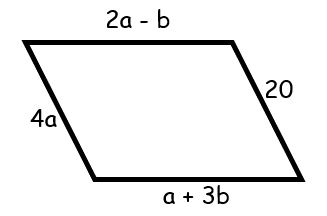
Use the parallelogram below for the next two questions.
Question 12
12.

What is the value of a?

Question 13
13.

What is the value of b?

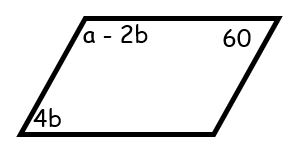
Use the parallelogram below for the next two questions.
Question 14
14.

What is the value of b?

Question 15
15.

What is the value of a?

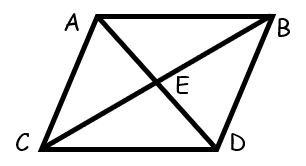
Use parallelogram ABCD below to answer questions 16-21.
Question 16
16.

If the measure of angle ACD = 65, then what is the measure of angle CDB?

Question 17
17.

If the measure of angle ACD = 65, then what is the measure of angle ABD?

Question 18
18.

If AC = 12, then BD = _______

Question 19
19.

If CB = 25, then CE = _______

Question 20
20.

If AC = 9x + 5, and BD = 6x + 17, find the value of x.

Question 21
21.

If AE = x + 22, and DE = 38, find the value of x.

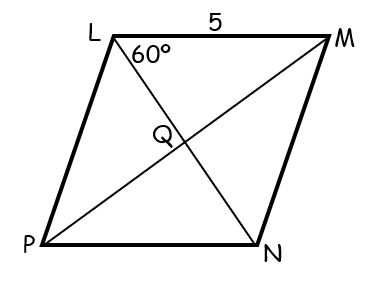
Use rhombus LMNP below to answer questions 22-30.
Question 22
22.

What is the measure of angle LMN?

Question 23
23.

What is the measure of angle LQM?

Question 24
24.

What is the measure of MN?

Question 25
25.

If the measure of angle LQP = 2x + 32, find the value of x.

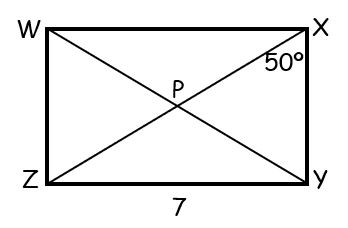
Use rectangle WXYZ below to answer questions 32-37. The diagonal XZ = 12
Question 26
26.

What is the measure of angle WXZ?

Question 27
27.

What is the measure of angle WPX?

Question 28
28.

What is the measure of angle WZP?

Question 29
29.

What is the measure of XZ?

Question 30
30.

What is the measure of WX?

Question 31
31.

What is the measure of WZ? Use Pythagorean Theorem and round your answer to the nearest tenth.

Question 32
32.

If WY = 5x + 3, and ZX = x + 15, find the value of x.

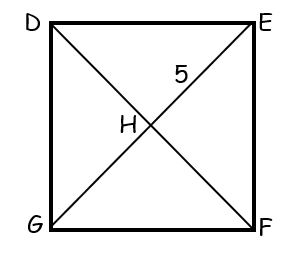
Use square DEFG below to answer questions 38-41.
Question 33
33.

What is the measure of angle GHF?

Question 34
34.

What is the measure of angle DGH?

Question 35
35.

What is the measure of HF?

Question 36
36.

What is the measure of DE? Use Pythagorean Theorem and round your answer to the nearest tenth.

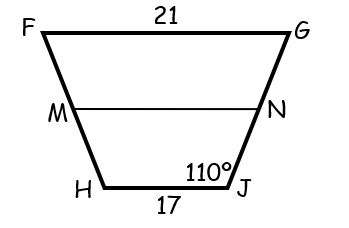
Use isosceles trapezoid FGHJ below to answer questions 42-49. MN is the midsegment, and GJ = 8.
Question 37
37.

Which of the following pairs of angles are base angles.

Question 38
38.

What is the measure of angle G?

Question 39
39.

What is the measure of angle H?

Question 40
40.

What is the measure of MN?

Question 41
41.

What is the measure of FM?

Question 42
42.

What is the measure of FH?

Question 43
43.

What is the measure of angle FMN?

Question 44
44.

What is the measure of angle JNM?

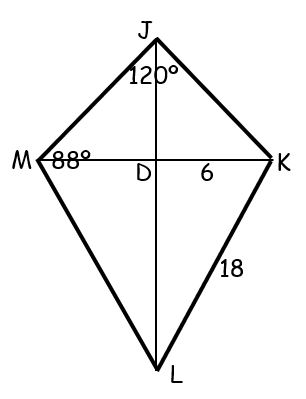
Use kite JKLM below to answer questions 50-55.
Question 45
45.

What is the measure of angle K?

Question 46
46.

What is the measure of angle JDM?

Question 47
47.

What is the measure of angle L?

Question 48
48.

What is the measure of KM?

Question 49
49.

What is the measure of LD? Use Pythagorean Theorem and round your answer to the nearest tenth.

Question 50
50.

What is the measure of ML?

For questions 56-64, determine the most specific quadrilateral shown.
Question 51
51.

Question 52
52.

Question 53
53.

Question 54
54.

Question 55
55.

Question 56
56.

Question 57
57.

Question 58
58.

Question 59
59.

For the final section of the review, determine what kind of quadrilateral is provided using coordinates. First, graph the quadrilateral, then find the slopes of all the sides, then find the distances of all the sides. With that information, decide the correct type of quadrilateral.
Quadrilateral #1: A(-5, 1), B(-3, 5), C(5, 1), D(3, -3)
Question 60
60.

Graph quadrilateral ABCD.

Question 61
61.

What is the slope of AB? Make sure to simplify.

Question 62
62.

What is the slope of BC? Make sure to simplify.

Question 63
63.

What is the slope of AD? Make sure to simplify.

Question 64
64.

What is the slope of DC? Make sure to simplify.

Question 65
65.

What is the length of AB? Leave your answer in radical form.

Question 66
66.

What is the length of BC? Leave your answer in radical form.

Question 67
67.

What is the length of AD? Leave your answer in radical form.

Question 68
68.

What is the length of DC? Leave your answer in radical form.

Question 69
69.

What kind of quadrilateral is ABCD?

Quadrilateral #2: P(-3, 0), Q(0, 4), R(6, 3), S(0, -5)
Question 70
70.

Graph quadrilateral PQRS.

Question 71
71.

What is the slope of PQ? Make sure to simplify.

Question 72
72.

What is the slope of QR? Make sure to simplify.

Question 73
73.

What is the slope of PS? Make sure to simplify.

Question 74
74.

What is the slope of SR? Make sure to simplify.

Question 75
75.

What is the length of PQ? Leave your answer in radical form.

Question 76
76.

What is the length of QR? Leave your answer in radical form.

Question 77
77.

What is the length of PS? Leave your answer in radical form.

Question 78
78.

What is the length of SR? Leave your answer in radical form.

Question 79
79.

What kind of quadrilateral is PQRS?