Let’s Be Playful with our Inner Scientist. Watch the "Football to the Face" video below.
Let’s Be Playful with our Inner Scientist. Watch the "Football to the Face" video below.
In this physics system (the ball and the face) consider only those two objects before the collision and only those two objects after the collision.
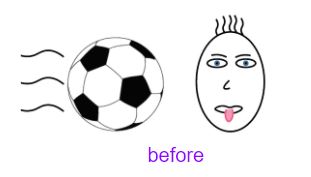
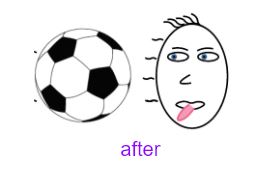
Now Sketch a before collision picture of the system and after collision picture of the system.
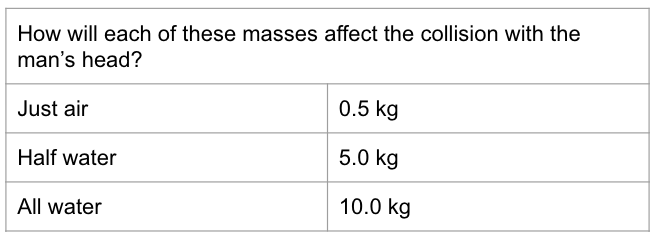
Rank the different masses (1= most force, 3=least force) that would create the most force in this situation.
Just air
Half water
All water
1 = most force
2 = medium force
3 = least force
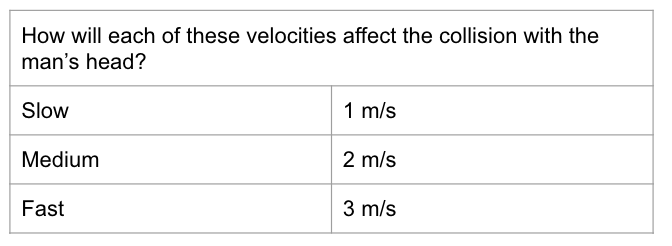
Rank the different velocities (1= most force, 3=least force) that would create the most force in this situation.
Slow
Medium
Fast
1 = most force
2 = medium force
3 = least force
According to your work in question #2 above, which two combinations of mass and velocity would create a Mass
Take another look at just the impact of the ball on the head (3:39 in video "Football to the Face").
What is happening to the Mass

Take another look at just the impact of the ball on the head (3:39 in video "Football to the Face").
What is happening to the Mass
Take another look at just the impact of the ball on the head (3:39 in video "Football to the Face").
What is happening to the Mass
Consider only the ball and it's Mass
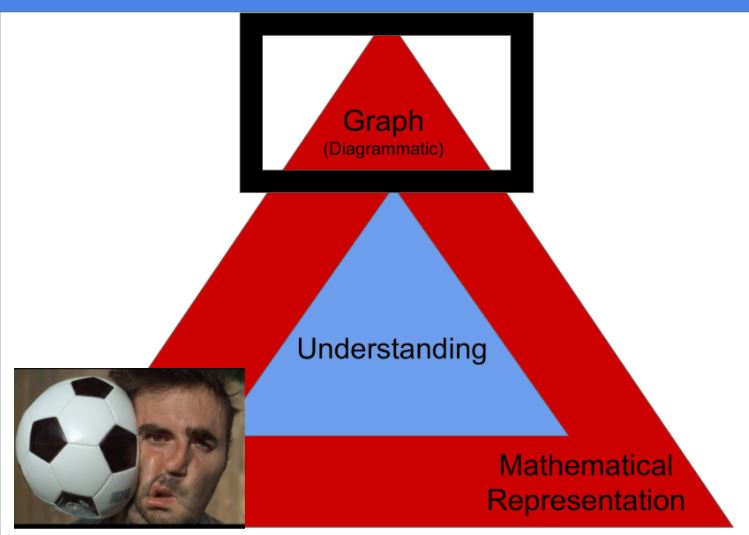
Consider only the head and it's Mass
Consider the system (Ball and Head) and the Mass
Let’s Be Playful with our Inner Scientist. Watch this short video on Momentum.
In the video above what is the "silly" word used to describe momentum (Mass
Take another look at just the impact of the ball on the head (3:39 in video "Football to the Face").

If we think of the head as two objects: 1. the skull and separately 2. his lips, where do you see examples of Newton's first law of motion (Things in motion stay in motion, things are rest stay at rest, unless acted upon by an outside force) ?
TWO THINGS TO NOTE:
MassVelocity has already been named:
1. Momentum and abbreviated with p
2. If we look closely, we realize we have oversimplified a bit: the ball keeps moving a bit at the end so we should include its Mass Velocity (momentum or p) after and technically even if his head isn’t moving much at the beginning we should still include its MassVelocity (momentum or p) before.
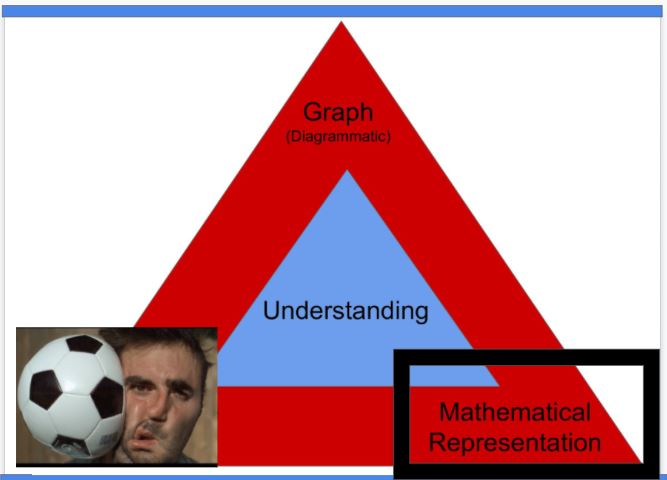
VISUALIZATION OF MATH MODEL
MassVelocitybefore = MassVelocityafter
MassVelocity of Ballbefore + MassVelocity of Headbefore =
MassVelocity of Ballafter + MassVelocity of Headafter
MassVelocity of Ballbefore + MassVelocity of Headbefore = MassVelocity of Ballafter + MassVelocity of Headafter
Which of these would be the best (easiest) ways (2 choices) to write a math formula for this situation?
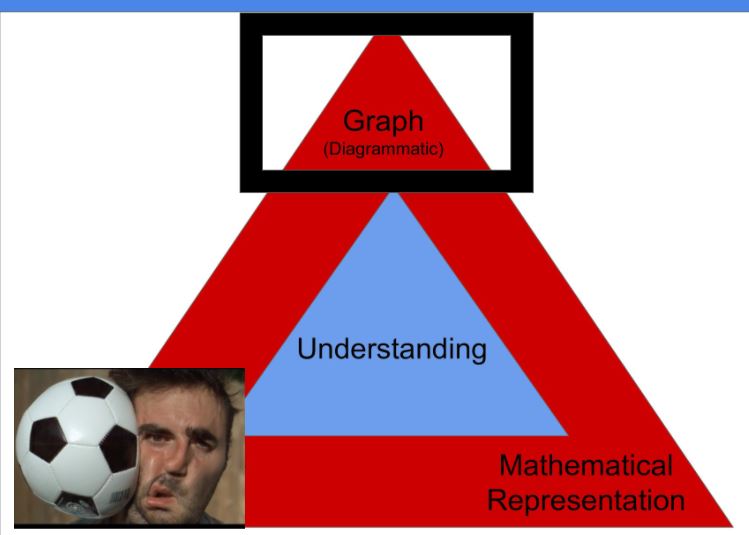
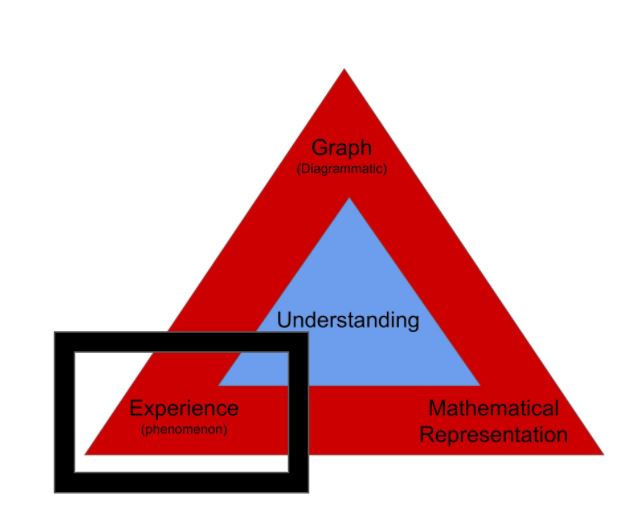
Graphing the Ball hitting Head situation (walk the triangle) Go to Desmos and graph the following data. Use the a value slider to find the best fit line for the ball and the head.
https://www.desmos.com/calculator/ayqi50ymrt
Data for your graph.
Time (in milliseconds ms)
Once your graph has been completed in Desmos insert an image here. (Screen shot or download image from Desmos first then insert that image using the image button available when you edit background)
Step one select the share button on the top right of your screen
(looks like a window with an arrow next to your name)

Step two choose export image
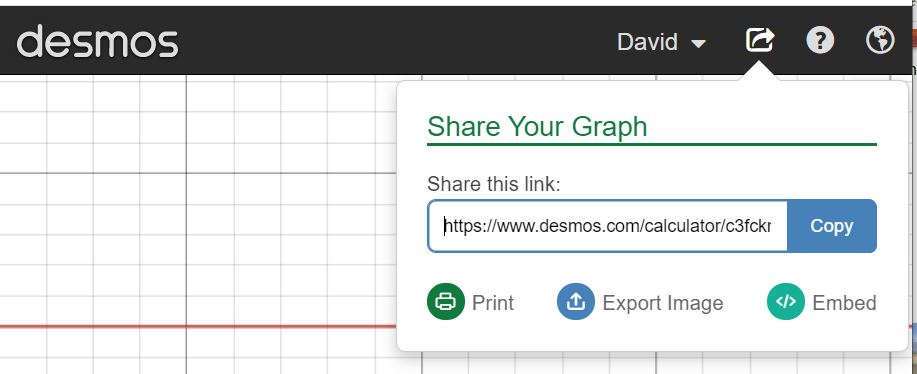
Step three download PNG
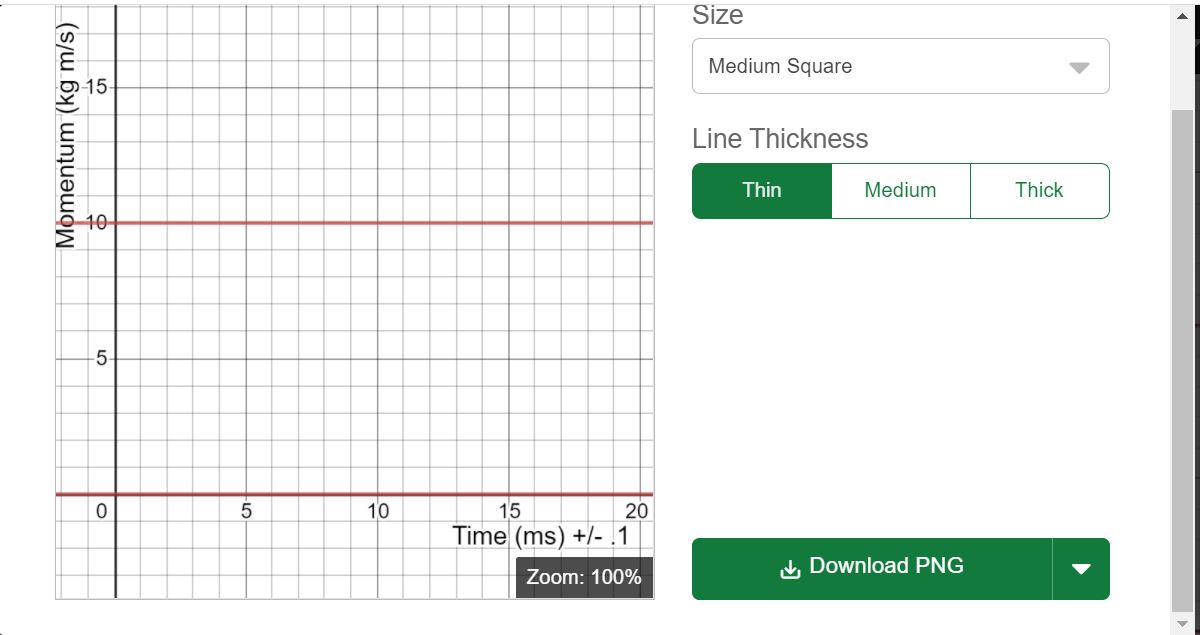
If you were to add the momentum of the ball to the momentum of the head at any point on your graph (add the two values together) what would the total momentum be?
The variables (a) and (b) represent the change in momentum of the ball and the head respectively. If you add the change of momentum of the ball to the change of momentum of the head (a+b),
what is the total change of momentum in the system?
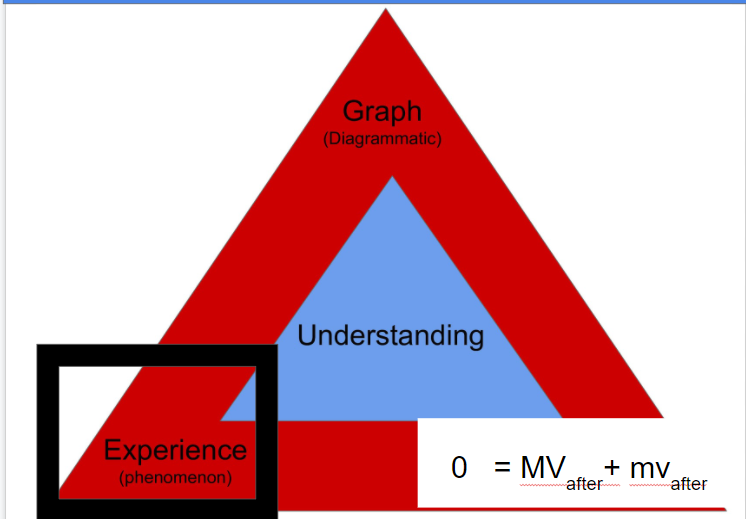
So if: MVbefore+ mvbefore = MVafter+ mvafter and it starts with zero, ( 0 + 0 = MVafter+ mvafter)
how can anything move? (Give your theory on this apparently impossible situation)
Watch this slow motion video of a model rocket (same concept as a full size rocket). The rocket had no momentum (momentum =0) but then it did!
The system, in this case, is the rocket and the rocket fuel. Decribe, in your own words, what is happening to both of those things in the video. (include before and after launch and include the direction each is going)
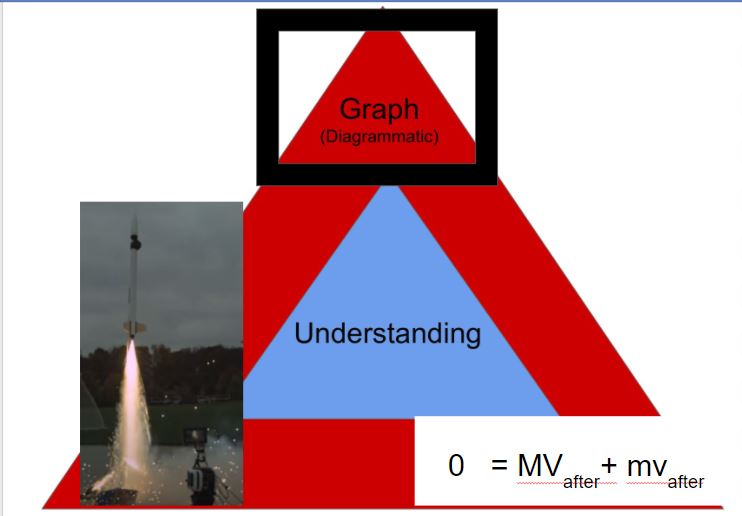
Physics: Velocity is speed with direction which is why we can have negative and positive velocity. Momentum is MassVelocity so we would then be able to have negative and positive momentum. Normally, in physics world, down is negative and up is positive. The rocket, therefore, has positive momentum and the fuel has negative momentum.
Graphing the Rocket system (walk the triangle) Go to Desmos and graph the following data. Use the a value slider to find the best fit line for the rocket and the rocket fuel.
https://www.desmos.com/calculator/wk2nv5o0ob
Data for your graph:
Once your graph has been completed in Desmos insert an image here. (Screen shot or download image from Desmos first then insert that image using the image button available when you edit background)
Step one select the share button on the top right of your screen
(looks like a window with an arrow next to your name)
Step two choose export image
Step three download PNG
Physics: Velocity is speed with direction which is why we can have negative and positive velocity. Momentum is MassVelocity so we would then be able to have negative and positive momentum. Normally, in physics world, down is negative and up is positive. The rocket, therefore, has positive momentum and the fuel has negative momentum.
If you add up the momentum of the rocket and the momentum of the rocket fuel, at any point on your graph, what is the total momentum?
Check for understanding.
Walk the triangle of this system. (to make it easier to see we will call going forward (the best way to describe the snow and train) as postive and, although there is no motion backwards it would be negative.
Here is a graph for the train and snow system. Sketch the graph for the momentum of the train, the momentum of the snow, and graph total momentum as well.
It's not just mass, it's not just velocity, but it seems to be Mass
According to your work in question #2 above, which 3 combinations of mass and velocity will create the largest force (have the biggest Mass