EMS: 2.1 (2/8) Version B
star
star
star
star
star
Last updated about 3 years ago
9 Nsɛmmisa

0

0
0
0
0
0
2
0
2
Eric said, “I took these photos from the same hill behind my house on three different nights. If half of the Moon is always illuminated and the other half is always dark, then why does the Moon look so different on different nights?”
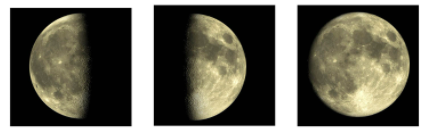
Phases of the Moon
Have you ever looked at the Moon and seen a face looking back at you? So have lots of other people—many cultures have myths about a face or other shapes on the surface of the Moon. Of course, the face on the Moon isn’t really a face. It’s an arrangement of large flat areas called maria (that’s Latin for seas, because early astronomers thought these areas were oceans) that were formed by volcanic eruptions. Whether the maria look like a face or something else to you, they are always facing Earth, even when they aren’t illuminated by light from the sun. The side of the Moon that faces Earth is always the same.
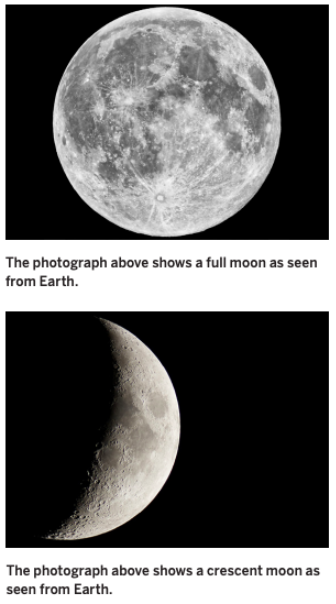
However, that doesn’t mean that the Moon always looks the same when we see it in the sky. When we look up at the Moon, what we see depends on where the Moon is in its orbit, the nearly circular path that it travels around Earth. You may know that the sun always illuminates half of the Moon, but because the Moon is constantly moving and changing position along its orbit, the half of the Moon that faces the sun doesn’t always face toward Earth. As the Moon moves around Earth, different parts of the Moon are illuminated by the sun. This makes the Moon look different from night to night. These changes in the Moon’s appearance are called the phases of the Moon, and you’ve probably seen them before. In the sections below, you’ll read about five phases of the Moon: the new moon, the crescent moon, the quarter moon, the gibbous moon, and the full moon.
How would you describe the term ‘orbit’, in context of the article?
Describe what causes the Moon to look different from night to night?
"From a view from Earth, The Moon always looks different each night because ..."
(think: if the moon wasn't moving, would it appear different from Earth?)
New Moon
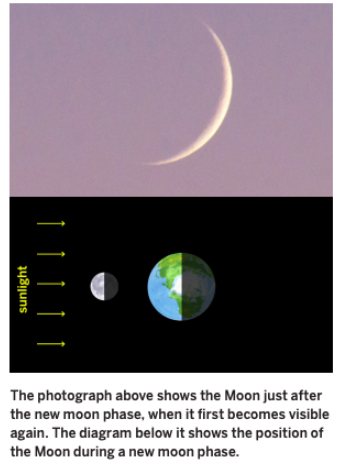
Sometimes, it’s hard to see the Moon from Earth at all. When the side of the Moon that faces Earth doesn’t get any light from the sun, we call it a new moon. During a new moon, the Moon is between Earth and the sun. As always, the sun illuminates half the Moon—but during a new moon, the half that’s illuminated is the half that faces away from Earth. Therefore, the side of the Moon that faces Earth is dark during a new moon.
The exact moment of a new moon, when the Earth-facing side of the Moon isn’t illuminated by the sun at all, always happens during the day. The new moon is not easily visible from Earth because the side of the Moon that faces us is dark at the same time that the sky is bright with daylight. This is because the Moon and the sun are always on the same side of Earth during a new moon.
Many cultures use calendars that are based on the phases of the Moon. Those calendars often use the new moon to mark the beginning of each month.
Crescent Moon
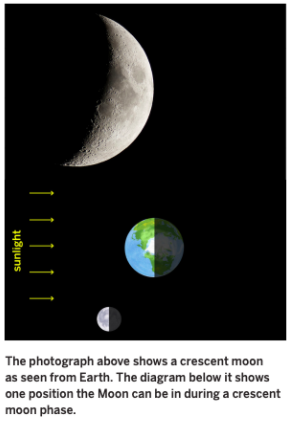
During the crescent moon phase, only a small section of the part of the Moon that faces Earth is illuminated. Half of the Moon is still illuminated by the sun, but we only see a small part of the illuminated portion. This means we see the Moon as a small sliver, or crescent.
Describe the position of the Sun, Earth, and Moon when you would see a New Moon from Earth?
Describe the position of the Sun, Earth, and Moon when you would see a Crescent Moon from Earth?
"A cresent moon happens when the half of the moon that is illuminated is (barely visable/ almost all visable). Therefore from earth we see .... on the moon."
(think: use the image to help you, where is the moon located?)
Quarter Moon
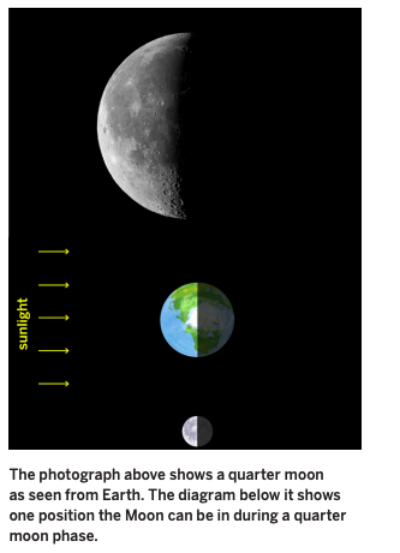
In the quarter moon phase, the Moon looks like a half-circle from Earth. Half of the side that faces Earth is in sunlight, and half is in darkness. Just as always, sunlight illuminates the half of the Moon that faces toward the sun, and from Earth we see half of that illuminated half. Half of a half is a quarter, and that’s why this phase is called a “quarter moon.”
Gibbous Moon
During a gibbous moon phase, the side of the Moon facing Earth is almost, but not quite, completely illuminated. Half of the Moon is still illuminated by the sun, and we see almost all of the illuminated half.
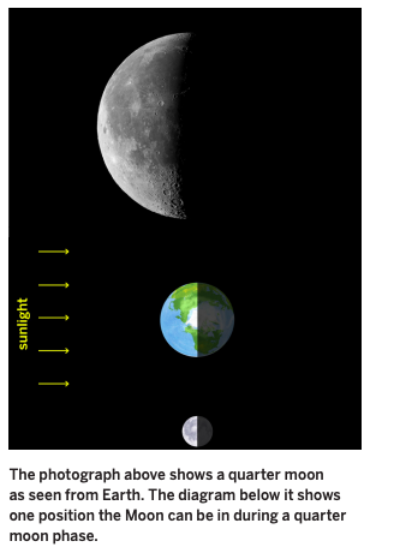
Describe the position of the Sun, Earth, and Moon when you would see a Quarter Moon from Earth?
Describe the position of the Sun, Earth, and Moon when you would see a Gibbous Moon from Earth?
"A Gibbous Moon happens when the half of the moon that is illuminated is (barely visable/ almost all visable). Therefore from earth we see .... on the moon."
(think: use the image to help you, where is the moon located?)
Full Moon
During a full moon, the Moon is on the opposite side of Earth from the sun. As always, the sun illuminates half of the Moon—and during a full moon, the side that’s being lit is the side we see! That also means the side of the Moon we don’t see is totally dark during a full moon. During a full moon, the entire side of the Moon that faces Earth is illuminated and easy to see.
No matter what phase the Moon is in, one thing is the same: half of the Moon is illuminated by the sun. What changes from night to night is how much of that half we can see from Earth. When the entire illuminated half of the Moon is facing Earth, we see a full circle of light, which we call a full moon. Then, as the Moon continues in its orbit around Earth, we see less and less of it until the illuminated half is facing directly away from Earth, and it seems to disappear. This happens when the illuminated half faces entirely away from Earth, and we call this a new moon. But don’t worry—the Moon is never out of sight for very long. As its orbit around Earth continues, the illuminated half of the Moon moves back into our view—just a little at first, but more and more each night until, about a month after the last full moon, it is finally full again.
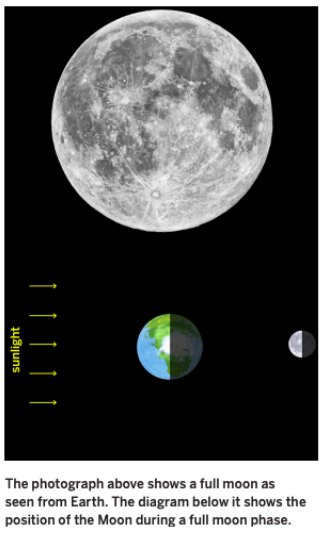
Describe the position of the Sun, Earth, and Moon when you would see a Full Moon from Earth?
"A Full Moon happens when the half of the moon that is illuminated is (barely visable/ almost all visable). Therefore from earth we see .... on the moon."
(think: use the image to help you, where is the moon located?)
Even though half of the moon is always illuminated by the sun, what factors play into why we sometimes see more or less than half of the moon on different nights?
CFS:
Accurately identifies the light on the moon based on its position
Accurately describes the cause and effect relationship between the sun’s light and illuminated objects