Some Go "Pop," Some Do Not

Last updated almost 5 years ago
22 questions
Note from the author:
Learning about different types of volcanoes and their locations in the world.
Background:
Volcanic eruptions range from mild to violent. When volcanoes erupt, the materials left behind provide information to scientists studying the Earth’s crust.
- Mild, or non-explosive eruptions, produce thin, runny lava that is dark in color, and low in light colored minerals called silica. During non-explosive eruptions, lava simply flows down the side of the volcano. Shield volcanoes produce these types of eruptions.
- Explosive eruptions, on the other hand, are gassy and do not produce much lava. Instead, the violent explosions hurl ash, and debris into the air. The materials left behind are light in color and high in light colored minerals called silica. Cinder cone volcanoes produce these types of eruptions. These materials help geologists determine the composition of the crust underneath volcanoes. Some volcanoes have both types of eruptions, and they are known as composite or strato-volcanoes.
Part 1: Read the description for each volcano on the data table. This will generally explain the type of eruptions one can expect from that volcano. Use the eruption description to determine the type of volcano it is and record your answer for each in the correct space on the data table. Use the background information above to help you.
1

Cerro Negro has had eruptions that have sent cinders and ash high into the air, damaging land and property.

1

Cotopaxi has had explosive pyroclastic flows from eruptions that have descended all sides of the mountain, with hot mud flows, called lahars, traveling more than 100 km. Occasionally, some eruptions will also cause lava to exit Cotopaxi’s vents and descend its slopes.

1

Eruptions of Etna are not always the same. Most occur at the mountain’s summit, where the energy released can be described as spectacular. Other eruptions occur on the flanks, where there are more than 300 vents that have generated lava flows that may, or may not, threaten nearby towns.

1

The seismic station at Puerto Ayora does not generally record earthquakes associated with the eruptions at Fernandina. Often, observers of eruptions note a lava pool within the volcano’s caldera and an almost black pyroclastic dust rising from it.

1

Erupting since 1983, slowly moving lava flows move gently down Kilauea’s slopes into the Pacific Ocean rarely affecting local towns.

1

Kilimanjaro has been dormant for thousands of years, scientists have discovered that the rock around the volcano was formed from alternating layers of ash and lava.

1

Mauna Loa's eruptions consist mainly of lava which generally remains near the summit crater and occasionally makes its way down to the black sand beaches along the Pacific Ocean.

1

The 1980 eruption blew the top off the Mt. Sain. Helens' mountainside drastically changing its height. Light-colored ash covered thousands of square kilometers. In 2004, another eruption caused no damage as minor amounts of dark volcanic dust were released from the central vent.

1

The Okmok caldera formed when a portion of this giant mountain collapsed into its magma chamber. This occurred after a long, slow eruption of runny lava left the magma chamber empty and unable to hold up the tremendous weight of the mountain.

1

Violent shaking and mass eruption of light-colored material created Paricutan, over 1,100 feet in a matter of a few years.

1

Pavlov's eruptions have sent ash columns 10 km into the air. Occasionally, small eruptions have caused lava flows.

1

Massive ash producing eruptions have also been responsible for creating large landslides along the slopes of Pinacate.

1

Ash and debris from a 1991 eruption destroyed homes, crops, and roads within 52,000 km2 around Pinatubo. The previous eruption only resulted in minor seismic activity.

1

Popocatepetl has been called the “Smoking Mountain” due to the occasional release of dark volcanic dust clouds from its summit during some eruptions. During other eruptions, damaging avalanches have been reported. Mexico City was once forced to close its airport for 14 hours because huge columns of grey/white ash made it too dangerous for pilots to fly.

1

Tavurvur's eruptions have caused earthquakes powerful enough to create tsunamis and have left 1–2 m of ash on nearby buildings causing many to collapse. Other eruptions were not noticeable enough to worry the citizens of the nearby port town of Rabaul.

1

Vesuvius' eruptions have included tremendous ash fall, lahars and pumice stones “raining” from the sky. In 79AD the wealthy cities Herculaneum and Pompeii were quickly buried during one such eruption. Other eruptions throughout history have resulted in predictable lava flows.

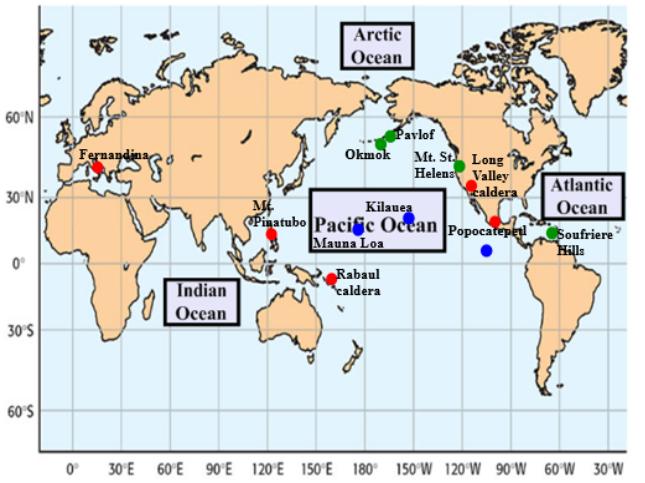
Part 2: After learning about the different types of eruptions. Study the map below to observe their location in the world. You will use the map provided below to help you answer the analysis questions. Carefully observe the key below to understand how to read the map.
Map Key:
Red circle plots = cinder cone volcano
Green circle plots = composite volcanoes
Blue circle plots = shield volcano
1

According to the map, where are most of the non-explosive eruptions (shield volcanoes, such as Kilauea) generally located?

1

According to the map, where are volcanoes that erupt both explosively and non-explosively (composite volcanoes, such as Etna) generally located?

2

If volcanoes receive magma from the Earth below them, what can you say about the amount of silica in magma beneath Earth’s continental crust? How do you know? (Hint: Cinder-cone volcanoes often form on land).

2

What can you say about the amount of silica in magma beneath Earth’s oceanic crust? How do you know? (Hint: Think about which type of volcano most often forms above oceanic crust – check your map!)

2

Volcanoes are present on other planets. If a planet had only non-explosive volcanoes on its surface, what would we be able to infer about the silica content on that planet?

1

In the description of Mt. Etna’s eruption, what does the word “summit” mean?