1. Classify the triangle by its SIDES and ANGLES.
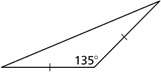
1. Classify the triangle by its SIDES and ANGLES.
1. Classify the triangle by its SIDES and ANGLES.
What would you use to prove corresponding parts of congruent triangles congruent?
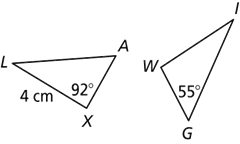
Use the following figure below for 3- 5.
If ∆ALX is congruent to ∆GIW, then what is measure of angle I ?
Complete the sentence:
If ∆ALX is congruent to ∆GIW, then segment LA is congruent to...
Complete the sentence:
If ∆ALX is congruent to ∆GIW, then ∆XAL is congruent to...
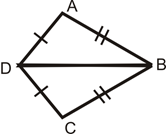
Can you prove ∆ABD ≅ ∆CBD by one of the following theorems?
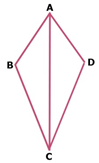
Can you prove ∆ABC ≅ ∆ADC by one of the following theorems?
Given: Segment AC bisects angle BAD and angle BCD.
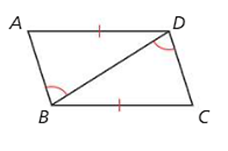
How would you conclude that ∆ABD ≅ ∆CDB ?
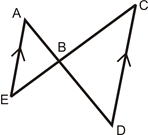
If segment AE is parallel to segment CD, then which of the following statement would be true?
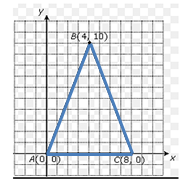
Classify the triangle with vertices A (0, 0), B (4, 10), and C (8, 0) by its sides and angles?
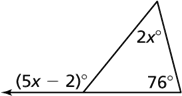
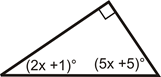
What is the value of the exterior angle?
Hint: The exterior angle is the sum of the two nonadjacent interior angles.
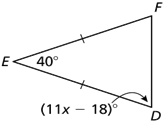
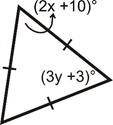
Determine the value of x.
Note: You must first figure out the measure of the base angle in the isosceles triangle.
Determine the value of x.
Given an equilateral triangle, determine the values of x.
Note: You must first figure out the measure of an angle in an equilater triangle.
Given an equilateral triangle, determine the values of y.
Note: You must first figure out the measure of an angle in an equilater triangle.
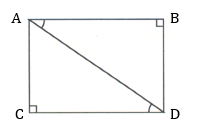
Prove that ∆ABD is congruent to ∆DCA by matching the statements to the correct reasons.
| Draggable item | arrow_right_alt | Corresponding Item |
|---|---|---|
∠B ≅ ∠C | arrow_right_alt | Given |
| arrow_right_alt | All right angles are congruent. | |
∆ABD ≅ ∆DCA | arrow_right_alt | Given |
∠BAD ≅ ∠CDA | arrow_right_alt | Reflexive Property |
∠B & ∠C are right angles | arrow_right_alt | AAS Theorem |
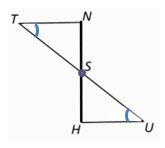
Prove that triangle TSN is congruent to triangle USH by putting the steps of the following proof in logical order.
(Definition of a Midpoint)
∠T ≅ ∠U and S is the midpoint of segment NH (Given Facts)
∆TSN ≅ ∆USH (AAS Theorem)
∠TSN ≅ ∠USH (Vertical Angles are Congruent)
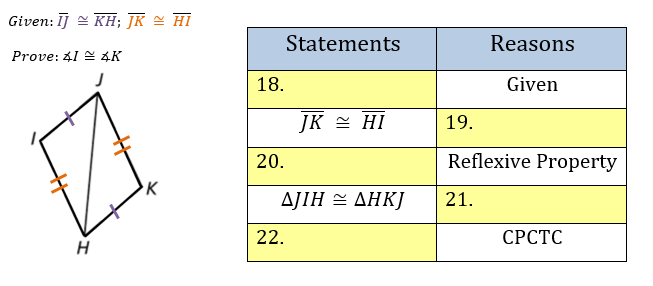
For problems 18 – 22, fill in the missing statements or reasons to complete the proof.
Fill in the missing statement from above.
Fill in the missing reason from above.
Fill in the missing reason from above.
Fill in the missing reason from above.
Fill in the missing statement from above.