Lactose Tolerance Bell Work
Background: Lactose Tolerance
Lactose is a disaccharide (made of two sugar molecules), and is commonly found in milk. When we are born, we produce an enzyme called lactase that breaks down lactose into the monosaccharides glucose and galactose. Glucose and galactose can diffuse through the small intestine and be used for energy in cellular respiration. Most mammals cease producing lactase after they no longer drink their mother’s milk, and therefore become lactose intolerant.
A gene located on chromosome 2, called the MCM6 gene, controls when the lactase gene is turned on/
off. Once the lactase gene has been turned off, lactose is no longer broken down and cannot diffuse
through the small intestine. Instead, the lactose passes into the colon, & bacteria in the colon
break down lactose for energy- in doing so produce large amounts of gas that cause the symptoms associated with lactose intolerance. Symptoms of lactose intolerance include cramps, diarrhea, nausea, bloating, flatulence (passing gas), or vomiting and vary by the amount of lactose an individual has consumed.
At some point in human history, a mutation occurred in the MCM6 gene that prevented the lactase gene from being turned off, and allowed individuals with this mutation to continue consuming lactose into adulthood. Archeological records indicate that human populations in North Africa and the Middle East had domesticated cattle around 9,000 years ago. This practice later moved into Europe. In these populations the mutation that allowed for lactose tolerance was a clear advantage, and allowed individuals to continue consuming dairy products from cattle into adulthood. This was particularly advantageous in environments where drought was common, and milk could be used as a source of water. In populations without domesticated cattle, the mutation would not be as advantageous, and lactose tolerance was less common in those populations.
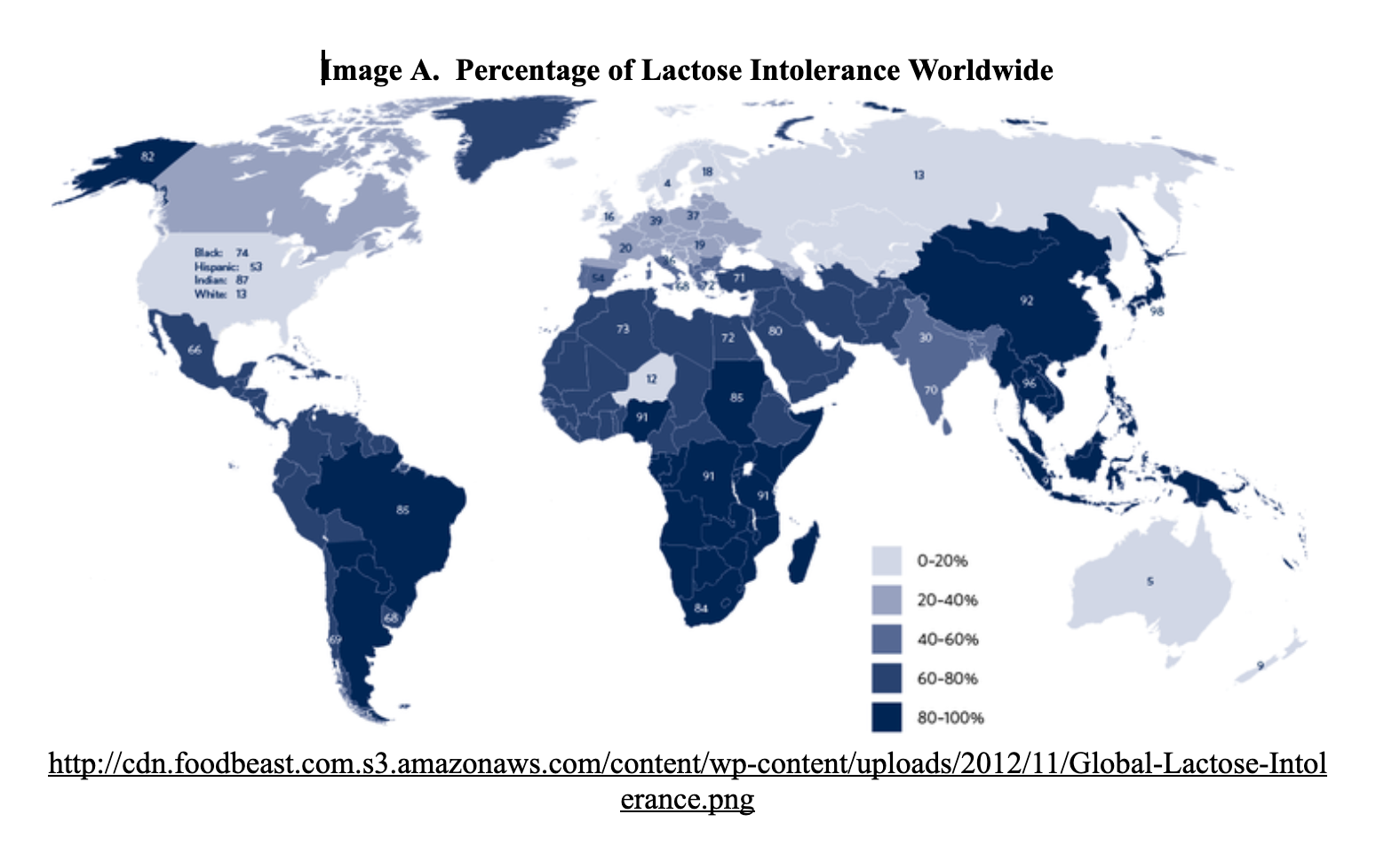
Currently, approximately 75% of the world’s population remains lactose intolerant. The link between cattle domestication and lactose tolerance becomes even more evident when it is broken down by region. Approximately 5% of Northern Europeans, 10% of Americans, 50% of the French/Spanish, and 99% of Chinese people are lactose intolerant. The following map contains average percentages of the human population that is lactose intolerant in countries throughout the world.