Case Study 3: Huntington's Disease
star
star
star
star
star
Last updated about 5 years ago
7 Nsɛmmisa

1
1
1
1
1
1
1
Huntington’s disease (HD) is a brain disease that is passed down in families from generation to generation. It is caused by a mistake in the DNA instructions that build our bodies and keep them running. DNA is made up of thousands of genes, and people with HD have a small error in one gene, called huntingtin. Over time this error causes damage to the brain and leads to HD symptoms.
HD causes deterioration in a person’s physical, mental, and emotional abilities, usually during their prime working years, and currently has no cure. Most people start developing symptoms during adulthood, between the ages of 30 to 50, but HD can also occur in children and young adults (known as juvenile HD or JHD). HD is known as a family disease because every child of a parent with HD has a 50/50 chance of inheriting the faulty gene. Today, there are approximately 41,000 symptomatic Americans and more than 200,000 at-risk of inheriting the disease.
The symptoms of HD can vary a lot from person to person, but they usually include:
Personality changes, mood swings & depression
Forgetfulness & impaired judgment
Unsteady gait & involuntary movements (chorea)
Slurred speech, difficulty in swallowing & significant weight loss
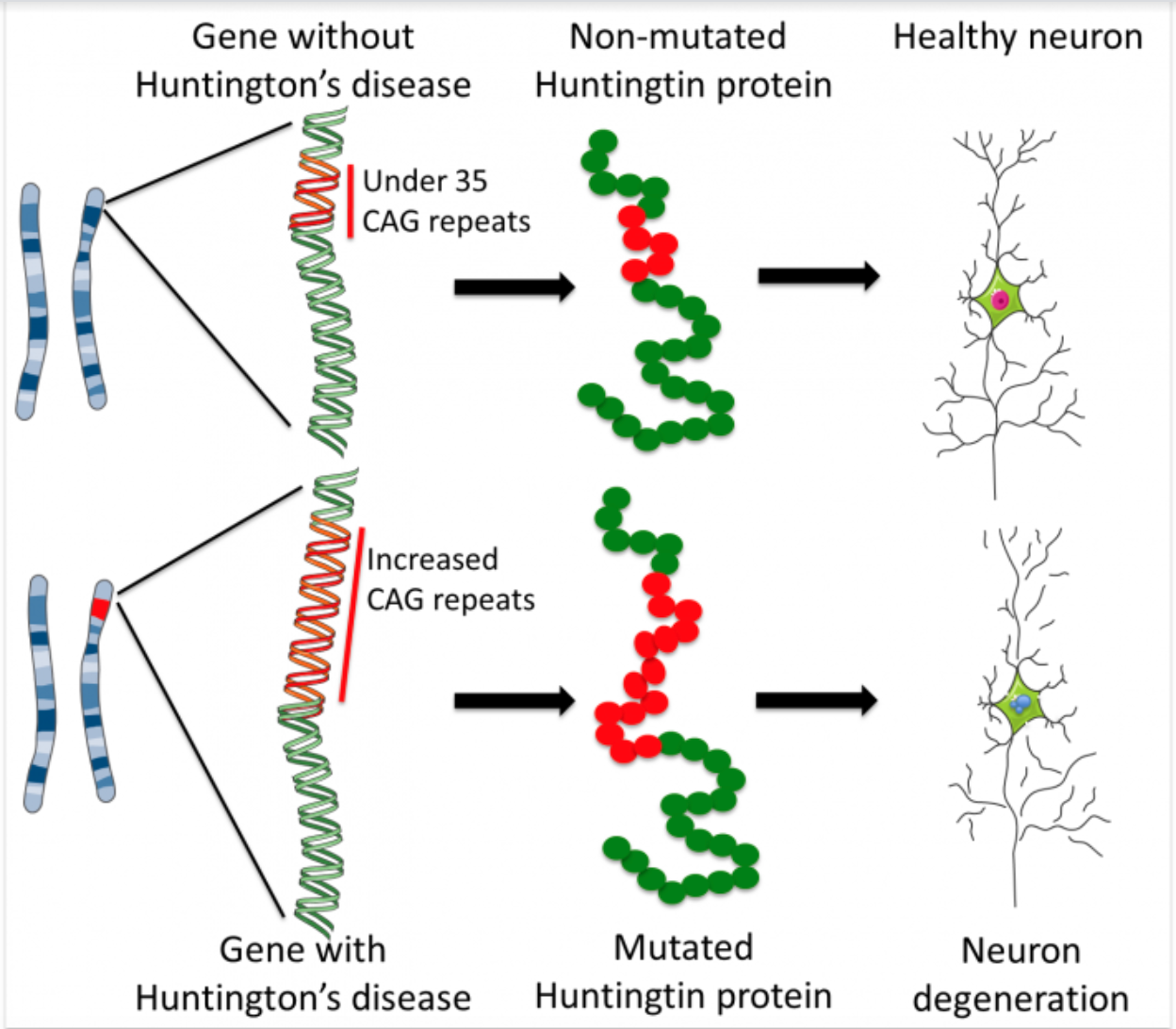
The DNA error that causes HD is found in a gene called huntingtin. This gene was discovered in 1993. Everyone has the huntingtin gene, but only those that inherit the mistake, known as the HD mutation, will develop HD and risk passing it on to their children. Genes are made up of the nucleotide “letters” A,G,C, and T, which form a code that is read in groups of three. HD is caused by a stretch of the letters C-A-G in the huntingtin gene which repeat over and over, too many times…CAGCAGCAGCAGCAG. This is known as a CAG repeat expansion. In the huntingtin gene, most people have around 20 CAG repeats, but people with HD have around 40 or more. Every person who has this CAG repeat expansion in the HD gene will eventually develop the disease, and each of their children has a 50% chance of developing HD.
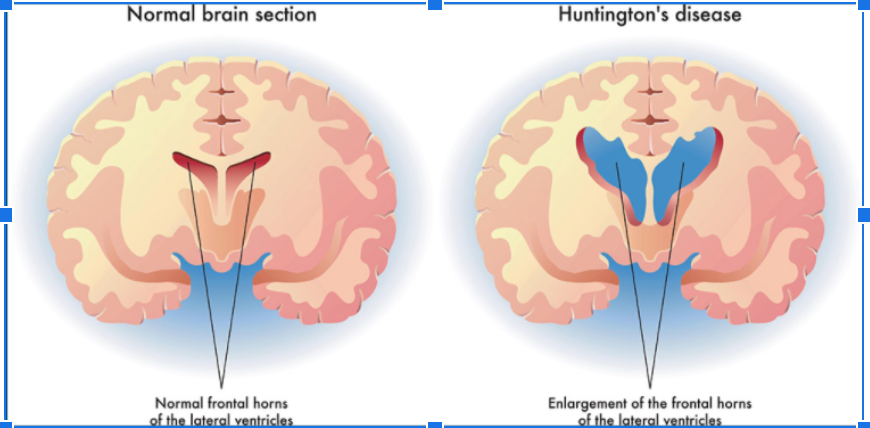
Our genes are like an instruction manual for making proteins, the machines that run everything in our bodies. The huntingtin gene (DNA) contains instructions that are copied into a biological message (RNA) which makes the huntingtin protein. The huntingtin protein is very large and seems to have many functions, especially as the brain is developing before birth, but it is not fully understood. We know that the extra CAG repeats in people with HD cause the huntingtin protein to be extra-long and difficult to maintain, which makes it difficult for it to do its job. Over many years, this “mutant” huntingtin protein forms clumps in brain cells, and causes them to become damaged and die. The most vulnerable part of the brain in HD is called the striatum, and it controls movement, mood, and memory. Damage to the striatum over time is what causes the symptoms of HD.
Does the insertion of CAG’s in the mutant Huntingtin gene affect the mRNA transcript? Make a claim to answer the question.
Provide reasoning to tie the evidence you have from transcription in question 1, to your claim above in question 2.
Does the insertion of CAG’s in the mutant Huntingtin gene affect the amino acid sequence? Make a claim to answer the question.
Provide reasoning to tie the evidence you have from translation in question 1 to your claim above in question 4.
Does the sequence of amino acids affect the shape of the Huntingtin protein? Make a claim and provide evidence from figure 2.
How does the shape of the mutated Huntingtin protein slowly kill someone? Reference the bolded paragraph in the background information and figures 2 (neurons) and 3 (brain) in your answer.