02.08.21 - Balancing Chemical Equations
star
star
star
star
star
Last updated over 5 years ago
51 Nsɛmmisa
1
1
1
1
1
1
1
1
1
1
1
1
1
1
1
1
1
1
1
1
How are you doing today?
What was the highlight of your weekend?
Examine the following reaction, then identify the reactants and products:
H2O2 --> H2O + O2
H2O2
O2
H2O
Reactant(s)
Product(s)
Compare and contrast reactants and products in a chemical reaction.
What does the smiley face in the simulation indicate?
Balance the 'Make Ammonia' reaction. How many total molecules are on the reactants and products side?
Balance the 'Make Ammonia' reaction. How many total atoms are on the reactants and products side?
Balance the 'Separate Water' reaction. How many total molecules and how many total atoms are on each side of the balanced equation?
2 molecule
3 molecules
6 molecules
1 atom
2 atoms
3 atoms
6 atoms
9 atoms
Reactant side
Product side
Balance the 'Combustion of Methane' reaction. How many total molecules and how many total atoms are on each side of the balanced equation?
1 molecule
2 molecules
3 molecules
1 atom
2 atoms
4 atoms
6 atoms
Reactant side
Product side
Which of the following statements about balanced chemical equations is correct?
Play Level 1 of the Balancing Equation game.
Take a screenshot of your score and put it in the 'Show Your Work' box below. (Don't know how to take a screenshot? Click here to find out how!)
Write down two strategies that you used to balance chemical equations.
Play Level 2 of the Balancing Equation game.
Take a screenshot of your score and put it in the 'Show Your Work' box below. (Don't know how to take a screenshot? Click here to find out how!)
What do you find most difficult about balancing chemical equations so far?
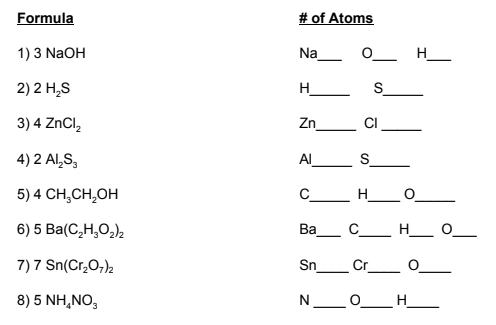
For questions 13-20, state how many of each atome there is. See the example below:

Answer: 4, 2
Consider the equation from the 'Making Ammonia' example:

What are the numbers in green and blue called, and what do they represent?
The number of a specific type of atom
Subscripts
The number of molecules
Coefficients
Green numbers
Blue numbers
The equation from the previous question can also be written as follows:

How is this equation different from the one in the previous question?
Which of the following coefficients could you use in a balanced chemical equation?
If you were balancing an equation containing the O2 molecule, which of the following would be correct representations of O2 and its coefficient?
Examine equation a and equation b below. Both are balanced, but equation b is the correct way to write a balanced equation:
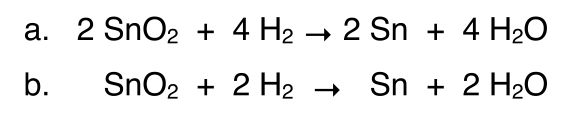
Answer the following questions:
What is the relationship between the coefficients in equations a and b?
How can you check if an equation is written in the correct way after you've balanced it?
Play Level 3 of the Balancing Equation game.
Take a screenshot of your score and put it in the 'Show Your Work' box below. (Don't know how to take a screenshot? Click here to find out how!)
Are there any other strategies you found for balancing?
Following along with your teacher, click on the 'show your work' box below and balance the equation.
Enter the coefficients in the following format:
a, b, c, d
where a is the first coefficient, b is the second, c is the third, and d is the fourth.
Following along with your teacher, click on the 'show your work' box below and balance the equation.
Enter the coefficients in the following format:
a, b, c, d
where a is the first coefficient, b is the second, c is the third, and d is the fourth.
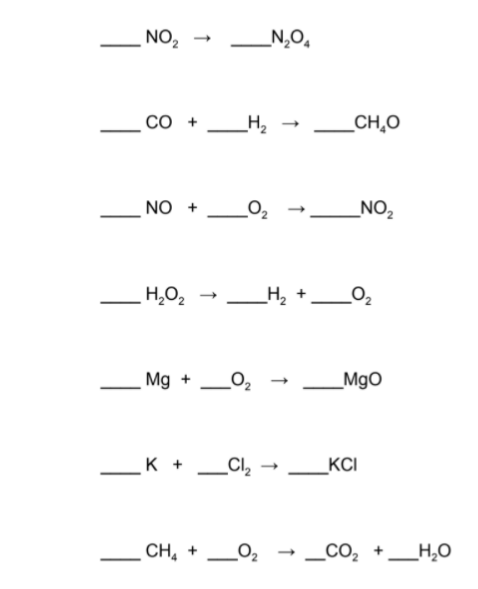
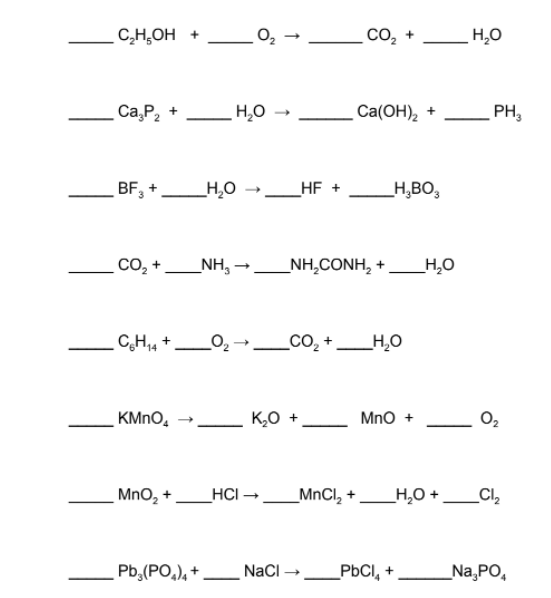
Now that you've been introduced to balancing equations, it's time to do some practice. The key thing to remember about balancing chemical equations is that it is a trial and error process. Don't be afraid to try something, erase it, try something else, erase that, try another thing - you get the picture.
A few reminders and hints as you work through these...
You may only change the coefficients - never change the subscripts!
If polyatomic ions are on both sides of the equation, treat them as a unit and balance them first.
Balance the metals, then the nonmetals.
If the equation has O2 or H2, balance those last.
For combustion reactions, balance carbon first, hydrogen second, and oxygen last (C-H-O)
Make sure that the coefficients are in the most reduced ratio.

Na:___ O:___ H:___
H:___ S:____
Zn:___ Cl:___
Al:___ S:___
C:___ H:___ O:___
Ba:___ C:___ H:___ O:___
Sn:___ Cr:___ O:___
N:___ O:___ H:___
What are the coefficients?
What are the coefficients?
What are the coefficients?
What are the coefficients?
What are the coefficients?
What are the coefficients?
What are the coefficients?
What are the coefficients?
What are the coefficients?
What are the coefficients?
What are the coefficients?
What are the coefficients?
What are the coefficients?
What are the coefficients?
What are the coefficients?
What are the coefficients?
What are the coefficients?
What are the coefficients?
What are the coefficients?
What are the coefficients?
What are the coefficients?
What are the coefficients?
What are the coefficients?