Log in
Sign up for FREE
arrow_back
Library

Energy diagrams and LOL charts

star
star
star
star
star
Last updated over 5 years ago
9 questions
1
1
1
1
1
1
1
1
1
Question 1
1.

Question 2
2.

Question 3
3.

Question 4
4.

Question 5
5.

Question 6
6.

Question 7
7.

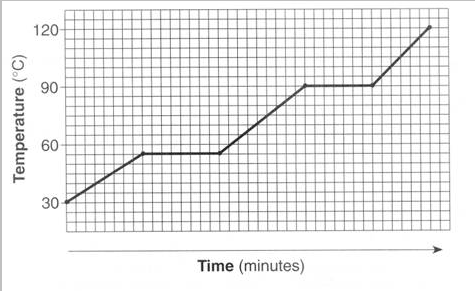
The graph below represents the heating curve of a substance that starts as a solid below its freezing point. What might the graph look like if the hotplate used to heat the substance were much hotter than the one used to generate this graph? Draw the new heating curve.

Question 8
8.

Fill in the LOL diagram for ice beginning at 0°C and ending at liquid water at 0°C.

Question 9
9.

Fill in the LOL diagram for when water at 120°C cools down and condenses on a cool window.

When a substance condenses, (select all that apply)
Energy is required
The process is exothermic
The surroundings would gain energy
The molecules move farther apart
The temperature decreases
The substance goes from gas to liquid
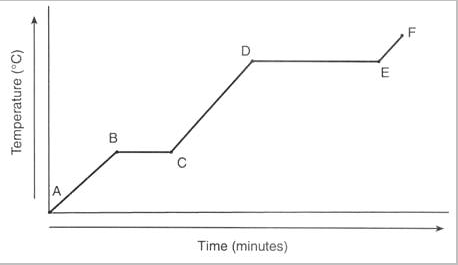
Below is a heating curve. What would be another unit that could be used on the x-axis instead of time and the shape of the curve would remain the same?
A . Energy added
B . solidification/Freezing
C . vaporization/Boiling
D. Kinetic energy
Identify the process that takes place during line segment DE of the heating curve.

A . melting
B . solidification/Freezing
C . vaporization/Boiling
D. condensation
Given the heating curve where substance X starts as a solid below its melting point and is heated uniformly:
Identify where the average kinetic energy is increasing in our graph. (select all that apply)
A . segment AB
B . segment BC
C. segment CD
D. segment DE
E. segment EF
How would the particles appear at point F in this graph?

A . The particles of the substance would be very close together
B . The particles would be far apart enough to move around one another in a circular like motion
C . The particles would be very far apart, filling up the entire container with their rapid movement.
The graph below represents the heating curve of a substance that starts as a solid below its freezing point.

What is the melting point of this substance?
A . 30 deg C
B . 55 deg C
C . 90 deg C
D . 120 deg C