Unit 3 - Colonial America final test 1
star
star
star
star
star
Last updated over 5 years ago
30 Nsɛmmisa
1
1
3
1
2
1
1
2
1
1
2
1
1
2
1
1
1
1
2
1
1
1
1
2
1
1
1
1
1
2
What did people, who disagreed with the Puritans, often do? (Lesson 1, slides 63 - 67)
The Pilgrims were better prepared than the Puritans because (Lesson 1, Slides 63 - 67)
Match the word that completes the sentence (Lesson 1, slides 63 - 67)
| Draggable item | arrow_right_alt | Corresponding Item |
|---|---|---|
_________________is the practice of owning people and forcing them to work. | arrow_right_alt | covenant |
Puritan families signed a _____________, promising to follow the rules of the church | arrow_right_alt | tolerate |
Roger Williams believed that government should ______________ people with different religious views. | arrow_right_alt | slavery |
Why did Philadelphia become a busy port? (Lesson 2, slides 50 - 55) RESTATE the question and ANSWER the question.
Match the word that completes the sentence. (Lesson 2, slides 50 - 55)
| Draggable item | arrow_right_alt | Corresponding Item |
|---|---|---|
_________________ appointed the governor and ran the colony as a business. | arrow_right_alt | patroons |
Wealthy Dutch men, also known as ____________, agreed to bring 50 people to a new colony. | arrow_right_alt | proprietors |
General James Oglethorpe wanted to put ______________ to work in Georgia. (Lesson 3, slides 39 - 44)
Why was the colony of Maryland founded? (Lesson 3, slides 39 - 44)
Match the word that completes the sentence. (Lesson 3, slides 39 - 44)
| Draggable item | arrow_right_alt | Corresponding Item |
|---|---|---|
____________________ are people who owe money. | arrow_right_alt | plantation |
Normally one cash crop is grown on a large farm, or ________________________ | arrow_right_alt | debtors |
What was an apprentice supposed to learn? (Lesson 4, slides 21 - 26)
Some colonists settled in the backcountry because __________________. (Lesson 4, slides 21 - 26)
Match the word that completes the sentence. (Lesson 4, slides 21 - 26)
| Draggable item | arrow_right_alt | Corresponding Item |
|---|---|---|
A ______________ growth rate will show how much a colony grew from year to year. | arrow_right_alt | slave trade |
The ________________ was the business of buying and selling people | arrow_right_alt | growth rate |
Which colony was the first to make slavery legal? (Lesson 5, slides 15 - 20; they aren't in order)
Why were traditional stories important to enslaved Africans? (Lesson 5, slides 15 - 20). RESTATE the question and ANSWER the question.
Match the word that best completes the sentence. (Lesson 5, slides 15 - 20)
| Draggable item | arrow_right_alt | Corresponding Item |
|---|---|---|
Religious songs of enslaved Africans, known as ____________________ are an important part of American music today. | arrow_right_alt | slave codes |
________________ were laws that set rules for slavery. | arrow_right_alt | spirituals |
The goal of slave revolts was to _______________. (Lesson 5, slides 15 - 20)
Colonists viewed English trade laws as ________________. (Lesson 6, slides 10 - 14; they are not in order)
People who benefited most from the triangular trade were ________________. (Lesson 6, slides 10 - 14)
Why did England made it illegal for the colonists to make certain goods, like hats, nails, and horseshoes?
Match the word that best completes the sentence. (Lesson 6, slides 10 - 14)
| Draggable item | arrow_right_alt | Corresponding Item |
|---|---|---|
The ____________________ was the middle part of the three-sided trade. | arrow_right_alt | triangular trade |
Ships on the __________________ route sold products and picked up cargo at each stop. | arrow_right_alt | Middle Passage |
Building ships was considered an industry in the colonies.
What does "freedom of the press" mean? (Lesson 7, slides 3 - 9)
Who was allowed to vote in the colonial government? (Lesson 7, slides 3 - 9)
Phillis Wheatley was a well known governor.
Match the word that best completes the sentence. (Lesson 7, slides 3 - 9)
| Draggable item | arrow_right_alt | Corresponding Item |
|---|---|---|
The colonial ________________ was a lawmaking body guaranteed in the charters of most of the colonies. | arrow_right_alt | legislation |
When colonists made ________________, they were making laws. | arrow_right_alt | assembly |
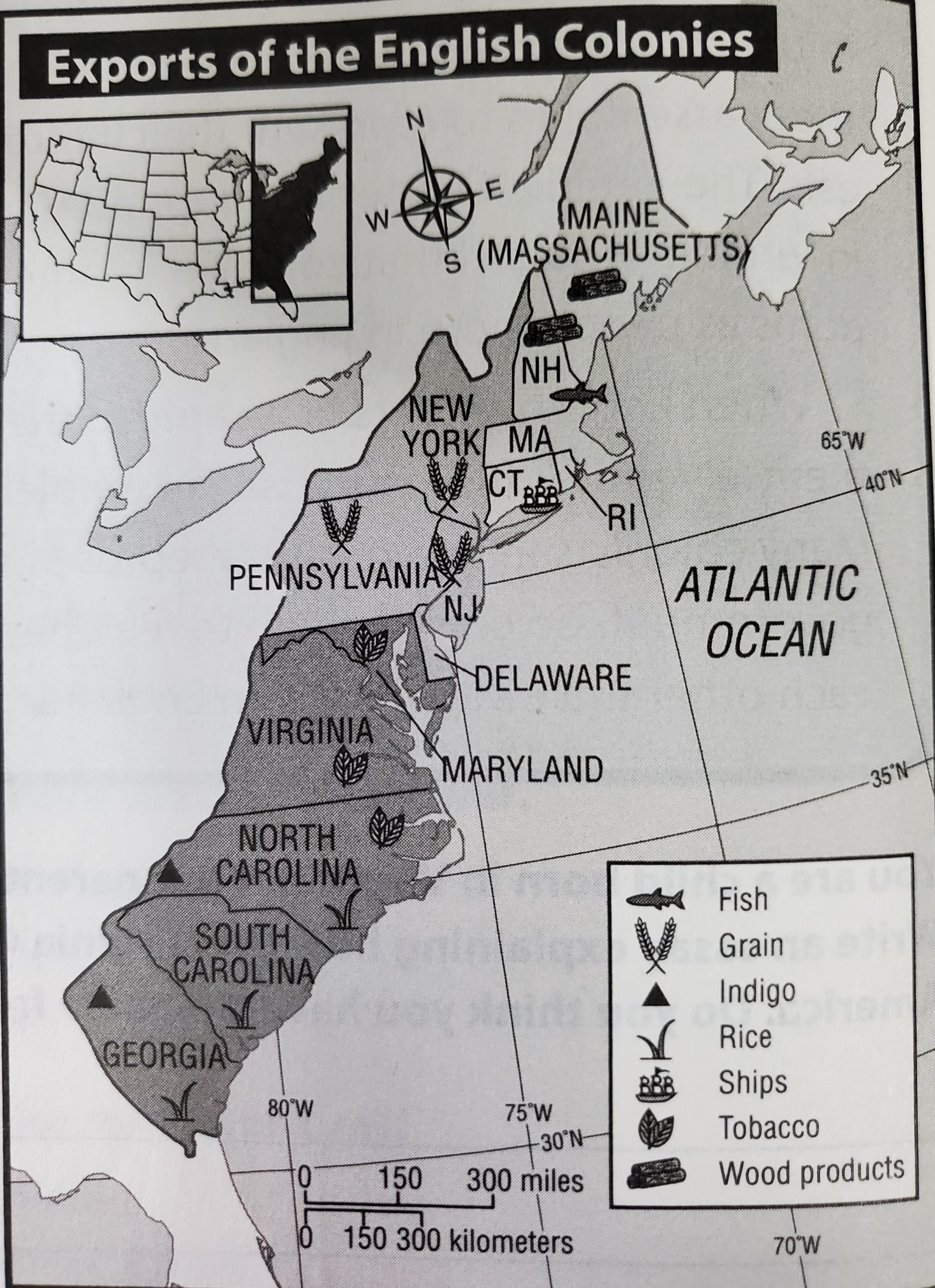
Which of the following was an export in New Hampshire?
Which of the following was probably most needed in North Carolina?
What is the title of the map?
John Peter Zenger was put on trial because he spoke out against slavery in the colonies. (Lesson 7, slides 3 - 9)
Enslaved Africans were taken to England before they were taken to the Americas.
In your opinion, do you think there was a better way to farm large plantations than force enslaved Africans to work them, and why?