14 Chemical Reactions M
star
star
star
star
star
Last updated over 4 years ago
12 questions
OBJECTIVES
- Identify, explain and predict reactions based on the outermost electron states of atoms, trends in the periodic table, and knowledge of the patterns of chemical properties.
VOCABULARY
combination reaction - Two or more elements or compounds combine to form one compound.
combustion - A chemical reaction that occurs between a hydrocarbon and oxygen to produce carbon dioxide and water.
decomposition reaction - A single compound breaks apart to form two or more elements or compounds.
double displacement reaction - Ions in aqueous compounds exchange cations and anions respectively.
neutralization reaction - A chemical reaction that occurs between an acid and a base that produces a salt and water.
product - A substance formed as a result of a chemical reaction.
reactant - One of the starting substances involved in a chemical reaction.
single displacement reaction - One element replaces another in a compound.
Chemical reactions occur all around us every day. The burning of a match, the running of an engine and the digestion of food are all examples of chemical reactions. A chemical reaction occurs when elements or compounds rearrange their atoms and form new substances. In order for the reaction to take place, there must be enough energy present to cause the atoms to collide. The collision of the atoms in the reactants causes them to break their initial bonds and form new bonds that result in a product. There are five types of chemical reactions: combination or synthesis, decomposition, single displacement, double displacement and combustion.
A chemical equation is a representation of the actual reaction. A plus sign (+) separates the different reactants and products and an arrow (⟶) separates reactants from products. Reactants and products are also identified by phase. Gasses are represented by a (g). Liquids are shown with a (l). Solids are noted by a (s). And substances that have been dissolved in water are considered aqueous and are shown with a (aq).
Combination Reactions
A combination reaction is a reaction that takes place when two elements or compounds combine to form a single larger compound. Combination reactions have two or more reactants forming a single product. Combination reactions are also known as synthesis reactions.
A + B ⟶ AB
When two elements react, the product of the reaction is a compound that consists of only two types of atoms, a binary compound. When a metal and a nonmetal react, the product is molecule with an ionic bond, a salt. In a reaction with two nonmetals, the product is a molecule with polar covalent bonds.
Combining 2 elements
Example #1:
Predict the products when magnesium reacts with oxygen.
2Mg(s) + O2(g) ⟶
Solution:
When an element reacts with oxygen, oxides are formed.
Magnesium reacts with oxygen to form magnesium oxide.
2Mg(s) +O2(g) ⟶ 2MgO(s)
Example #2:
Predict the products when barium reacts with sulfur.
8Ba(s) + S8(s) ⟶
Solution:
When an element reacts with sulfur, sulfides are formed.
Barium reacts with sulfur to form barium sulfide.
8Ba(s) + S8(s) ⟶ 8BaS(s)
Example #3:
Predict the products when sodium reacts with chlorine.
2Na(s) + Cl2(g) ⟶
Solution:
Halogens are found in Group 17 on the Periodic Table. The halogens group contains the elements, fluorine (F), chlorine (Cl), bromine (Br), iodine (I), and astatine (At). When halogens react with metals, salts are formed.
Sodium reacts with chlorine to form sodium chlorine.
2Na(s) + Cl2(g) ⟶ 2NaCl(s)
Combining with Compounds
Example #4 oxides:
Predict the products when calcium oxide reacts with water.
CaO(s) + H2O(l) ⟶
Solution:
The reaction of a metal oxide with water produces a metal hydroxide, a strong base.
Calcium oxide reacts with water to form the basic solution calcium hydroxide.
CaO(s) + H2O(l) ⟶ Ca(OH)2(aq)
Example #5 oxides:
Predict the products when sulfur trioxide reacts with water.
SO3(g) + H2O(l) ⟶
Solution:
A nonmetal oxide reacts with water to produce an acid.
Sulfur trioxide reacts with water to form sulfuric acid.
SO3(g) + H2O(l) ⟶ H2SO4(aq)
1 point
1
Question 1
1.
Identify the combination reaction.
1 point
1
Question 2
2.
Identify the combination reaction.
Decomposition Reactions
Decomposition reactions occur when a single compound splits into two elements or simpler compounds. In decomposition reaction there is a single reactant and two or more products. We can think of decomposition reactions as the opposite of combination reactions.
AB ⟶ A + B
Energy such as heat, light or electricity is usually introduced to assist in the breaking of bonds. We will look at the decomposition of binary compounds, carbonates and chlorates.
Binary Compounds:
Example #6:
Predict the products when silver oxide decomposes.
2 Ag2O(s) ⟶
Solution:
Binary compounds break down to their respective elements. Silver oxide decomposes to form silver and oxygen gas.
2 Ag2O(s) ⟶ 4 Ag(s) + O2(g)
Carbonates:
Example #7:
Predict the products when calcium carbonate decomposes.
CaCO3(s) ⟶
Solution:
Carbonates break down to the oxide and carbon dioxide. Calcium carbonate decomposes to form calcium oxide and carbon dioxide.
CaCO3(s) ⟶ CaO(s) + CO2(g)
Chlorates:
Example #8:
Predict the products when potassium chlorate decomposes.
2 KCIO3(s) ⟶
Solution:
Chlorates break down to form a binary salt and oxygen. Potassium chlorate decomposes to potassium chloride and oxygen gas.
2 KCIO3(s) ⟶ 2 KCI(s) + 3 O2(g)
1 point
1
Question 3
3.
Identify the decomposition reaction.
1 point
1
Question 4
4.
Identify the decomposition reaction.
Now we will be working with single displacement and double displacement reactions. These reactions are also known as single replacement and double replacement because one or two elements or compounds are replaced or switch places when the reaction occurs.
SINGLE DISPLACEMENT REACTIONS
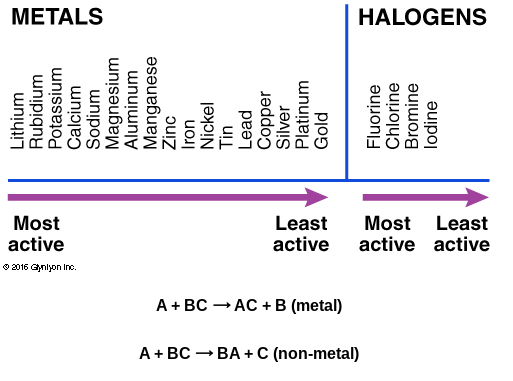
A single displacement reaction is a reaction that takes place when a single element reacts with a compound and replaces one of the elements in the compound. In single displacement reactions a more active metal replaces a less active metal in the compound or a more active nonmetal will replace a less active nonmetal. Given the reactants a prediction can be made as to the products of the reaction. Use an activity chart to determine the activity level of the free element. If the free element in the reactants has a higher activity level than the element it is trying to replace, asingle displacement reaction will occur. If the free element in the reactants has a lower activity than the element it is trying to replace in the compound, there will be no reaction.
Example #1:
Predict the products when copper reacts with silver nitrate.
Cu(s) + 2AgNO3(g) ⟶
Solution:
The activity level of copper is higher than the activity level of silver therefore a single displacement reaction occurs. Copper reacts with silver nitrate to produce copper nitrate plus solid silver.
Cu(s) + 2AgNO3(aq) ⟶ 2Cu(NO3)(aq) + 2 Ag(s)
Example #2:
Predict the products when zinc reacts with tin chloride.
Zn(s) + SnCl2(aq)
Solution:
The activity level of zinc is greater than the activity level of lead; therefore a single displacement reaction occurs. Zinc replaces the tin and the products are zinc chloride and tin.
Zn(s) + SnCl2(aq) ⟶ ZnCl2(aq) + Sn(s)
1 point
1
Question 5
5.
Identify the single replacement reaction.
1 point
1
Question 6
6.
Identify the single replacement reaction.
DOUBLE DISPLACEMENT REACTIONS
Double displacement reactions occur when two ionic compounds react to form two new compounds. The metal in the first compound replaces the metal in the second compound or the nonmetal in the first replaces the nonmetal in the second compound.
AB + CD ⟶ AD + CB
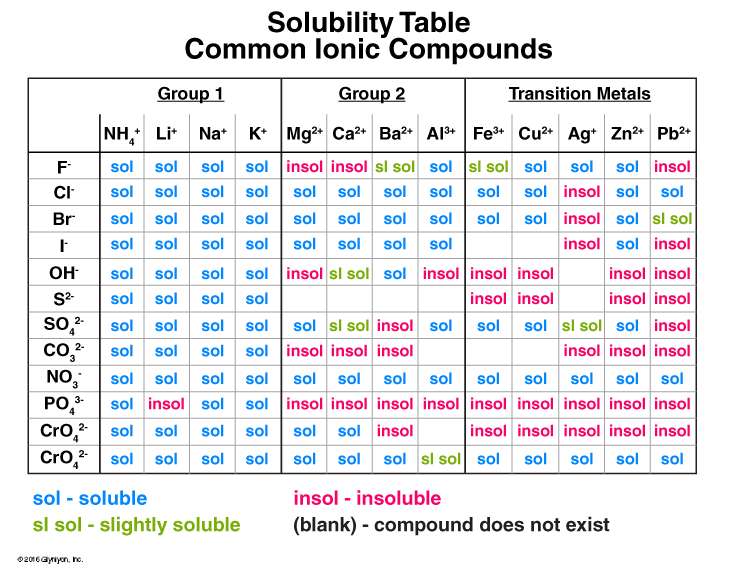
For double displacement reactions to occur both of the reactants must be soluble in water and one of the products of must be a precipitate, insoluble.
Example #3:
Predict the products when lead nitrate and potassium iodine combine
Pb(NO3)2(aq) + 2Kl(aq) ⟶
Solution:
Lead nitrate and potassium iodine combine to form lead iodine and potassium nitrate.
Pb(NO3)2(aq) + 2Kl(aq) ⟶ Pbl2(s) + 2KNO3(aq)
Example #4:
Predict the products and balance the chemical equation for the reaction of aluminum chlorate and sodium nitrate.
AlCl3(aq) + NaNO3(aq) ⟶
1 point
1
Question 7
7.
Identify the double displacement reaction.
1 point
1
Question 8
8.
Identify the double replacement reaction.
Did you ever wonder why fuel burns and what happens to it? Or why when you have an upset stomach and take an antacid it helps you to feel better? The next two special types of reactions we will be studying explain these phenomena. The burning or combustion of fuel is a special type of chemical reaction that takes place with a hydrocarbon, organic substance, and oxygen. The products of the reaction of these two substances are always carbon dioxide and water. Similarly, when an acid, like stomach acid reacts with a base, the antacid, a special type of double displacement reaction occurs and the products of the reaction are a chemical salt and water.
COMBUSTION REACTIONS
Combustion reactions are reactions that occur between organic materials and oxygen. Organic materials are those that are derived from living things such as coal. They contain carbon bonded with hydrogen and sometimes other elements. When organic materials and oxygen are exposed to heat, the reaction that occurs is known as a combustion reaction and carbon dioxide and water are the products of the reaction.
Example #1:
Predict the products and balance the reaction when propane, C3H8, burns in the presence of oxygen.
C3H8 + O2
Solution:
Propane, C3H8, is a hydrocarbon. When it reacts with oxygen, the products will be carbon dioxide and water. The following is the balanced combustion reaction with propane burning in the presence of oxygen.
C3H8 + 5O2 ⟶ 3CO2 + 4H2O
Example #2:
Predict the products and balance the reaction when glucose, C6H12O6, reacts with oxygen.
C6H12O6 + O2
Solution:
Glucose, C6H12O6, is an organic molecule. When it reacts with oxygen, the products will be carbon dioxide and water. The following is the balanced combustion reaction for glucose reacting with oxygen.
C6H12O6 + 6O2 ⟶ 6CO2 + 6H2O
1 point
1
Question 9
9.
Identify the combustion reaction.
1 point
1
Question 10
10.
Identify the combustion reaction.
NEUTRALIZATION REACTIONS
Neutralization reactions are a special type of double displacement reactions. They occur when acids react with bases. Recall that an acid is simply the combination of a hydrogen ion and a negatively charged ion, and a base is the combination of the negatively charged hydroxide ion with a positively charged ion. During a neutralization reaction the positively charged hydrogen ion combines with the negatively charged hydroxide ion forming water. At the same time, the cation of base and the anion of the acid form a new compound, a chemical salt.
Example #3:
Predict the products and balance the reaction when acetic acid, HC2H3O2, reacts with sodium hydroxide, NaOH.
HC2H3O2 + NaOH
Solution:
When acetic acid, HC2H3O2, reacts with sodium hydroxide, NaOH, the anion of the acidic acid, C2H3O2, and the cation of the sodium hydroxide, Na, react to form water and sodium acetate.
HC2H3O2 + NaOH ⟶ NaC2H3O2 + H2O
This reaction is balanced. There are five hydrogens, two carbons, three oxygen atoms and one sodium atom in both the reactants and the products.
Example #4:
The acid, hydrogen bromide, reacts with aluminum hydroxide, a base, to produce water and aluminum bromide, a salt.
HBr + AI(OH)3 ⟶
Solution:
The acid, hydrogen bromide, reacts with aluminum hydroxide, a base, to produce water and aluminum bromide, a salt.
HBr + AI(OH)3 ⟶ H2O AIBr3
To begin to balance the equation look at bromide; there are three on the product side so we need to put a three in front of hydrogen bromide in the reactants. There are six hydrogens in the reactant side so placing a three in front of the water in the product side will balance the hydrogen atoms. There is one aluminum and three oxygen atoms on both sides of the reaction.
3HBr + Al(OH)3 ⟶ 3H2O + AlBr3
Now it is balanced
1 point
1
Question 11
11.
Identify the neutralization reaction.
1 point
1
Question 12
12.
Identify the neutralization reaction.
LET'S REVIEW!
In this lesson you have learned:
- to understand and identify reactions based on the outermost electron states of atoms, trends in the periodic table, and knowledge of the patterns of chemical properties.
- to identify the type of reaction based on the reactants.