EMS: 3.3 (2/24)
star
star
star
star
star
Last updated about 3 years ago
5 Nsɛmmisa

0
0

0
2
2
Analyze the Earth, Moon, Sun system below.
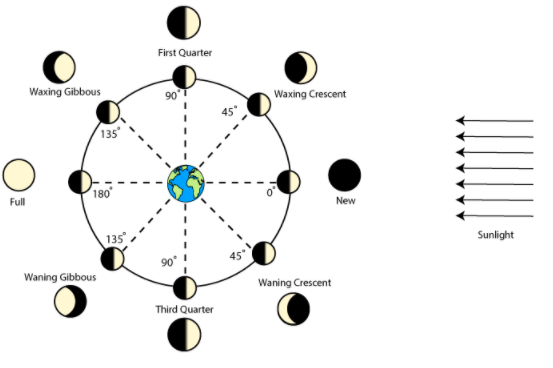
What side of the Moon is the Sun on to illuminate the Moon as shown above?
Why will the first quarter moon appear to get more illuminated the next night?
Complete the Moon Phase diagram below:
Shade in the top-view model
Use the top-view method for each moon phase
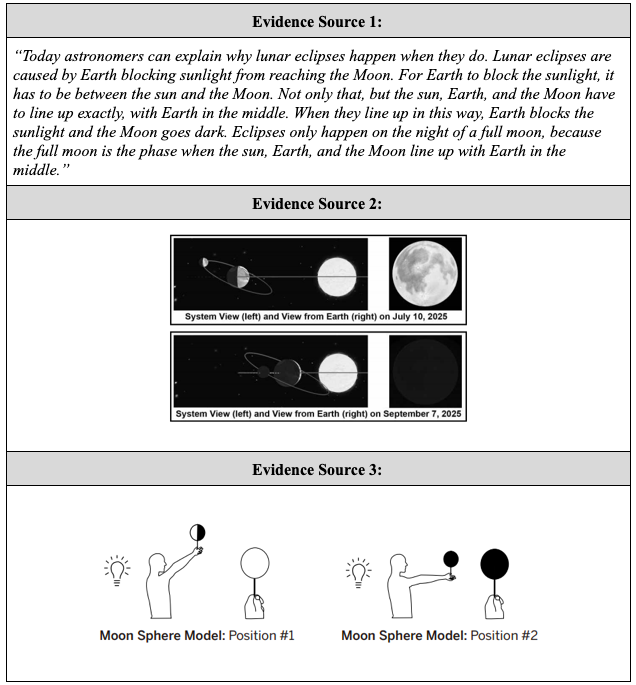
Chloe is a photographer for the school paper. After learning about Eric Wu’s assignment for About Space magazine, she decided to try to take her own picture of a lunar eclipse for the school paper. However, on the night of the lunar eclipse, Chloe wasn’t feeling well, so her parents wouldn’t let her go outside with her camera.
The next day at school, Chloe was feeling disappointed, so her friend Khalil tried to cheer her up. “Don’t worry,” he said. “Remember, we learned that the Moon moves in the same circle around Earth each month. That means you can photograph a lunar eclipse when Earth is in between the sun and the Moon again next month.”
“Maybe, but maybe not,” Chloe said. “A lunar eclipse happens sometimes when Earth is in between the sun and the Moon, but not always. It could be a long time before I have another opportunity to take a picture of a lunar eclipse.”
Which student, and why does that student have a better understanding of lunar eclipses?
CFS:
Accurately identifies how light impacts the moon’s appearance
Accurately describes the cause and effect relationship between the rotational movement of the Moon and its illuminated face
Question: When can a lunar eclipse be photographed?
Claim 1: A lunar eclipse can be photographed anytime Earth is in between the sun and the Moon.
Claim 2: A lunar eclipse can be photographed sometimes when Earth is in between the sun and the Moon.
Prompt: What are the conditions that cause a lunar eclipse rather than a full moon phase?
CFS:
Accurately identifies how light impacts the moon’s appearance
Accurately describes the cause and effect relationship between the rotational movement AND position of the Moon and its illuminated face
Accurately includes data from the most relevant evidence (2)