Log in
Sign up for FREE
arrow_back
Library

Unit 7 MCQ Exam

star
star
star
star
star
Last updated 12 months ago
25 questions
1
1
1
1
1
1
1
1
1
1
1
1
1
1
1
1
1
1
1
1
1
1
1
1
1
Question 1
1.

Question 2
2.

Question 3
3.

Question 4
4.

Question 5
5.

Question 6
6.

Question 7
7.

Question 8
8.

Question 9
9.

Question 10
10.

Question 11
11.

Question 12
12.

Question 13
13.

Question 14
14.

Question 15
15.

Question 16
16.

Question 17
17.

Question 18
18.

Question 19
19.

Question 20
20.

Question 21
21.

Question 22
22.

Question 23
23.

Question 24
24.

Question 25
25.

Which of the following locations would most likely receive acid deposition?
A major city receiving its electricity from hydroelectric sources
A large lake downstream from a concentrated animal feeding operation
A town downwind from a coal-fired power plant
A stream flowing through agricultural land
Which of the following best describes one way the Clean Air Act helped reduce air pollution?
roposed incentives for countries to reduce carbon emissions
Implemented a program to manage hazardous and nonhazardous wastes
Introduced regulatory measures to control the amount of lead in fuels
Created a fund to aid developing countries in reducing ozone-depleting emissions
The graph below shows the experimental data from an investigation testing how carbon monoxide levels in the ambient air alter the amount of oxygen hemoglobin can carry. The experiment was performed with five different laboratory mice. Each mouse was kept in its own habitat under constant conditions of water, food, light, and temperature. Each mouse was exposed to a different concentration of carbon monoxide, and the oxygen saturation level of hemoglobin was measured.

Which of the following modifications would improve the validity of the investigation?
Determine the oxygen saturation at carbon monoxide levels higher than 80%
Compare the oxygen saturation of mice at rest to that of mice that are active
Perform the experiment on a larger sample size of mice
Add a different number of plants to each habitat to add oxygen to the setup
The graph below shows the experimental data from an investigation testing how carbon monoxide levels in the ambient air alter the amount of oxygen hemoglobin can carry. The experiment was performed with five different laboratory mice. Each mouse was kept in its own habitat under constant conditions of water, food, light, and temperature. Each mouse was exposed to a different concentration of carbon monoxide, and the oxygen saturation level of hemoglobin was measured.

Which of the following conclusions can be drawn from the investigation?
Carbon monoxide impairs the transport of oxygen in the bloodstream
Oxygen saturation prevents the body from absorbing carbon monoxide from the air
Carbon monoxide improves oxygen transport in mammals
Oxygen saturation enhances the uptake of carbon monoxide from the air
Particulates can be removed from smokestack emissions by which of the following methods?
Irradiation by UV light
Electrostatic precipitators
Catalytic converters
Exhaust-stream aeration
Which of the following would most likely neutralize the effect of acid rain on bodies of water, based on the composition of soils and bedrock in the region?
A valley that is frequently shrouded in fog
An area downwind of a coal-burning electrical plant
An open plain underlain by granite
A forest underlain by limestone
Bats use echolocation to find prey by emitting high-pitched bursts of sound and analyzing the reflection. Scientists studying a population of bats in a forest observed that their population size had declined in the years following the completion of a nearby highway.

Based on the information above, which of the following best explains how noise pollution from the highway has affected the size of the bat population?
The highway noise is producing sound waves that disrupt air flow, preventing the bats from flying at night
The highway noise is interfering with bats’ echolocation, preventing them from successfully locating and catching prey as they fly
The highway noise is attracting more bats to the forest, causing an increase in intraspecies competition
The highway noise is decreasing the bats’ echolocation, allowing them to catch more prey each night
Which of the following best describes a natural process that adds carbon dioxide to the atmosphere?
Carbon dioxide is released from the interior of Earth during volcanic eruptions
Deposition of sediments into ocean basins release carbon dioxide from rock
Plants excrete carbon dioxide during photosynthesis
Burial of dead plants and animals in swamps and bogs allows CO2 to escape to the atmosphere
Which of the following is a problem that is associated with a thermal inversion?
A decrease in the release of carbon dioxide from warmer air temperatures at the Earth’s surface, which accelerates global climate change
A decrease in evaporation rates over the ocean, which increases potential for more severe thunderstorms and hurricanes
An increase in UVUV radiation reaching Earth’s surface, which can damage plant tissue and decrease crop yield
An increase in pollutants trapped at Earth’s surface, which increases the number of cases of human respiratory problems
Industrial scrubbers and electrostatic precipitators collect enormous amounts of particulate matter (coal ash) at coal-burning power plants. Which of the following best describes an environmental disadvantage of using industrial scrubbers and electrostatic precipitators for pollution abatement?
Coal ash contains toxic levels of several different pollutants, so when it is collected and stored long-term in coal ash ponds, there is increased risk of exposure to toxic metals
Coal ash is highly flammable, and it is very hazardous to ship the materials to hazardous waste landfills
Industrial scrubbers and electrostatic precipitators cannot remove fine particles like dust and smoke from the waste, so a secondary measure must be used
Industrial scrubbers and electrostatic precipitators are very costly to install and increase the cost of operating coal-burning power plants, leading to increased costs for consumers
Which of the following illustrates the reactants needed to form tropospheric ozone?
SO2+H2O
CO2+H2O+sunlight
O2+C6H12O6
NO2+VOCs+O2+sunlight
Increased use of which of the following technologies would cause the greatest reduction in the primary source of photochemical smog?
Catalytic converter
Methane collection system
Carbon sequestration
Electrostatic precipitator
Which of the following statements best describes photochemical smog in large cities in the United States?
Photochemical smog contains secondary pollutants that form when sulfur dioxide and nitrogen oxide interact in the atmosphere
Photochemical smog is more prevalent during winter months
Photochemical smog is composed of primary and secondary pollutants that are not reactive
Photochemical smog causes negative human health impacts such as eye and lung irritation
Which of the following is a human health impact associated with exposure to radon gas inside homes or other buildings?
Acute health effects such as skin burns from high levels of radioactivity
Increased incidence of lung cancer
Transmission of pathogens from mother to fetus
Increased occurrence of developmental disorders in children
Which of the following is most likely the source of the radon found in a house?
Radon gas leaked from open paint and paint products used by the homeowner for repairs
Radon found in pressed wood products such as plywood emitted gas into the house
Radon gas found in bedrock and soil leaked into the home through cracks in the foundation
Radon gas leaked from a malfunctioning fuel-burning appliance, such as a furnace
Which of the following is used to reduce SO2 emissions from coal-burning power plants?
Ultrafine mechanical filters
Wet-scrubber units
Catalytic converters
Electrostatic precipitators
Which of the following is a natural source of atmospheric carbon dioxide?
Decay of uranium in igneous rock
Photosynthesis of terrestrial plants and ocean plankton
Decomposition of organic matter
Formation of rocks on the ocean floor
Of the following, which is true of noise pollution?
Sudden or persistent noise may lead to permanent hearing loss
earing damage occurs most quickly when the intensity level of the sound is low
In urban areas, few individuals are exposed to noise pollution
Noise pollution is an insignificant occupational hazard
All of the following are likely consequences of indoor air pollution EXCEPT an increase in
The development and exacerbation of asthma
The risk of developing lung cancer
Flulike symptoms, chronic fatigue, and nausea
The risk of developing skin cancer
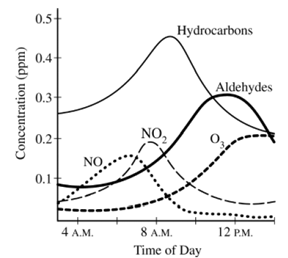
The following questions(s) refer to the diagram below, which depicts the concentrations of various gases in the air over a city on a typical smoggy day.

If the technology that reduces the hydrocarbon concentration had been utilized, which of the following would have been the most likely result?
The concentration of CO2 would have been lower
The concentration of O3 would have been lower
The concentration of NO would have been higher
The concentration of O3 would have been higher
The following questions(s) refer to the diagram below, which depicts the concentrations of various gases in the air over a city on a typical smoggy day.

Which of the following best explains the pattern in NO concentration?
NO is a secondary pollutant with a long residence time in the atmosphere
NO does not play a significant role in smog formation
NO is formed in the lower atmosphere in the morning by the rising Sun
NO is produced by rush-hour traffic and is quickly oxidized in the atmosphere
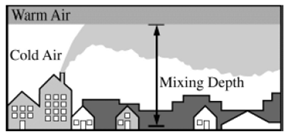
What important phenomenon that often plays a role in air pollution episodes is illustrated in the diagram above?
Albedo
Stratification
Greenhouse effect
Inversion
The three main anthropogenic sources of gaseous air pollutants in the United States are
Soil erosion, volcanoes, and forest fires
Industry, construction, and agriculture
Industry, transportation, and energy production
Industry, transportation, and agriculture
Which of the following is the human health impact most closely associated with atmospheric particulates?
Asthma
Diabetes
Melanoma
Cataracts
Which of the following would most likely reduce the concentration of ground-level ozone in the air of a city?
Formation of a temperature inversion
Release of VOCs into the air of the city
Decrease in the emissions of nitrogen oxides
Occurrence of several consecutive days of sunny weather