Scientists are interested in how the severity of acid deposition affects the soil of the red spruce forests. They design a laboratory experiment in which rainwater of different pH values is used to water soil samples taken from red spruce forests. The soil samples are the same size and contain the same ratios of sand, silt, and clay. The same amount of water is sprayed on the soil samples every day for a week.
Throughout the experiment, the scientists measured the concentration of toxic forms of aluminum in the soil samples.
Identify the likely scientific question being investigated in the experiment.
1 point
1
Question 2
2.
Scientists are interested in how the severity of acid deposition affects the soil of the red spruce forests. They design a laboratory experiment in which rainwater of different pH values is used to water soil samples taken from red spruce forests. The soil samples are the same size and contain the same ratios of sand, silt, and clay. The same amount of water is sprayed on the soil samples every day for a week.
Throughout the experiment, the scientists measured the concentration of toxic forms of aluminum in the soil samples.
Identify a dependent variable for the experiment.
1 point
1
Question 3
3.
Scientists are interested in how the severity of acid deposition affects the soil of the red spruce forests. They design a laboratory experiment in which rainwater of different pH values is used to water soil samples taken from red spruce forests. The soil samples are the same size and contain the same ratios of sand, silt, and clay. The same amount of water is sprayed on the soil samples every day for a week.
Throughout the experiment, the scientists measured the concentration of toxic forms of aluminum in the soil samples.
Explain how the results of the experiment would change if the soil sample used contained higher concentrations of limestone.
1 point
1
Question 4
4.
In 2018 researchers found that many of the red spruce forests had started to recover from the damage caused by acid deposition. Based on this research, a group of scientists hypothesized that coal-fired power plants were a likely source of the pollutants that lead to acid deposition in the red spruce forests.

To test their hypothesis, they researched the consumption of coal by electric utility companies in the United States and the pH of rainwater from a red spruce forest in Vermont between 2001 and 2018.
Based on the data in the graph, describe the trend in pH of rainwater from 2001 to 2018.
1 point
1
Question 5
5.
In 2018 researchers found that many of the red spruce forests had started to recover from the damage caused by acid deposition. Based on this research, a group of scientists hypothesized that coal-fired power plants were a likely source of the pollutants that lead to acid deposition in the red spruce forests.
To test their hypothesis, they researched the consumption of coal by electric utility companies in the United States and the pH of rainwater from a red spruce forest in Vermont between 2001 and 2018.
Based on the data in the graph, identify the year with the highest coal consumption.
1 point
1
Question 6
6.
In 2018 researchers found that many of the red spruce forests had started to recover from the damage caused by acid deposition. Based on this research, a group of scientists hypothesized that coal-fired power plants were a likely source of the pollutants that lead to acid deposition in the red spruce forests.
To test their hypothesis, they researched the consumption of coal by electric utility companies in the United States and the pH of rainwater from a red spruce forest in Vermont between 2001 and 2018.
Describe how a pollutant that is released from the combustion of coal contributes to the formation of acid deposition.
1 point
1
Question 7
7.
In 2018 researchers found that many of the red spruce forests had started to recover from the damage caused by acid deposition. Based on this research, a group of scientists hypothesized that coal-fired power plants were a likely source of the pollutants that lead to acid deposition in the red spruce forests.
To test their hypothesis, they researched the consumption of coal by electric utility companies in the United States and the pH of rainwater from a red spruce forest in Vermont between 2001 and 2018.
One way that acid deposition can be reduced is by using scrubbers at coal-fired power plants to remove the pollutants that lead to its formation. Describe how a scrubber removes the pollutants that lead to the formation of acid deposition at coal-fired power plants.
1 point
1
Question 8
8.
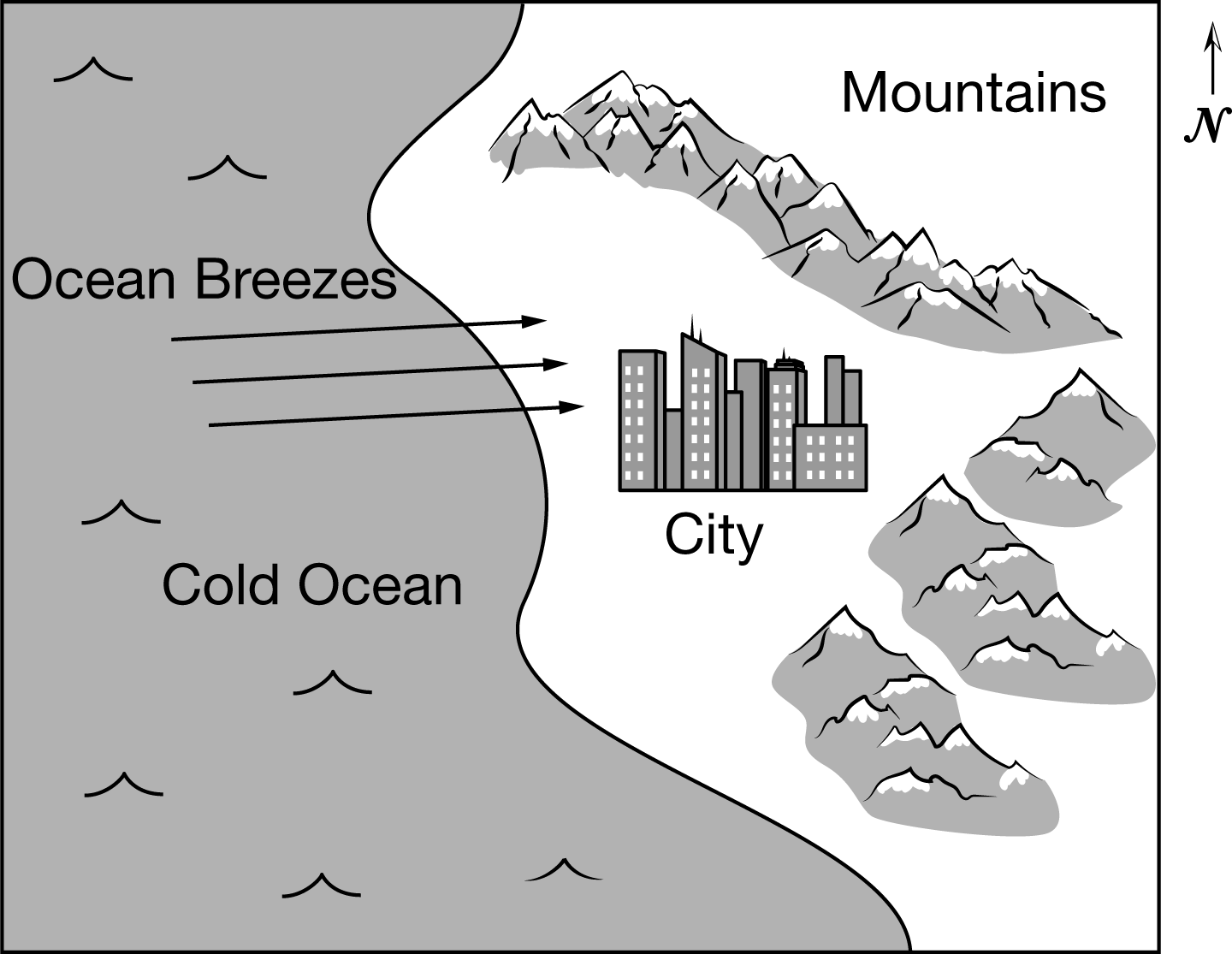
Geographic features and climatological factors can make some locations more prone to the effects of air pollution. The diagram below illustrates a city of millions of people and its surrounding geography. Human activities in urban areas can release pollutants into the air that lead to ground-level ozone and smog formation.
Describe how a thermal inversion would form in the city shown in the diagram.
1 point
1
Question 9
9.
Propose a solution to reduce the formation of ground-level ozone or smog resulting from human activities in the city.
1 point
1
Question 10
10.
In more developed countries, indoor air pollution is also a problem. Common indoor air pollutants in developed countries include asbestos, radon, and mold.
Choose ONE of the three common air pollutants listed above and complete the table below.
Identify a source for ONE indoor air pollutant and describe a method for reducing exposure to the pollutant you choose.