Which is true of the model of bonding shown in this figure?
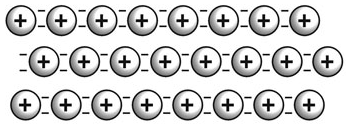
Which is true of the model of bonding shown in this figure?
A cation is a negatively charged atom.
In an ionic bond, two cations can bond together to form a compound.
When an atom gains electrons, it becomes positively charged.
Metallic elements tend to form cations rather than anions.
Polyatomic ions are particles made of several different ions.
According to the electron sea model, metals consist of metallic cations surrounded by delocalized valence electrons.
A metallic bond is the attraction of a metallic cation for delocalized electrons.
Which is true of the model of bonding shown in this figure?
Which is the charge that results when oxygen becomes an ion?
Which is a property of substances that exhibit metallic bonding?
Which is a physical property of ionic compounds in their solid state?
Which is the correct formula for the compound formed between beryllium and nitrogen?
Which is the correct formula for the compound Manganese (III) Fluoride?
Which is the correct name for the compound FeS?
Which is the correct name for the compound
Which is the correct name for the compound Na3P?
Which is the correct name for the compound CoCO3?
Which is the correct name for the compound NH4SO4?
Chemical bond formation may take place due to the interaction between a(n) ____________________ and an anion.
The name of the anion
The name of the anion BO3-3 is ____________________ ion.
In the electron sea model, it is proposed that all the metal atoms in a metallic solid contribute their ____________________ electrons to form a sea of electrons.
Write the chemical names for each of the following compound BaF2.
Write the chemical names for each of the following compound
Write the chemical names for each of the following compound Ag2CrO4.
Write the chemical names for each of the following compound NH4CN.
Write the chemical formula for the following ionic compound: Beryllium iodide
Write the chemical formula for the following ionic compound: rubidium arsenate
Write the chemical formula for the following ionic compound: cobalt(II) nitride
EXTRA CREDIT: Write the chemical formula for the following ionic compound: nickel(II) phosphite.
EXTRA CREDIT: Write the chemical formula for the following ionic compound: ammonium carbonate
EXTRA CREDIT: Write the chemical formula for the following ionic compound: chromium(III) iodite
Essay--Write the answer to one essay question in the space provided below.
FCA’s 1. Write in complete sentences and paragraph form. 2. Use Chapter 7 terminology to answer questions(example: electrons, binary, ionic, etc...).
3. Provide inferences, other thoughts, or personal experiences in your answer whenever possible.
#1 Explain why Lithium(III) chloric is not a correct name for the ionic compound formed between lithium and chlorine.
#2 Explain why it is not possible to write a correct chemical formula for the compound nitrogen hydride.