Compare and Contrast Quiz
star
star
star
star
star
Last updated about 5 years ago
5 Nsɛmmisa
6
6
6
9
12
Page 94:
A Mind for Math
Katherine’s father was a math whiz. Though educated only through the sixth grade, he could tell how much lumber a tree would yield just by looking at it. From the time she was a toddler, Katherine’s parents realized that she had inherited her father’s mind for math. Katherine, the youngest of four children, counted whatever crossed her path—dishes, steps, and stars in the sky. She excelled in school, especially in math. Whenever her teachers noticed that Katherine’s desk was empty, they would look for her in the classroom next door, where they would find her helping her older brother with his math lesson.
Page 95:
Katherine graduated from high school at age fourteen. In 1933, she enrolled at West Virginia State Institute, a black college outside Charleston. By her junior year, she had tackled every math course the school offered, so her math professor created special advanced math classes just for her.
“You would make a good research mathematician,” her professor told Katherine when she was a sophomore. “I am going to prepare you for this career.” He believed in Katherine and her special ability, even though job prospects were poor. In the 1930s, employers openly discriminated against Irish and Jewish women with math degrees; the odds of a black woman finding work as a mathematician were especially low.
After graduation, Katherine took a job teaching at the high school in Marion, Virginia. She met Jimmy Goble and they fell in love and married, but they kept their marriage secret. Katherine loved teaching, but at the time, the law didn’t allow married women in the classroom as teachers.
Katherine Johnson loved to count. “I counted everything. I counted the steps to the road, the steps up to church, the number of dishes and silverware I washed. . .anything that could be counted, I did.” And so it began for this young girl from West Virginia. Born in 1918 in White Sulphur Springs, W.Va., Johnson’s love for mathematics was inherent, an inclination she had from birth. At a young age, she was ready and anxious to go to school. She can vividly remember watching her older siblings go to school and wishing so much that she could go with them. The opportunity to attend school finally did come. Johnson so excelled that she began her studies in the second grade, then moved into advanced classes. By age 10, Johnson was in high school.
Lesson: Love learning.
In school, one teacher stood out to Johnson. Miss Turner taught geometry, and Johnson couldn’t wait to take her class. The teacher was a great encourager to the students and a strong mentor to many of them. Johnson did so well in her classes that she graduated early from high school, and at age 15 she entered West Virginia State College. She had two years before having to declare a major, so Johnson wavered between English, French and mathematics. One of her professors at West Virginia State College helped Johnson with her choice. She told Johnson, “If you don’t show up for my class, I will come and find you.” And so it was, through part threat and part joke, Johnson steered her way into what was already her first love: mathematics.
Lesson: Follow your passion.
At West Virginia State College, Johnson became immersed in academia and the mathematics program. She loved being surrounded by smart people, she said, and knew all of the professors and students on campus. One of her professors, the renowned Dr. William W. Schiefflin Claytor, recognized the bright and inquisitive mind that Johnson had. “You’d make a great research mathematician,” he told her. Then professor Claytor did something else. He told Johnson that he would help her become one. Johnson said, “Many professors tell you that you’d be good at this or that, but they don’t always help you with that career path. Professor Claytor made sure I was prepared to be a research mathematician.” He saw that Johnson took all of the mathematics classes listed in the catalog that were needed to pursue her life’s passion, and even went so far as to create a class in analytic geometry of space just for her. At age 18, Johnson graduated summa cum laude with Bachelor of Science degrees in mathematics and French. Johnson recalls of her professor, “Claytor was a young professor himself, and he would walk into the room, put his hand in his pocket, and take some chalk out, and continue yesterday’s lesson. But sometimes I could see that others in the class did not understand what he was teaching. So I would ask questions to help them. He’d tell me that I should know the answer, and I finally had to tell him that I did know the answer, but the other students did not. I could tell.”
Answer in THREE COMPLETE SENTENCES
What three things are included in the excerpt from Hidden Figures and NOT in the excerpt?
Answer in THREE COMPLETE SENTENCES
What three bits of content are included in the excerpt from “Katherine Johnson . . .” and NOT in the book excerpt?
Answer in THREE COMPLETE SENTENCES
What three bits of content are included in both texts?
Allusion = refers to a famous person, place, or historical event
Example: "You're being a grinch!" I am ALLUDING to someone being mean like the Grinch in the Christmas tale
Section headings = the titles of each part of text
example: "Lesson: Love learning."
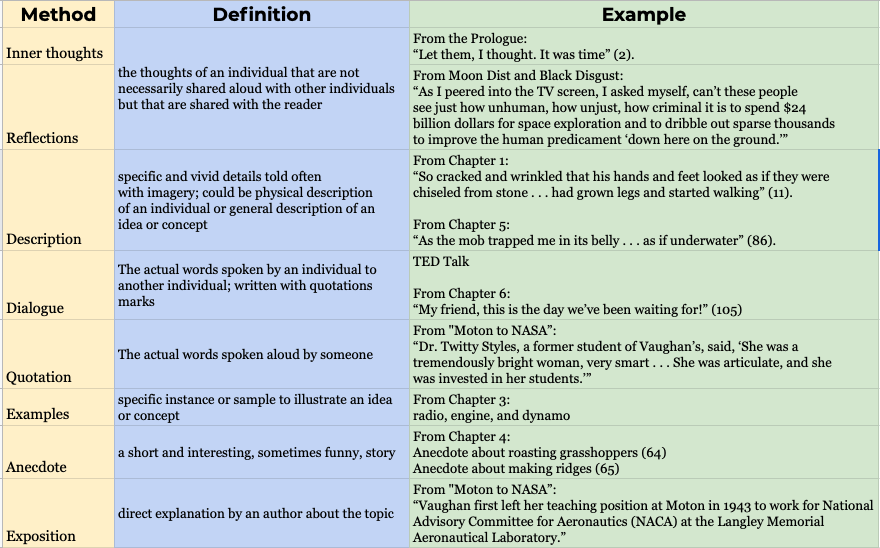
Below are possible author’s methods to convey information about Katherine Johnson.
Place an X in the box of the column that best describes the use of each method in the two texts.
Answer in NO LESS than 4 sentences.
How do the points of view conveyed about Katherine and her education in the two texts compare?
Compare and contrast each author's point of view about Katherine and her education.