Sketch an isosceles right triangle. Keeping in mind the features of an isosceles triangle, fill in the remaining 2 missing angle measures.
Question 5
5.
Question 6
6.
Use the Pythagorean Theorem to fill in the missing side lengths of these 45-45-90 triangles. Leave answers in reduced radical form.
Question 7
7.
Question 8
8.
1. Using the pattern above, and without using the Pythagorean theorem, how would you find the missing side lengths of a triangle if the hypotenuse is 23√2? Explain your process and reasoning below in a sentence or two:
Question 9
9.
Question 10
10.
Using the pattern above, and without using the Pythagorean theorem, how would you find the missing side lengths of a triangle if the hypotenuse is 10? Explain your process and reasoning below in a sentence or two:
Question 11
11.
Simplifying when a Radical is in the Denominator: You cannot leave a radical in the denominator of a fraction. You need to simplify or “rationalize” the expression. Simplify the following into its simplest rationalized form:
2 / √3
2 / √3
2√3
(2√3) / 3
2 / 3
Simplify the following into its simplest rationalized form:
15 / √5
3√5
(15√5) / 5
3
15√5
What similarity theorem shows that all isosceles right triangles are similar?
SSS
AA
SAS
SSA
Based on the pattern in #2, how can you represent x in terms of a for the isosceles triangle pictured below? Use the Pythagorean theorem to help solve.
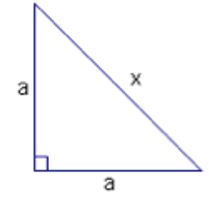
2a
2√a
a√2
2a^2
What answer did you get when you solved for the missing side lengths in question #8?
23
√2
23√2
none of these
What answer did you get when you solved for the missing side lengths in question #10?