Gizmo: Digestive System Shortened

Last updated over 1 year ago
21 questions
Click through the major organs to determine which organ is responsible for the following functions.
1

Which organ absorbs water and vitamin K?

1

Which organ stores and compacts waste before it is eliminated?

1

Which organ starts mechanical digestion by cutting and grinding food into smaller pieces?

1

Which organ is lined with villi? Villi helps absorb nutrients.

1

Click on the TWO organs where food is mechanically broken down.

Look at the organs under the SMALL ORGAN tab to find which small organ does the following
1

Which small organ stores bile?

1

Which small organ produces digestive enzymes like amylase, trypsin, and lipase?

1

The tiny blood vessels that transport absorbed monosaccharides, amino acids, and water in the bloodstream.

1

What cells produce hydrochloric acid?

1

What cells produce pepsin, an enzyme that breaks down proteins?

Build: Now it is time to design and build your own digestive system! Start with the LARGE ORGANS tab to build a basic system, starting with the Mouth/pharynx. Add 3 large organs of your choice. Next, attach TWO organs from the SMALL ORGANS tab to the large organs to complete your system.
0

Take a screenshot and paste it below

Prepare: Select the FOOD tab. The energy we get from food is measured in food calories (Calories). Each Calorie is equal to 4,184 joules of energy. Calories are found in the three main nutrients in food: carbohydrates (sugars and starches), proteins, and fats.

Drag the Cheeseburger above the mouth in your digestive system.
1

How many Calories in the cheeseburger come from carbohydrates?

1

How many Calories in the cheeseburger come from proteins?

1

How many Calories in the cheeseburger come from fats?

Run the Gizmo: Click Play, and observe the food moving through the digestive system. The muscular contractions that push food through the system are called peristalsis. When food has finished passing through the system, you will see a message.
1

What percentage of Calories were absorbed by your system?

1

What percentage of water was absorbed?

0

Based on these results, how well do you think this digestive system worked?

1

In order for calories to enter the bloodstream, what must be present?

Introduction: Before nutrients are absorbed, they must be broken down to their simplest components. Teeth and muscular contractions in the stomach break food down into smaller particles, a process called mechanical digestion. In the meantime, powerful chemicals break down food in a process called chemical digestion.

Set up the Gizmo: Check that the current digestive system has a mouth, salivary gland, esophagus, pancreas, large intestine and rectum, as shown
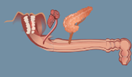
From the FOOD tab, drag the Baked potato to the mouth. A potato mostly consists of complex carbohydrates, such as starch.
1

View the ANALYSIS tab. What is the initial value of complex carbohydrates?

1

Click Play or Fastplay. What is the current value of complex carbohydrates?

1

The pancreas releases pancreatic juices like sucrase which breaks down what organic molecule?