PreCalculus Unit 6 Test
star
star
star
star
star
Last updated over 5 years ago
16 Nsɛmmisa
Hyɛ no nsow a efi ɔkyerɛwfo no hɔ:
PreCal level Exponents and Logs Test
8
8
8
4
4
7
7
7
8
8
3
3
3
5
7
0
PreCal level Exponents and Logs Test
Complete this test without the use of a Calculator. For some problems, showing your work on a whiteboard will be enough. Others will prompt you for a numeric answer, which might be a number, an expression or an equation. These prompts will contain a little keyboard icon that will give you all the formatting tools you'll need to enter such an answer. Within this formatting tool, typing a forward slash (/) will make a division bar!
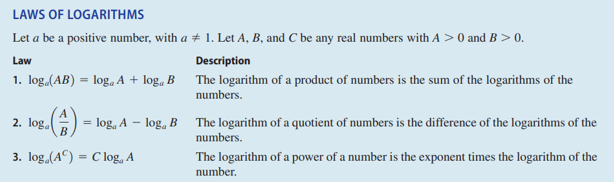
Below is a graphic with the Laws of Logs, numbered 1, 2 or 3. Use these numbers later in the test when prompted.
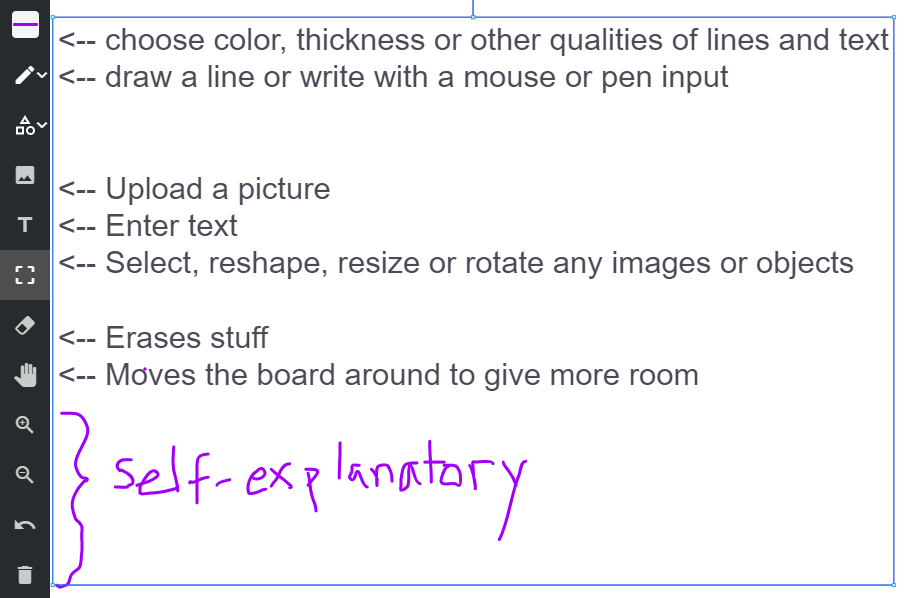
Also below is a picture that gives you the functions of the editing icons you will find in any "show your work" whiteboard. NOTE: It will probably be faster to use the built-in editing tools, but if you are having any problems, you can always upload a photo of the problem's work completed on paper to any "show your work" whiteboard.
Given the function:
Sketch a quick graph in "show your work" and then give the Domain, Range and equation for the asymptote for that function, as prompted on the "show your work" page.
Given the function:
Sketch a quick graph in "show your work" and then give the Domain, Range and equation for the asymptote for that function, as prompted on the "show your work" page.
Given the function:
Sketch a quick graph in "show your work" and then give the end behavior, as prompted on the "show your work" page.
Simplify the expression:
What two consecutive integers (integers right next to each other) does log(101) fall between? You will write two answers that fill in the blanks in this statement: ______ < log(101) < ______. Justify your answers for full credit - just putting numbers in the spaces will not receive full credit.
Solve for x, leaving exact answers in simplified form. If multiple answers, separate them with a comma, then a space.
Show your work.
Solve for x, leaving exact answers in simplified form. If multiple answers, separate them with a comma, then a space.
Show your work.
Solve for x, leaving exact answers in simplified form. If multiple answers, separate them with a comma, then a space.
Show your work.
Expand the Expression as far as you can, showing ONLY ONE change per line. For each step you show, IF it involves a law of logs, you must cite the Law number next to that line. [Laws 1, 2 and 3 are at the beginning of the test, and are numbered so you can easily refer to them in this problem.]
Condense the Expression into a single logarithm, showing ONLY ONE change per line. For each step you show, IF it involves a law of logs, you must cite the Law number next to that line. [Laws 1, 2 and 3 are given at the beginning of the test, and are numbered so you can easily refer to them in this problem.]
Simplify as much as possible.
The answer will be a number or a fraction.
Simplify as much as possible.
The answer will be a number or a fraction.
Simplify as much as possible.
The answer will be a number or a fraction.
The half-life is the time it takes for somesubstance to decay to half of its initial amount. The radioactive decay equation is modeled by the following formula:
N(t) is the quantity of substance after time t (in seconds).
No is the initial quantity of the substance.
L is the decay constant, which depends on your substance. (NOT the same as the half-life of the substance.)
The half-life of a certain substance is 30 years. Find the decay constant L for this substance.
The amount in milligrams of a drug in the body t hours after taking a pill is given by the following formula:
When will the patient have 10% of the initial dosage left in their body?
[BONUS] Albert deposited x dollars into a new account that earned 6.5% annual interest, compounded annually. One year later, Albert deposited an additional x dollars into the account. If there were no other transactions and if the account contained w dollars at the end of those two years, find an expression for x in terms of w, x(w).